
 Human trafficking has been the subject of many recent movies and documentaries, but confusion persists among the public about what it is and how to recognize it. The Child Advocacy Center of Fayetteville is on a mission to change that in collaboration with several other local organizations.
While the number of trafficked individuals within the United States is difficult to estimate, trafficking has been reported in all 50 states. According to John Webster, executive director of the Child Advocacy Center, Cumberland County is a hotspot for such crimes, in part due to the presence of Interstate 95 and a military installation.
Human trafficking occurs in many forms—both labor and sex trafficking—and exploits men, women, adults, and children. January, known as Human Trafficking Awareness Month, is set aside by many organizations as an opportunity to educate and raise awareness for victims of human trafficking. This month, the Child Advocacy Center has a lineup of events that are open to the public, which will help community members understand what trafficking really looks like, how it impacts victims, and how community members can help.
Having worked in child welfare for over 32 years, Webster has seen the vulnerability of not only many Cumberland County children but also people from all walks of life.
“The people of Cumberland County need to be aware that Human Trafficking does occur right here in our communities and can take on many faces and does not always fall into the stereotypes that many of us may have in our minds. Awareness and education are key to better detection and prevention to keep potential victims safe from this growing problem,” he said.
The Child Advocacy Center’s threefold services include forensic interviews, trauma-focused therapy, and prevention and volunteer management. This month, they’ll lean into the prevention side of their services by co-hosting events and conferences.
The month’s theme is titled “Be Their Voice,” and features a 5k Run/Walk co-hosted with WORTH Court, North Carolina’s only designated human trafficking court; a Domestic Minor Sex Trafficking Conference featuring keynote speaker John-Michael Lander who was groomed and trafficked as a 14-year-old Olympic-bound athlete; and a Lunch and Learn with community experts.
Be Their Voice 5k Run/Walk is an annual event that features a scenic course through the Methodist University campus. The race is stroller-friendly, and dogs are allowed on the course. Registration includes a race shirt, and finishers receive medals. The Fayetteville Running Club runs a 3rd-party fundraiser in support of the event. This year, the event will take place Jan. 24 from 9 a.m. to 10:30 a.m.
Attendees at the DMST Conference can expect to gain knowledge about the scope and signs of DMST, learn best practices for prevention and intervention, and connect with local advocates and multidisciplinary partners. According to the Child Advocacy Center, keynote speaker John-Michael Lander has been a pivotal voice in the global fight against child abuse and trafficking. Featured in Time Magazine, USA Today, CBC’s Canada Tonight and the Netflix documentary Athlete A, he is recognized for his advocacy. He has also been noted for his groundbreaking educational programs, Predatory Grooming Trifecta, Predatory Internet Grooming, and Athletes’ Arena. Lander empowers survivors and organizations through the transformative power of Self-Talk. DMST will be held Jan. 15 from 8 a.m. to 4 p.m. at Temple Baptist Church. To register, visit https://www.southernregionalahec.org/courses-and-events/76917/dmst-be-their-voice-breaking-the-silence-to-stop-human-trafficking
The Child Advocacy Center’s January Lunch and Learn will feature Speakers Abbie and Michael Arena on the topics of Gate Beautiful & Magnolia Hope—two nonprofits that offer safe places for victims of human trafficking to rehabilitate and heal.
Webster and Child Advocacy Center prevention and volunteer coordinator Faith Boehmer hope the Human Trafficking Awareness month activities could dispel common misconceptions surrounding the crime.
“People think ‘they have [human trafficking] in other areas, but not here’ but that’s not true. Our numbers are just coming out more because we have people working on it and bringing it to light,” Boehmer explained.
“Traffickers are not necessarily the ‘man in the trenchcoat’ that people imagine,” shared Webster. He said they’re people who pay attention to vulnerable adults and children, grooming them both in-person and over the internet.
“Some people are more susceptible to being trafficked,” he explained, “even still, traffickers don’t really discriminate.”
Traffickers can be anyone who has the opportunity to build a trusting connection with a vulnerable individual, eventually exploiting that trust through coercion and force. Webster says community members can learn to recognize unexpected signs of grooming that children around them may be susceptible to—such as kids coming home with expensive gifts they’ve been given by adults, or internet predation that occurs when adults pose as children on gaming apps.
“We as a community must do our best to promote awareness about this issue,” Boehmer said, “It’s not something that happens ‘over there,’ it happens here.”
Find more information about these and other events at cacfaync.org.
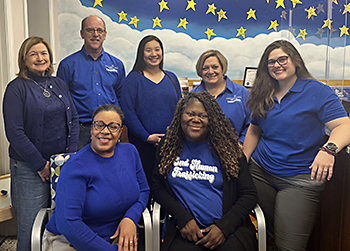
(Photo: The team at the Child Advocacy Center wear blue for human trafficking awareness on Human Trafficking Awareness Day, Jan. 11, 2025. Photo courtesy of Child Advocacy Center's Facebook page)