
 History tends to favor the loudest names. The American Revolution, as it is commonly told, belongs to figures like George Washington and Marquis de Lafayette; men whose legacies have long defined the narrative of independence. But on May 16, at City Center Gallery & Books, author Ted Hart will offer a different perspective—one grounded not in fame, but in forgotten lives.
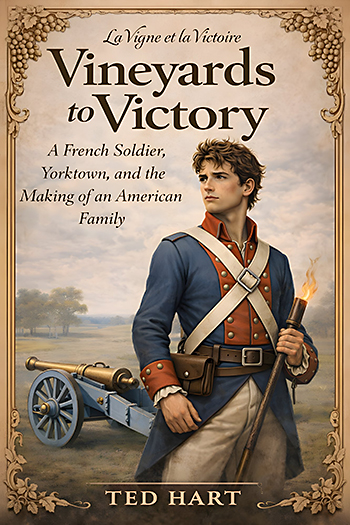
Hart returns to Fayetteville from 2 p.m. to 4 p.m. for an encore presentation and book signing of Vineyards to Victory: A French Soldier, Yorktown, and the Making of an American Family, following a Revolutionary War ceremony earlier that day. His work reframes the Revolution through the eyes of Siméon Gaugien, a young French artilleryman whose story, until recently, lived largely in obscurity.
Rather than retell the war through strategy and command, Hart focuses on what he calls the “lived experience” of the conflict.
“Focusing on Siméon Gaugien allowed me to step away from the familiar narratives of generals and statesmen,” Hart said. “What emerges is a far more human story—one that reveals the uncertainty, sacrifice, and international complexity of the Revolution.”
Gaugien, a farmer’s son from rural France, joined the army of Comte de Rochambeau and sailed to America in 1780. As part of the French artillery, he endured a grueling Atlantic crossing, a winter encampment in Newport, and ultimately the Siege of Yorktown, a decisive moment that helped secure American independence. Yet for Hart, the significance of the story lies not just in victory, but in the men behind it.
“The French artillery played a decisive role at Yorktown,” he explained, “yet the individuals behind those guns are largely absent from traditional accounts.”
That absence is what Vineyards to Victory seeks to correct.
For Hart, the project is more than historical, it is deeply personal. Gaugien is his fifth great-grandfather, a connection that could have easily turned the book into a family tribute. Instead, Hart approached it with deliberate restraint.
“Being a direct descendant created both an opportunity and a responsibility,” he said. “It gave me a starting point, but it also required discipline to separate family lore from verifiable history.”
That discipline led him into years of archival research across France and the United States, where small discoveries reshaped the larger story. One such moment came early, when Hart uncovered that Gaugien had an older brother, an overlooked detail that reframed his decision to leave home and enlist.
Other findings broadened the historical scope. The failed Franco-Spanish invasion of England in 1779 revealed just how uncertain the war effort remained even on the eve of French involvement in America. And then there were the human losses—quiet, devastating moments that rarely make it into textbooks.
Hart points to the deaths of two soldiers from Gaugien’s company, Jacques-Christianne Closset and Nicolas Fole, who drowned in the York River just days before the siege began. One is memorialized. The other is not.
“The loss of two comrades in this manner, so close to battle, would have been deeply felt,” Hart said. “It was important to me that this moment be included.”
In Fayetteville, a city shaped by military service, those stories carry a familiar weight. Hart sees clear parallels between 18th-century soldiers and those who serve today.
“Young men, often far from home, operating within complex alliances, facing uncertainty about outcomes—that hasn’t changed,” he said. “What has changed is connection. An 18th-century soldier like Siméon had no real contact with home. Months, even years, could pass in silence.”
Despite advances in technology, the emotional core of service duty, isolation and sacrifice, remains constant. That resonance is part of what makes Hart’s upcoming appearance more than a typical book event. Described as both a polished speaker and an engaging conversationalist, he invites audiences into dialogue, not just presentation. The May 16 gathering will offer attendees the chance to explore history not as distant fact, but as a lived experience, one shaped by individuals whose names rarely appear in bold print. At its heart, Vineyards to Victory is not just about one man. It is about thousands.
“I hope readers come away with a deeper appreciation for how international the American Revolution truly was,” Hart said, “and how much it depended on individuals whose names have largely been lost to history.”
In telling Siméon Gaugien’s story, Hart does more than recover a single life he restores dignity to a generation of soldiers who stood in the background of history, even as they helped shape its outcome. And in a place like Fayetteville, where service is both legacy and present reality, that reminder lands with quiet force: history was never only written by the men at the top, it was carried forward by those in the ranks, one story at a time.
Ted Hart reclaims forgotten voices of American Revolution
- Details
- Written by Jamie Bishop