
Sept. 11 ceremony, Field of Honor and special exhibit connect the attacks to two decades of service and sacrifice
Before the flags ever reach the parade field, there is work behind the scenes.
They are prepared, organized and paired with tags that identify the people they honor. Each name represents a life, a story and someone who is remembered for more than a moment in history.
That is where the phrase “never forget” takes on weight.
Remembering Sept. 11, 2001, is not only about marking what happened that morning. It is also about remembering the people behind the numbers — who they were before that day, the people who loved them and the lives they touched.
Twenty-five years later, that remembrance will take physical form outside the U.S. Army Airborne and Special Operations Museum.
The XVIII Airborne Corps and Fort Bragg, in conjunction with the U.S. Army Airborne and Special Operations Museum Foundation, will host a remembrance ceremony at 8:30 a.m. Sept. 11 at the museum, 100 Bragg Blvd. in Fayetteville.
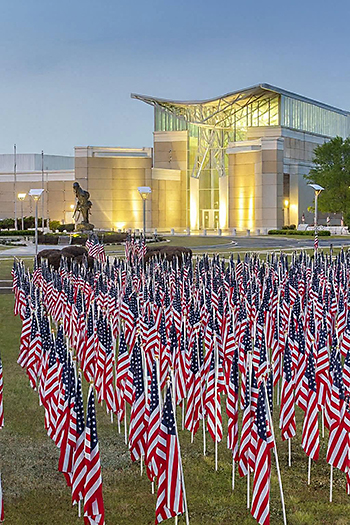
The ceremony will formally open the museum’s Field of Honor, where 500 American flags will stand across the parade field representing service members, first responders and those who were lost. The flags will remain on display through Veterans Day.
This year’s commemoration marks 25 years since the terrorist attacks on the World Trade Center and the Pentagon and the crash of Flight 93 in Pennsylvania.
Scheduled speakers include Lt. Gen. Gregory “Greg” K. Anderson, commanding general and senior mission commander of the XVIII Airborne Corps and Fort Bragg, and William J. Lehmann Jr., chief of U.S. Army Emergency Medical Services at Fort Bragg.
Lehmann is a former New York City Fire Department paramedic and a survivor of the Sept. 11 attacks on the World Trade Center, bringing a firsthand connection to the history being remembered.
The remembrance also reaches beyond the events of Sept. 11 itself.
Inside the museum, the special exhibit “Remembering 9/11: From Ground Zero to Abbey Gate” traces the attacks and the two decades of war that followed.
According to information provided by ASOM, the exhibit begins with the attacks on the World Trade Center and the Pentagon, the actions of the passengers and crew aboard Flight 93 and the response of first responders at Ground Zero.
From there, the exhibit moves into the Global War on Terrorism and the deployment of U.S. Army Airborne and Special Operations soldiers to Afghanistan and beyond. It follows 20 years of service and conflict before reaching the final days of the U.S. mission in Afghanistan, including the evacuation from Hamid Karzai International Airport in Kabul and the Aug. 26, 2021, attack at Abbey Gate.
The history is carried through artifacts as well.
Among them are a steel truss recovered from the World Trade Center, a fragment of the Pentagon’s limestone facade and personal artifacts from Airborne and Special Operations soldiers who served during the Global War on Terrorism.
The ceremony, exhibit and Field of Honor each mark a different part of the same history — the day itself, the people it affected and the years that followed.
“Never forget” means remembering what happened. It also means remembering the lives that existed before Sept. 11, the first responders who ran toward danger and the service members whose lives and service were shaped by what came next.
The ceremony will last one morning. The 500 flags will remain through Veterans Day.
Twenty-five years later, the names, stories and history they represent remain.
(Photo: The Field of Honor at the Airborne and Special Operations Museum will be open on Sept. 11 and be on display until Veterans' Day. Photo courtesy the Airborne and Special Operations Museum Foundation Facebook page)