
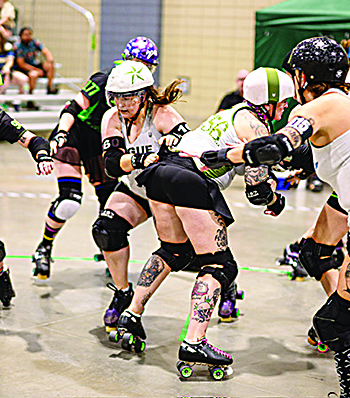
The Oct. 10 Birthday Bash at the Crown Expo Center will feature three bouts showcasing established, youth and new skaters while honoring the friendships and community that have kept the league moving.
When I learned I would be interviewing a Fayetteville Roller Derby skater named Claire Lee Psycho, her name alone gave me a preconceived notion of who would answer the phone. Within moments, I realized I had it wrong.
The soft-spoken woman on the other end was a military spouse and mother who had participated in roller derby in Colorado before moving to Fayetteville with her husband and 2-year-old. She had no family nearby and joined Fayetteville Roller Derby while looking for connection.
Thirteen years later, she is the league president.
The contrast reminded me that Fayetteville Roller Derby is about more than women racing around a flat track in a full-contact sport. It is about community, friendships and creating family with people whose paths may never have crossed otherwise.
My first Fayetteville Roller Derby experience came in 2019, when former league skater Pharaoh Fawcett introduced me to the sport and the local organization.
Seven years later, I was being reintroduced to the league as it prepared to celebrate its 20th anniversary. The conversation gave me a chance to look beyond the track and into what has kept the league moving for two decades.
As Psycho and I talked, I realized we had plenty in common, although I had never put on skates to compete in a bout.
“Most of the time, I’m just called Mom,” she said. “But when I leave and I go to derby, I’m Psycho.”
Many women, military spouses and civilians alike, can relate to carrying one title so often that it can eclipse other parts of who they are. Being Mom does not fully capture all of Psycho. Fayetteville Roller Derby gives her space to embrace another part of her personality alongside women doing the same.
When Psycho arrived in Fayetteville, she remembered her previous roller derby experience and searched for a local league.
“I showed up, and I never left,” she said.
What she found was not simply a team. The skaters have attended one another’s weddings, welcomed new children and supported one another beyond the track. Former skaters return to practices when visiting, and friendships continue after moves take members elsewhere.
One former skater, now living in Ohio, drove from Myrtle Beach during a vacation just to attend a practice. A transfer from Hawaii arrived with a connection to a former Fayetteville skater and received an immediate welcome.
Those relationships have sustained a league in a military community where permanent change of station moves can alter a roster quickly. When Psycho joined, the league sometimes had barely enough skaters to compete. Members left, new skaters arrived and the team repeatedly rebuilt itself.
Then came the pandemic.
Because roller derby depends on close physical contact, the team could not safely compete for nearly two years. Psycho said the league almost did not make it through the interruption.
Yet, they are still rolling.
That makes the 20th anniversary more than ceremonial. The league survived military turnover, fluctuating membership and a prolonged period when its sport could not be played.
It also avoided making the experience solely about winning.
“When other teams reach out and say, ‘You guys were so much fun to play. Do you want to play us again?’ that’s what makes me the happiest,” Psycho said. “I don’t care if we win or lose. I just want to go skate and hit my friends.”
Experienced skaters have even encouraged newer opponents while blocking them, offering advice as they attempt to break through the pack. The competition is real, but so are the sportsmanship and desire to help the sport grow.
For those of us who thought roller derby was simply women skating in a circle and hitting one another, there is more strategy involved.
Each team may have five skaters on the flat track. Four are blockers, while one is the jammer, identified by a star on her helmet cover. After breaking through the pack, the jammer earns points by passing opposing blockers. A jam may last up to two minutes, although the lead jammer can end it early. The team with the most points wins.
During my first bout, I learned one thing quickly: Watch the woman wearing the star. If you remember nothing else, that will help you follow the action.
And yes, the contact can hurt.
“Sometimes it does hurt, but I usually don’t notice until later,” Psycho said.
Fayetteville Roller Derby will celebrate its 20th Birthday Bash on Saturday, Oct. 10, at the Crown Expo Center. Doors open at 2 p.m.
Fayetteville Roller Derby will face Black Skaters With Attitude at 3 p.m. A youth mixer follows at 5 p.m., and a new-skater mixer begins at 7 p.m.
The three bouts will showcase established competitors, Black skater representation, young skaters and new adult skaters. Experienced skaters will also help guide participants who may be competing outside practice for the first time.
Admission at the door is $15 for adults and $10 for children. Presale tickets are available through skaters. Reach out to FRD.publicrelations@gmail.com for more information.
Beyond the track, the nonprofit has supported charitable organizations through bout proceeds. Members have helped food banks, participated in Adopt-a-Highway cleanups and held recruitment information nights.
For those who walk through the door, Psycho said the welcome is immediate.
“You’re walking into an entire group of friends that want you to be here.”
For 20 years, Fayetteville Roller Derby has continued making room for the next person searching for competition, connection or a place that may eventually feel like family.
(Photo: Running Scarred, Corporal Killah and Kris of Death, skaters with Fayetteville Roller Derby, compete during a recent bout. Photo by Belsaas Photography)