
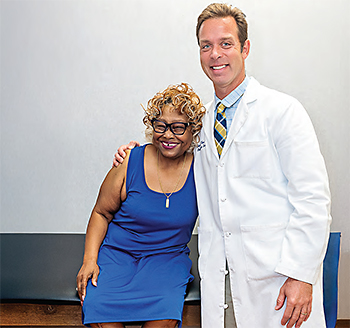
 At 74, Joyce Bryant has a lot to be proud of: a loving family, a happy retirement from a long career and a very independent spirit.
“Some people might say I’m too independent,” she said. “I try to do things on my own. Very rarely would I ask anyone for help, and I’ve got to be really down to where I just can’t do it alone.”
Before her retirement, Bryant was working at the front desk of a Fort Bragg medical clinic. She prided herself on being a team player.
“I liked being someone who got things done,” she said. “I would pitch in and do whatever anyone needed help with.”
But in 2017, Bryant’s can-do attitude was challenged by a nagging pain in her right shoulder. Over time, it went from a dull ache when lifting to a noticeable sting when reaching, to a distracting pain even at rest. She couldn't ignore it anymore.
“I just got to a point where I said, you know what, I’m going to make an appointment with Dr. Barnes,” Bryant said. “I knew we needed to do something.”
Christopher Barnes, MD, is an orthopedic and sports medicine surgeon at Fayetteville Orthopedics & Sports Medicine. He specializes in shoulder surgery, including the repair of joint injuries that may stem from athletic
exertion—or merely from the wear and tear of life.
Dr. Barnes had helped Bryant with her knee issues in the past, so she knew whom to trust for her shoulder problem. He suspected a rotator cuff tear, which was confirmed by MRI.
“He said he recommended surgery,” Bryant said. “And I was like, OK, let’s go.”
Bryant was scheduled for an arthroscopic rotator cuff repair. The rotator cuff is a group of muscles and tendons that hold the shoulder in place and help it move. It may be injured suddenly or gradually damaged by a lifetime of wear and tear. An arthroscopic surgery uses a small camera, inserted through a tiny incision, to help the surgeon see and repair the damage with minimal pain and scarring for the patient.
“He explained the procedure to me, how it would go and how long it would probably take,” Bryant said. “He didn’t rush me, and he answered all my questions. I appreciated that a lot.”
Bryant was in particularly good hands with Dr. Barnes, who was the first to offer arthroscopic rotator cuff repair at Cape Fear Valley when he arrived in 2003. He has performed more than 5,000 shoulder arthroscopies since then.
Though she was no stranger to surgery, Bryant said she was still nervous when the big day came.
“And I told them,” she said. “I said it a lot, because when I get scared or nervous, I talk a lot. But they helped me to feel better. They answered all my questions until I felt like I could do it.”
The next thing she knew, Bryant was waking up with a repaired shoulder and no complications. She went home to recover, with lots of help from loved ones—three generations of them, from her husband to her grandchildren.
“I had excellent support at home with my family,” she said. “Especially my husband, Bernard. I call him my Uber because he’s always taking me somewhere.”
The next stop for Bryant and her Uber was a crucial step in full recovery: physical therapy. By helping to restore strength and range of motion in the joint, physical therapy is nearly as important to rotator cuff repair as the surgery itself.
“Physical therapy ain’t never easy,” Bryant said, laughing. “But they were so patient with me. They said, ‘Just try. That’s all we ask, is that you try.’”
To her relief, physical therapy did get easier as her shoulder healed. Soon, with no pain in her right shoulder, she was becoming more aware of a growing ache in her left shoulder. When Dr. Barnes recommended the same surgery on that side, Bryant didn’t hesitate.
“I had the other shoulder done later that same year,” she said. “And they’re perfect. I have no pain, no problems. I can get around and do what I want to do.”
(Photo courtesy of Cape Fear Valley Health)