
 DistiNCtly Fayetteville’s trail series is a wonderful way to see the sights around the city. Last week, Up & Coming Weekly profiled the Paths, Plank Roads and Planes Trail. This week, we’ll delve into Fayetteville’s Revolutionary past. What better way to get into the spirit of the semiquincentennial of the United States than to take a shot at the American Independence Trail?
North Carolina is one of the original 13 colonies, and has a rich Revolutionary history. Fayetteville itself has interesting ties to the Revolution. Formerly the villages of Cross Creek and Campbelton, Fayetteville had been founded by a large population of Highland Scots. A lot of these founders were staunchly in support of the Crown, and Fayetteville was split in its loyalties. It made for quite a tense time.
The Cumberland Association, a group of individuals who believed in independence, signed what would be known as the “Liberty Point Resolves.” These were signed on June 20, 1775, a full year before the signing of the Declaration of Independence. The Resolves were slightly different from the Declaration, however. The 55 signers of this document expressed hope for a reconciliation with Great Britain, but also made it clear they would fight to the death to “secure freedom and safety.”
The Resolves were signed at Barge’s Tavern, a local spirit house in James Square, historically located where Green, Rowan, Ramsey and Grove streets all converge. This building is actually still in existence today, but it has since been moved from its original location to its current home at 519 Ramsey St. The signers took the Liberty Point Resolves just a few blocks over from James Square, to a large Virginia live oak tree and nailed them to the trunk. The Liberty Tree, as it is now known, is part of the modern Airborne and Special Operations Museum. The tree is on the corner of Hay and Hillsborough streets, and is still alive and well today. In
August of 2025, the Airborne and Special Operations Museum Foundation held a ceremony commemorating a historic marker plaque for the tree.
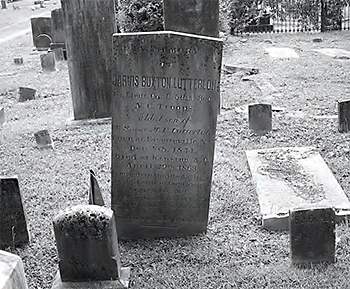
A monument was set up in 1933 to commemorate the signers of the Resolves. 16 signers had been forgotten, and were added to the stone in 1976. This marker can be found at the corner of Bow and Person streets. The Cross Creek Cemetery on Grove and Ann streets holds the graves of Revolutionary veterans, including Robert Rowan, the original signer of the Liberty Point Resolves. This cemetery is stop
number 3 on the tour.
Another important gravesite is located in Fayetteville: The Fifer’s Grave. Isaac Hammond, a free African American who lived in Fayetteville, became a member of the Fayetteville Independent Light Infantry and served for 30 years as a fifer. He served in the Revolutionary War and set up shop as a barber after the war. His is the only grave on FILI land, and his grave is stop 2 on the trail.
Fayetteville’s Revolutionary roots don’t just include the Liberty Point Resolves. The namesake of the city, Gilbert du Motier, the Marquis de Lafayette, a French man, had joined the patriot cause during the Revolutionary
War, and was at the Siege of Yorktown when General Cornwallis capitulated on Oct. 17, 1781.
He took the ideals of the American Revolution with him back to France, and wrote the Declaration of the Rights of Man and of the Citizen with the help of Thomas Jefferson. This document was used during the French Revolution. He stormed the Bastille, and after a fashion, was known as The Hero of Two Worlds.
Fayetteville, NC is far from the only town named after the marquis. The colonies are littered with his name. Legend has it, however, that Fayetteville, NC is the only town he visited that bore his name. The Fayetteville History Museum has an exhibit full of artifacts of his trip to the city, and every year the Lafayette Society holds celebrations in his honor. A statue of the marquis is stop 4 on the tour.
The American Independence Trail from DistiNCtly Fayetteville dives into much of this history of the city. The tour can be found at https://www.distinctlyfayettevillenc.com/things-to-do/museumshistory/cultural-heritage-trails/american-independence/. Before taking off on the adventure, watch the video that accompanies the tour.
Hank Parfitt, owner of City Center Gallery & Books and a member of the Friends of Lafayette and the Lafayette Society, gives great detail about the history of the area.
DistiNCtly Fayetteville's American Independence Trail
- Details
- Written by Aly Hansen