
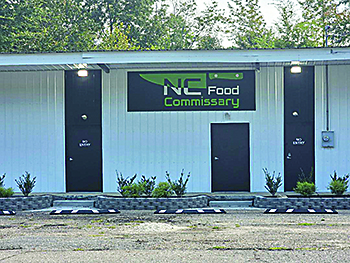
 Inside a modest cement-block building on Griffin Street, just minutes from downtown Fayetteville and not far from the city’s main social service corridors, is NC Food Commissary. A new commissary kitchen, NC Food Commissary is quietly redefining what faith-driven work can look like in the local food economy.
Located at 813 Griffin St., the facility operates as a licensed commercial kitchen for food trucks, caterers, bakers and small food businesses that need a legal base of operations. But for Chris Thiessen, one of the project’s founders, the space represents something deeper than compliance or entrepreneurship.
The commissary, she says, grew out of a calling.
Thiessen originally envisioned launching a food truck with the simple goal of feeding people in need. That plan stalled when she discovered a critical barrier: North Carolina law requires mobile food vendors to operate from an approved commissary, and none existed locally to support that vision. Rather than abandon the idea, Thiessen followed what she describes as a clear redirection.
The building on Griffin Street became the answer.
What now exists is a standalone commissary, the first of its kind in Cumberland County — equipped with a full cooking kitchen, two prep kitchens, secured dry storage, refrigeration, freezer options and classroom space. From a regulatory standpoint, it fills a long-standing gap for food entrepreneurs across Fayetteville and neighboring counties who previously had to borrow space, rely on limited church kitchens, drive to Raleigh, or operate under the radar. From a spiritual standpoint, Thiessen views it as an act of obedience.
Throughout the three-year process of securing the building, navigating permits and building out the space, prayer was central. One of the project’s partners, who also served as her pastor, prayed over the entire facility, every room and corner, before operations began. Thiessen believes that foundation matters.
She speaks openly about patience being one of the greatest lessons the process required. Doors did not open quickly, and plans often shifted. But she describes a steady pattern of confirmation through conversations, partnerships and timing that reinforced her belief the project was unfolding as intended.
The commissary operates as a for-profit business, but it is paired with a nonprofit ministry, NC Meal Train Ministry, which anchors the faith-based mission of the space. The two entities function together: the commissary provides infrastructure for businesses, while the nonprofit ensures that food and opportunity circulate back into the community.
Through NC Meal Train Ministry, surplus food prepared by vendors from catered events or unsold service days can be redirected rather than wasted. Participating businesses receive credits toward kitchen time or deductions facilitated through the nonprofit, while prepared meals are funneled to existing food pantries and individuals already serving Fayetteville’s unhoused population. Rather than creating new outreach programs, the ministry strengthens networks that are already active on the ground.
The location of the commissary reinforces that mission. Griffin Street sits near major service centers, including areas where residents seek identification, employment resources and emergency assistance. Thiessen says being physically close to need has shaped how she understands the work happening inside the building.
Plans are also underway for a community garden behind the facility, further tying food production to service. The garden, like the kitchen, is meant to be practical rather than symbolic, a tangible extension of care in a city where food insecurity remains visible.
Inside the building, the ministry often takes a quieter form. Many food entrepreneurs who contact the commissary arrive with talent but little understanding of licensing, insurance, tax obligations or pricing. Thiessen, whose background is in accounting and administrative work, spends much of her time guiding them through those early steps. She does not complete the work for them, but she connects them to free state and local resources, small-business advisors and regulatory offices that many do not know exist.
That guidance, she believes, is part of the ministry itself. Helping someone build a legitimate, sustainable business means helping them support their families and, in turn, serve the community through their work.
The commissary also includes classroom space that will be used for food-safety instruction, business education and regulatory training, including upcoming requirements for propane use at festivals and mobile operations. Classes are planned to be bilingual to ensure accessibility. While these offerings address compliance, Thiessen emphasizes that education is also about confidence, helping people move beyond fear and uncertainty.
Growth is already being considered in phases. The current site is designed to support up to 35 businesses initially, with expansion possible through added storage or a second location if demand continues. Still, Thiessen measures success less by numbers than by faithfulness to the mission.
She is currently praying over what will eventually fill a large blank wall near the entrance, something that quietly signals the spiritual foundation of the work being done there. The goal is not to make the space overtly religious, but unmistakably intentional.
The commissary’s grand opening and ribbon cutting, hosted by the Fayetteville Chamber of Commerce, is scheduled for Feb. 19 at 1 p.m. at the Griffin Street location. Thiessen says the celebration will reflect the spirit of the project itself, communal, inclusive and shared.
In a city where food trucks and pop-up vendors have become a defining part of local culture, the commissary stands as unseen infrastructure: prep tables instead of stages, storage shelves instead of spotlights. Yet for Thiessen, its purpose is clear.
The work, she says, is bigger than business. And for now, she remains committed to following where it leads
For information about NC Food Commissary membership, you can visit the website, www.ncfoodcommissary.com, or by phone at 910-807-7850.
(Photo courtesy of NC Food Commissary's Facebook page)