
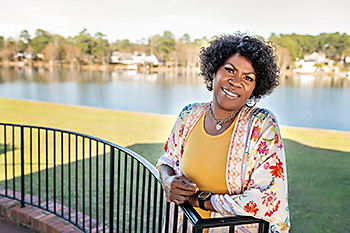
 Last October, Gladys Kirkland began experiencing some strange symptoms. It started with a cold, tingly sensation in her right arm. Later that week, there was a slight slur in her speech.
“I just figured I was tired,” she said. “I wasn’t too worried about it.”
Shortly after that, in the pickup line outside her granddaughter’s elementary school, Kirkland opened a book to pass the time until the bell rang. When she had trouble focusing on the story, she sensed something was really wrong.
“So, I called my daughter to tell her I was going to the urgent care,” she said. “And she told me, ‘No, you need to go to Cape Fear Valley.’”
As soon as she arrived at the emergency department, Kirkland said, there was a flurry of activity around her. By this time, there was a noticeable droop to her right eye.
“I had a CT scan,” she said. “And after that, they told me, ‘You’ve had a stroke.’”
It was a hemorrhagic stroke, meaning that a blood vessel in her brain had begun to leak and put dangerous pressure on the surrounding brain cells. It’s one of two main types of stroke and accounts for only about 15 percent of cases.
“The other main type is an ischemic stroke,” said Christian Bacheler, MD, a board-certified neurologist who serves as Medical Director of the Stroke Program at Cape Fear Valley. “That means there’s a blockage, so the blood flow and oxygen to the brain are restricted.”
Dr. Bacheler said it’s not unusual for stroke symptoms to appear subtly and gradually, as Kirkland’s did.
“Every stroke is different,” he said, “and it doesn’t always feel like an emergency. Sometimes the symptoms are very mild, and sometimes they come and go.”
It helps to know the possible signs of a stroke, so you can spot them even when they aren’t obvious. Dr. Bacheler recommends an acronym known as BE FAST:
Balance: Watch for a sudden loss of balance or coordination or feeling dizzy.
Eyes: Be aware of sudden vision changes, such as blurry vision, double vision or loss of vision in one or both eyes.
Face: You might have an uneven smile, facial drooping or numbness on one side of the face.
Arms: Notice if there is weakness, numbness or drifting in one arm (or leg) when raised.
Speech: Don’t ignore slurred speech, confusion or difficulty understanding others.
Time: If any of these signs are present, call 911 immediately.
“Time is especially important,” said Dr. Bacheler, “because the faster you get treated, the more brain you’re saving.”
This year, Cape Fear Valley Medical Center is poised to save even more of that precious time by becoming a thrombectomy-capable stroke center. This means it will be equipped to remove blood clots after an ischemic stroke, quickly restoring blood flow to the brain. It’s a level of care that was previously only seen at larger hospitals elsewhere in the state.
“Instead of giving a clot-busting medication and then transferring the patient to other facilities, we will be offering a mechanical thrombectomy here at home,” said Mena M. Samaan, MD, Director of Neurointerventional Services. “This can make a big difference in terms of recovery, and the family does not have to go miles out of town because we can do this here at home.”[LT1.1]
Kirkland feels fortunate that her stroke was relatively mild and caused no lasting damage. After three days in the hospital, she was discharged with new awareness about its potential causes: A pharmacy mishap had caused her to go a week without her blood pressure medication, and persistent knee pain had her relying heavily on aspirin and ibuprofen to get through the day. Together, it all heightened her risk of stroke.
“I’m being very careful with all of that now,” she said. “I don’t want to end up in the hospital again.”
Although it’s not an experience she wants to repeat, Kirkland has high praise for the hospital staff who kept her calm during a frightening time. She recalls receiving a thorough, reassuring explanation of her condition from Melissa Stamates, MD, and a particular ED nurse who kept her anxiety at bay.
“Her name was Andrea,” she said. “She was really on top of things, and she made little jokes to keep me from worrying too much. And everyone on 4 South was awesome.”
Thinking back on that day in the school pickup line, Kirkland is also grateful that her daughter encouraged her to go to Cape Fear Valley.
“I hate to think what would have happened if I’d picked up my granddaughter, gone home and gotten worse,” she said. “I have to say God was really watching us that day.”
(Photo courtesy of Cape Fear Valley Health)