
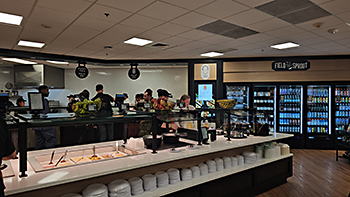
Fort Bragg’s first campus-style dining venue uses fresh food, flexible access, and personal choice to meet individual needs—recognizing that collective readiness is built Soldier by Soldier.
As a former military spouse, this was not my first visit to a dining facility, or DFAC. I have lived on military installations and walked into enough of them to recognize the general feel: functional, often stark and rarely designed to make anyone want to linger.
Until now.
Fort Bragg officially opened Rally Point Bistro on Sept. 29, becoming the fourth Army installation to embrace a different approach to the day-to-day dining experience. The Army launched its initial five-installation Campus-Style Dining Venue pilot at Fort Hood in February, followed by Fort Carson in April and Fort Drum in July. Fort Stewart is also included in the pilot.
Developed in response to Soldiers asking for more variety, greater flexibility and an environment that feels less like a traditional dining facility, the model combines extended access, multiple food stations, digital ordering and performance-focused nutrition. At Fort Bragg, it creates a space built around what Soldiers need nutritionally, when their schedules allow them to eat, what they prefer, what they cannot eat and what will help them perform at their best.
It also considers their well-being.
Before I stepped inside Rally Point Bistro, a story shared during the grand opening ceremony changed how I would see everything waiting beyond its doors.
Compass Group CEO Peter Fetherston held up a printed copy of a receipt left at 42 Bistro at Fort Hood. He said a photograph of the receipt had been sent to him, and although he does not typically use prepared notes, he wanted to read the handwritten message.
“Thank you for working and serving us,” the Soldier wrote. “I admire the effort the staff puts into keeping us fed. The people working here make our lives easier to manage, and the tall screens showing us how to utilize the menu is a big bonus. Thanks again.”
The Soldier did not leave a name. Instead, the note was signed, “One of many.”
“In this simple message, I can’t think of a better way to capture and articulate what this is all about,” Fetherston said.
It is the same reason I am certain those words stayed with more people than me. The Soldier understood their role as one of many. Yet something created to serve thousands had made a personal difference in that Soldier’s life as an individual.
By the time the ribbon was cut, and we entered Rally Point Bistro, we walked in with a different understanding of what each station, menu choice and added convenience could mean to one Soldier in an Army of many.
“Rally Point Bistro represents a fundamental change in how we think about the Army food service ecosystem,” said Lt. Gen. Gavin A. Lawrence, deputy commanding general and acting commander of U.S. Army Materiel Command.
Sgt. 1st Class Jermone Fisher saw that change take shape while helping facilitate the contracting process through the facility’s renovation and grand opening.
“The difference that this facility is going to make is really giving them more flexibility with the times that they open and close, and also providing more and better options,” Fisher said.
Inside, those options are easy to see. Instead of one cafeteria line, Soldiers can choose among different dining stations and rotating cuisines, order a prepared meal, pick up a smoothie or select fresh fruit, vegetables and other food to take with them. Digital kiosks provide another way to order without relying solely on a traditional serving line.
Before the grand opening, a soft-opening period allowed diners to experience the venue while staff tested food-preparation workflows, refined operations and collected feedback. By the grand opening, Spc. Lloyd Dubose had eaten nine meals at Rally Point as part of that early experience.
“I think the food is fantastic, and it’s got a lot of options, and it really caters to any physical fitness needs,” Dubose said.
He pointed to the protein and carbohydrate choices, fresh fruit and vegetables available throughout the venue. The variety supports the Army’s Holistic Health and Fitness approach, which considers nutrition part of total Soldier readiness.
“We look at nutritional standards for our Soldiers because we view them as warrior athletes,” Lawrence said. “We’re ensuring that for each and every meal, there are balanced menu choices to meet their nutritional needs and fuel them through the duty day.”
The food may draw Soldiers through the doors, but the flexibility may be what keeps many of them coming back. Traditional dining facilities operate around designated meal periods that do not always align with physical training, work assignments and other duties.
Pvt. 2nd Class Marisela Bowie said Rally Point gives her another option.
“It has great hours, so I can come here when I’m free to grab a quick lunch, breakfast or dinner, just because it can be hard to grab it during certain hours of the DFAC,” Bowie said.
She also uses the grab-and-go selections. “It’s a great opportunity to grab quick meals when you’re in a rush,” Bowie said.
Capt. Thomas McCarty explained that Soldiers who previously missed a dining window could arrive after the facility had closed and have to wait for the next meal period. Rally Point Bistro remains open throughout its operating day, allowing Soldiers to come in when their schedules permit.
That flexibility extends to the Freedom Dollar system. Soldiers living in the barracks and enrolled in Essential Station Messing receive $39 in daily purchasing value: $9.57 for breakfast, $15.86 for lunch and $13.57 for dinner. Unused breakfast value can move forward into lunch and dinner before resetting at midnight.
“If they don’t use it all at breakfast, it rolls into lunch. If they don’t use it all at lunch, it rolls into dinner. At midnight, it resets,” McCarty said.
That is where the grab-and-go cases and frozen meals become more than added conveniences. A Soldier who knows the day will run long can use the remaining value to take food back to the barracks for later instead of allowing that portion of the entitlement to go unused.
The bistro also recognizes that more choices only matter if they account for individual needs. Pvt. 2nd Class Jasine Jarrett said a dietary restriction has limited what she could select in other settings. Rally Point’s smoothie bar and wider range of food have changed that experience.
“Going to the smoothie bar has helped me a lot, and I really appreciate that I don’t have to limit myself to what I want to eat,” Jarrett said. “I have multiple options, so I’m grateful for that.”
Jarrett is also a 92G culinary specialist. With Compass Group employees operating Rally Point Bistro, she and other 92Gs can spend more time developing the tactical skills the Army will need from them in the field.
“What that means to me is that I get the opportunity to focus on more of my Soldier-like duties and tasks instead of focusing mainly on the DFAC,” Jarrett said. “This gives us a chance to focus more on our field-feeding duties as a 92G.”
The shift allows Army culinary specialists to spend less time preparing food inside garrison dining facilities and focus more heavily on feeding Soldiers during field exercises and combat operations.
“When we get food service right, ladies and gentlemen, the benefits extend well beyond the dining table,” Lawrence said. “Better food, better access helps Soldiers perform at their best. It gives them the fuel they need to train, to recover, to ultimately stay ready.”
The Soldier who left the receipt at 42 Bistro identified as “one of many,” but the signature did not take away the individual behind it. It revealed why that individual matters.
Rally Point Bistro is designed to support each Soldier’s schedule, nutritional needs and daily life because the readiness of the many depends on how well the Army fuels each one.
“This is more than just being about food,” Lawrence said. “It’s about quality of life, it’s about community, it’s about readiness.”
(Photo: The Rally Point Bistro will provide soldiers more flexibility in their dining options on Fort Bragg. Photo by Tiffany Haywood)