
Sometime in the last several decades, I realized that I was seeing more and more people with more and more tattoos.
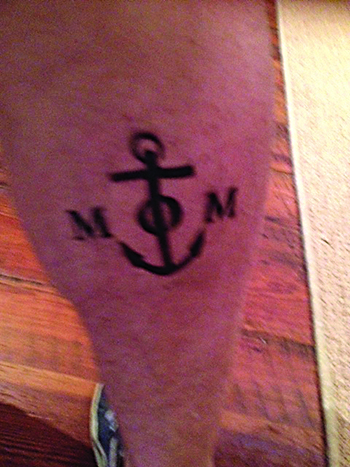
I am not talking about an old tar with a dark blue anchor on his bicep or a crusty guy with a heart emblazoned “Mama” on his chest. No, indeed. I am talking vibrant colors in intricate designs covering most of the real estate of an arm or a leg, maybe even on a neck or face. And, not just on curmudgeons, but on young folks, both men and women.
So startled and—yes—fascinated by this new development was I that I began investigating, a process that culminated in an observation visit to the internationally-known Bill Claydon’s Tattoo World on Yadkin Road, which closed last year to the deep regret of tattoo aficionados everywhere. A friend, who incidentally had a rose on her breast as well as something on a wrist and an ankle, and I watched while a young soldier received a highly colorful and curvaceous dragon tattoo wrapping about his calf. The design had been chosen by his 4-year-old son, who was not present for the actual procedure. The tattoo artist said the work would take 6-8 hours, so they took several breaks to sip something and have a snack. I asked the soldier whether getting a tattoo was painful; he acknowledged that it was uncomfortable at best and painful at worst. He said he would “self-medicate” when he got home.
I also wrote several Up and Coming Weekly columns about tattoos, which generated reader responses along the lines of “what’s your problem, lady?” I asked readers to tell me about their tattoos and why they got what they did, and their responses were enlightening. Their tattoos commemorated important markers in their lives—a marriage, a new baby, the loss of a loved one. Most were proud of their tattoos, although some regretted them, especially ones that addressed a relationship that no longer existed. One woman wrote that she loved her tattoo, but that she deliberately put it on her upper thigh where her grandmother was not likely to see it!
Fast forward to 2026, and tattoos are everywhere on all sorts of Americans as well as people in other cultures. The desire to decorate one’s body apparently transcends geographic boundaries.
Over the decades, we have also learned more about tattoos’ repercussions.
Tattoo regret is a real thing, especially among people who got them on a whim, when they were very young, and when they are in a highly visible place on one’s body. Tattoo removal is also a real thing, though it can be painful and expensive, requiring multiple sessions. Black and blue inks are the easiest to remove, with lighter and brighter colors more difficult and sometimes impossible to get rid of entirely. Some people opt for tattoo cover up to hide a regretted tattoo, perhaps the name or initials of a lost love.
There is also growing concern about tattoo ink being carcinogenic as it travels through the human body, perhaps causing cancers such as melanoma and lymphoma, although there are no direct causal studies.
Tattoos and the desire to decorate one’s body continue to fascinate me.
Do you have a tattoo or more than one? Do you love them or regret them? Do they speak to a special person or event in your life and do they bring you happy memories? Would you encourage your loved ones to get inked?
I would love to read your tattoo story and to share it with Up and Coming Weekly readers. Bring ‘em on!