
Let me ask you to consider something simple: What if Cumberland County decided that education was one issue important enough for us to approach together?
You may be Republican, Democrat, independent, or uninterested in political labels altogether. But when a child cannot read at grade level, misses weeks of school, feels unsafe in the classroom, or graduates unprepared for what comes next, that problem does not ask how you voted.
It affects your community.
Cumberland County Schools is making progress. Districtwide proficiency increased from 50.8% to 55.7% in 2025–26, and the four-year graduation rate reached a record 88.7%. Those numbers deserve recognition. But 55.7% proficiency also tells us plainly that substantial work remains.
Attendance tells a similar story. Chronic absenteeism stood at 33.76% for 2024–25—roughly one in three students. By the middle of 2025–26, that rate had fallen to 27.4%, an encouraging improvement, but still far from the district's attendance goals.
So perhaps our common enemies are already visible.
They are low proficiency, chronic absenteeism, unsafe learning environments, unrealized potential and policies that fail to produce results.
And another obstacle deserves attention: not political parties themselves, but the instinct to judge an education idea by who proposed it before asking whether it works.
That is where the old expression “the enemy of my enemy is my friend” takes on a different meaning.
You and I do not have to agree on everything to recognize the same problem. What if we agreed on the destination? Imagine a Cumberland County education agenda that could survive one election, one superintendent and one political season.
It might begin with a few questions most of us can understand: Can our children read and perform mathematics at grade level? Are they attending school? Are schools safe? Are graduates prepared for college, employment, technical training, military service, entrepreneurship or a skilled trade? When public money is invested in a program, can we demonstrate that it worked?
Those questions do not require ideological agreement. They require clarity of purpose.
The North Carolina School Boards Association teaches an important distinction. The school board governs; the superintendent administers. The board establishes policy, approves goals, monitors progress and provides direction. The superintendent implements those policies and manages the school system.
That distinction matters because governing well is not about trying to run a classroom from the boardroom. It is about asking better questions.
What are we trying to accomplish? Why is the problem occurring? What does the evidence show? What policy affects it? Are our resources aligned with our priorities? And did what we tried work?
Imagine if that became the language of education in Cumberland County. Then look beyond Cumberland County There is another opportunity worth discussing.
What if Cumberland County deliberately developed school-board members who became exceptionally knowledgeable about education governance—not merely successful politicians, but people who understood budgets, policy, accountability, facilities, transportation, student achievement and the consequences of statewide decisions?
Over time, some of those individuals could become credible candidates for service at the state level. That distinction is important because Cumberland County cannot simply elect someone to the North Carolina State Board of Education.
The State Board consists of the lieutenant governor, state treasurer and eleven members appointed by the governor and confirmed by the General Assembly. Eight appointed members represent education districts and three serve at large.
There is no formal requirement that someone serve on a local school board first. But local board service can provide something difficult to obtain from theory alone: experience seeing what happens when statewide policy reaches an actual classroom.
The State Board has constitutional responsibility for supervising and administering North Carolina's public-school system and educational funds and for establishing necessary rules and regulations within laws enacted by the General Assembly.
Think about the value of having someone at that table who understands Cumberland County not from a report, but from experience. What does a transportation policy mean to a rural family. What chronic absenteeism looks like inside a school. What an academic intervention cost?
What works—and what merely sounds good on paper. One purpose does not require one opinion Unity does not mean silence.
It does not mean Republicans must become Democrats or Democrats must become Republicans. It does not mean every disagreement disappears. It means recognizing that disagreement over how we get somewhere does not prevent us from agreeing about where our children need to go.
You can challenge my solution while still sharing my concern. I can disagree with your method while still respecting your goal. That is not political weakness. It is community maturity. Cumberland County does not need one political voice.
It could benefit from one educational purpose:
Students before partisanship.
Evidence before assumption.
Policy tied to results.
Accountability without micromanagement.
And perhaps, over time, something larger could grow from that approach: a county known not only for debating education policy, but for developing people capable of helping shape it statewide.
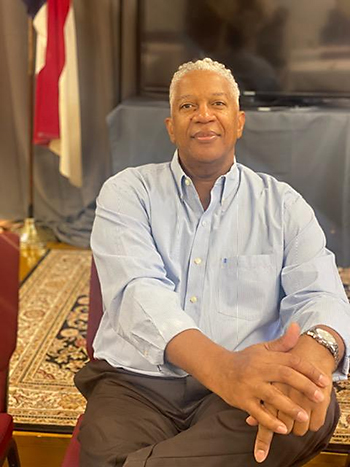
The goal would not be to guarantee Cumberland County a seat at the table. The goal would be to make sure that when opportunities to serve arise, Cumberland County has prepared people worthy of consideration for one. The idea is Johnathaun Lee’s; the plan belongs to Cumberland County.
Editor's Note: Johnathaun Lee's letter to the editor is another submission we have printed from a Cumberland County School Board candidate.
We welcome all letters from candidates, and encourage our readers to vote in November!
(Photo: Photo courtesy of Johnathaun Lee)