
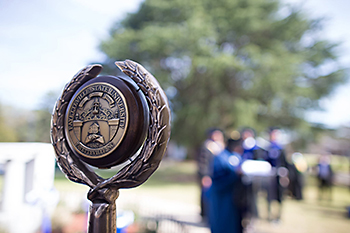
Sometimes, the greatest investments in human history aren't made by wealthy individuals, powerful corporations, or government institutions. Ordinary people with extraordinary vision, determination, and faith make them. Such is the story of Fayetteville State University. Here is the story: In 1867, just two years after slavery ended, seven Black men invested $136 to purchase two lots on Gillespie Street in Fayetteville. Adjusted for inflation, that's approximately $3,100 today. Now, let that marinate for a moment. These weren't wealthy philanthropists sitting in a corporate boardroom discussing investment opportunities. They were Black men living in the aftermath of slavery, determined that future generations would have opportunities denied to their ancestors. Their investment wasn't about financial returns. It was about freedom, education, dignity, and opportunity. Meeting at Evans Chapel Church, these seven visionaries helped establish what became the Howard School, named for a white Union General Oliver Otis Howard, an advocate for formerly enslaved African Americans. Howard University in Washington, D.C. is also named for General Howard.
The number seven has something spiritually fascinating about it. Biblically, it represents completeness, fulfillment, and divine perfection. Seven Black men. One mission. An investment that would change countless lives. Coincidence? Each reader can decide. The institution evolved into the State Colored Normal School in 1877, became Fayetteville State University in 1969, and joined the UNC System in 1972. Today, FSU is North Carolina's second-oldest public institution of higher education. Recently, the university celebrated another milestone: the ribbon-cutting of its magnificent $69.3 million College of Education building. The four-story, approximately 72,000-square-foot facility incorporates architectural tributes to those seven founders throughout its design. Imagine that! An investment of $136 in 1867 helped establish an institution now celebrating a $69.3 million educational facility. But impressive buildings don't necessarily produce extraordinary institutions. That requires visionary leadership.
And that brings us to Chancellor Darrell T. Allison. Since assuming leadership in March 2021, Allison has demonstrated that institutional advancement requires more than speeches, ceremonies, and promises. It requires measurable results. Under his leadership, FSU has secured more than $200 million in legislative capital investments and over $550 million in combined research, grants, and private funding. FSU has witnessed its highest student retention rate percentages, highest enrollment numbers exceeding 7,700 students. FSU has three franchises beneath its umbrella: Chick-fil-A restaurant, McAlister’s Deli, and Starbucks Coffee. Additionally, FSU manages Bronco Midtown Shopping Plaza. His leadership has earned recognition on Business North Carolina's Education Power List for five consecutive years, 2022–2026. That's not merely impressive. It's transformational. Certainly, no university's success belongs to one individual. Faculty, staff, students, alums, legislators, and community supporters all deserve recognition.
Nevertheless, exceptional leadership deserves exceptional acknowledgment. Those seven founders planted seeds they would never live to see fully blossom. Today, Chancellor Allison stands on their shoulders, reaching higher while creating opportunities for others.
Seven Black men invested $136 in a dream. Nearly 160 years later, that dream continues paying dividends. Some investments generate wealth. Others transform generations. Fayetteville State University has done both.