
Braxton Clark believes Fayetteville is carrying more history than it knows what to do with.
As a tour guide with Triangle Walking Tours, Clark spends Saturdays leading visitors through downtown streets that many residents pass every day without realizing what has happened beneath their feet. Ghost stories and true crime may draw the largest crowds, but for Clark, the real treasure is local history, the kind that reveals a city far older, stranger and more consequential than its reputation suggests.
“I feel like there are a lot of ways in this town where our history is treated very weird,” Clark said. “You’d be surprised at how historically significant this town was. Fayetteville is up there in terms of historically significant towns.”
Triangle Walking Tours offers several Fayetteville tours on Saturdays: a history and architecture tour at 2 p.m., a Black history tour at 4 p.m., a true crime tour at 6 p.m. and a ghost tour at 8 p.m. The tours give residents and visitors a chance to experience downtown Fayetteville as more than a collection of buildings, restaurants and familiar intersections.
For Clark, who describes himself as an archaeologist and local history enthusiast, the walking tours are about restoring depth to places that have often been flattened into a single sentence.
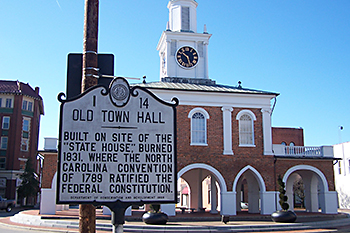
Take the Market House, for example.
To many, it is known primarily as a place where enslaved people were once sold. Clark does not dismiss that painful history, but he argues that the structure’s story is broader, more complicated and more revealing. He points to its role after the Civil War, when newly freed Black residents celebrated Jubilee Day there and gathered in the same space to mark freedom, survival and community.
“A lot of those newly freed enslaved individuals would have found out about their freedom at the Market House,” Clark said. “Going forward, you would actually have years and years where that Market House would be used specifically by the Black population of Fayetteville to celebrate their freedom on Jubilee Day.”
That, he said, is the kind of history Fayetteville should be willing to hold in full, not polished, not reduced, not hidden.
Clark is especially drawn to figures such as Isaac Hammond, a Black Revolutionary War soldier from Fayetteville who enlisted at 15, survived Valley Forge and returned home to a country that still denied Black citizens basic rights.
“He came home from the war fighting for the freedom of this new nation that he helped create,” Clark said. “And this nation immediately went and put up laws that said Black people aren’t allowed to be in a militia. Black people are not allowed to vote. And he did it anyway.”
For Clark, Hammond represents a Fayetteville spirit that deserves more recognition.
“That is the most American thing to do,” he said. “Do it anyway.”
The walking tours also challenge the idea that Fayetteville is simply an extension of Fort Bragg. Clark said many people think of the city as “Fort Bragg plus,” forgetting that Fayetteville’s story began long before the military installation became part of the region’s identity.
For most of its history, he said, Fayetteville was its own complicated, evolving Southern town, shaped by agriculture, commerce, slavery, war, Reconstruction, Black resilience and civic ambition.
The true crime and ghost tours offer a different doorway into that past. Some stories date back to the 1800s and, according to Clark, “read like a soap opera.” But even those darker tales are tied to real streets, real businesses and real families.
One of Clark’s favorite examples involves a carriage wheel he found near First Presbyterian Church and later donated to the local history museum. His research led him to the Simpson and McLaughlin carriage repository, once located near Liberty Point. That discovery connected to another tour story involving Alexander Simpson, one of the business owners, whose name appears in both the true crime and ghost tours.
“You start to really surprisingly easily put this puzzle together,” Clark said. “It’s like a 3D map of time and space.”
That is the power of a walking tour. Unlike a textbook or a museum case, the streets become part of the lesson. A guide can stand near the site of an old killing, point toward a nearby intersection and help guests imagine how a witness saw events unfold more than a century ago.
“There are so many things you don’t get from a page or a screen,” Clark said. “It’s a lot easier to get the lay of the land once you’re actually at an intersection.”
As America approaches its 250th anniversary, Clark believes Fayetteville has a responsibility to stop treating its local history as an afterthought. He wants the city to lean into its complexity, preserve what remains and tell the stories of ordinary people with the same care often reserved for generals, politicians and national heroes.
“History is just as much of a quilt,” Clark said. “Every person is a patch of fabric, and it’s all woven together in a way that really blows your mind when you start to look into it.”
That quilt, in Fayetteville, is still being stitched together.
And for those willing to walk slowly, listen closely and look again, the city is still speaking. For more information about the walking tours, visit their website, https://www.trianglewalkingtours.com
(Photo by J. Stephen Conn. For more photos, visit https://www.flickr.com/photos/jstephenconn/with/3908622566/)