https://www.upandcomingweekly.com/


  • 9While most fashion shows center around a cohesive theme, Jennifer Baker likes to keep individuality at the forefront.
    “This is your show, your way,” she explained. “What we do at North Carolina Fashion Week is we give the designers free rein on what they want to do.”
    Baker, founder of NC Fashion Week and owner of modeling agency Metro Faces International, wants to put regional talent on the map. Nearly 20 years ago, she launched the annual fashion event, and its impact continues to grow.
    “It gives models, designers and boutiques an opportunity to be seen,” Baker shared. The week includes both in-person and virtual opportunities; contests, complementary workshops, portfolio-building, and finally, the runway on Feb. 7.
    Fayetteville is a prime location for the event, according to Baker, given its central location between New York and Miami, both fashion hot spots.
    “Years ago, it was just about the city you lived in,” Baker said of models looking to launch a career. “But now you have the opportunity to be in larger markets. I think you should always look at the beginning as something that could get bigger.”
    NC Fashion Week is not only an open door for regional talent to expand their market. The event also draws models from across the country, and most recently, across the world.
    “When we first started North Carolina Fashion Week, we were dealing with models from right here in our area, but now we have models coming in from New York and Los Angeles,” Baker explained. “We also did a prelude to North Carolina Fashion Week about a month ago, where we actually partnered with an agency from the Bahamas.”
    The Bahamian agency found Baker through Facebook. When multiple models expressed a desire to participate, Baker conducted a virtual audition process and had models fly in for a show.
    “It was really amazing,” she shared, “It was such a good time.”
    This year, the week will feature events, workshops, and castings all designed to bolster models’ professional and practical skills and resources. They’ll participate in virtual opportunities to show off their best portfolio images and attend complimentary workshops. Baker says this year they’re hosting a photo movement workshop, which “gives models opportunities to learn how to pose for the camera, walk on the catwalk and just little things like how to pose and stand there for at least six seconds.” She says the preparation ensures models leave with “amazing photos from the fashion show.”
    At the end of the week, two “lucky models” will be chosen to attend Los Angeles Fashion Week in the spring, according to Baker. The decision will be made based on the model’s walk, enthusiasm, commitment and overall attitude.
    Baker says her biggest challenge this year has also been her biggest reward. As the fashion industry evolves, designers are expanding their search beyond models with small bodies.
    “A lot of designers are now saying, ‘We don’t really want double zero models, we want people to look like everyday people,’” Baker explained. “I’ve had to go outside my database, and that’s a good thing. I’ve been able to call one of my lifestyle models and say, ‘hey, this is going to be an opportunity for you because they’re looking for people that look like you.’”
    Through matching the right models with the right designers in a changing modeling landscape, Baker has overcome obstacles and continues moving forward.
    Diversity is important to Baker, and she auditions models of all abilities, sizes, and ages.
    “I’ve worked with fashion models as young as three and as old as seventy-two, so I would never want them to stop dreaming, and I would just want them to be authentic.”
    This year, Baker is excited to have autism represented among her models. A young man who previously took acting classes with her agency eventually circled back to modeling.
    “I’m really excited for him because he’s so happy and he’s excited about it.”
    On Feb. 7, models will gather at the Arts Council of Fayetteville/ Cumberland County to prepare for their big day. The morning will start with hair and makeup and end with models owning the catwalk.
    “This is the day they want,“ said Baker, explaining that this is their chance to be seen. “In the audience, there could be a boutique from New York or one from Paris. The sky is the limit.”
    North Carolina Fashion Week runs February 1-7. The runway will be held on Feb 7 at the Arts Council of Fayetteville/Cumberland County at 301 Hay St. Text “Model” to 910-978-8368 to learn more.

    (Photo courtesy of Jennifer Baker)

  • 8Even the most organized, orderly life is full of mishaps that can derail a well-planned week. When your car starts to make a funny noise, or your heating abruptly quits, you probably know exactly where to go and who to call to handle it.
    But when it’s your own body, and a sudden illness or injury has come out of nowhere, the options might be confusing. Is this cut an emergency situation? Can this sore throat wait for an appointment with your regular doctor?
    Where can you go for something that isn’t really an emergency, but probably should be looked at soon?
    SameDay Medical, just opened at 6201 Raeford Rd., is helping to cover the gap between “rush me to the hospital” and “let’s see what it looks like in a few days.” Open from 8 a.m. to 8 p.m. daily, they offer plenty of time for you to be seen for what ails you. Walk-ins are welcome, or you can call to make a same-day appointment that suits your schedule.
    “So if you know you need to come in after work, or after the kids get out of school,” said Brittany Bailey, Service Line Director of CFV Medical Group Primary Care & SameDay Medical Clinics, “you can set an appointment for that time and not have to wait as long when you arrive.”
    SameDay is ready to help with the little things that come out of nowhere. Illnesses like flu, strep and COVID can be diagnosed and treated quickly, getting you back to bed in minimal time. With X-ray services on site beginning January, you can get speedy clarity on whether that twisted ankle is a sprain or a fracture.
    And despite their swiftness with all these services, SameDay Medical doesn’t carry the urgent-care price tag you might be used to.
    “We charge patients the same copay they would have if they went to their primary care physician,” said Bailey. “Whether they are a walk-in or made an appointment, they won’t get charged the higher amount.”
    Of course, for actual emergencies, you should head to the nearest emergency department. Things like shortness of breath, chest pain, unbearable abdominal pain or signs of stroke could signal a problem that SameDay Medical may not be able to help with.
    “If someone comes in with any of those things, we of course would not turn them away,” said Bailey. “We would get them stabilized and transported to the emergency department. But to start there would save a lot of time and get them treated more quickly.”
    Keeping non-emergencies out of the emergency department helps the hospital run more efficiently, and handling minor cases quickly can really lighten the load for doctors around town.
    “If a primary care provider is booked out for a month and can’t get that patient in,” said Bailey, “they can refer them to SameDay Medical. It’s already been so helpful.”
    To make an appointment at SameDay Medical, call 910-609-3780. If you have access to the MyChart patient portal, you can go there to schedule an appointment online.

    (Photo courtesy of Cape Fear Valley Health)

  • 7It was late October when I first learned that a group of monks had left their temple in Texas and begun walking—step by step, mile by mile—toward Washington, D.C. in the name of peace. The moment I heard it, something inside me shifted. It felt less like news and more like a quiet awakening.
    These were not monks seeking attention, influence, or headlines. They carried no demands, no slogans, no noise. They carried only what was freely placed in their hands. And they were not simply Buddhist monks—they were referred to as Venerable Monks, a title that reflects deep spiritual discipline and devotion.
    Their journey wasn’t a protest. It was a prayer made visible. A moving meditation across the heart of America. The simple truth that these Venerable Monks felt called to walk for peace on our soil made me stop and breathe. It felt rare. It felt serious. It felt sacred.
    I knew I didn’t just want to witness it—I needed to. I wanted to stand in their path, even for a moment, and feel the presence of something so intentional, so humble, so pure.
    When their route shifted toward Columbia, South Carolina—just a couple of hours from Fayetteville—I made myself a promise. No matter where they were on January 12, I would go. My friend Bev agreed to join me, and by grace, alignment, or something greater, we met them exactly where my heart had hoped.
    We left my house at 4 a.m. and reached Ridgeway, South Carolina, before sunrise. The cold bit at our skin but knowing these Venerable Monks had walked through the same chill—some of them barefoot—made the discomfort feel small.
    The crowd gathered there was gentle, warm, and kind. We didn’t yet know that Aloka, their beloved canine companion, would be heading into surgery that morning, yet he still came out to greet everyone before leaving for the vet. Even that moment felt like a lesson in devotion.
    We walked with the monks briefly—only a few hundred feet—but even that short distance felt like an honor. Then we drove ahead, weaving through back roads until we found a quiet stretch where it was just us. Watching them approach in silence, wrapped in purpose, was unforgettable.
    I held out a few polished stones engraved with “peace” and “love,” not expecting any monk to take one. They only accept what they can carry, and a stone seemed unlikely. But Bhikkhu Pannakara, the leader of the walk, slowed his pace, looked with intention, smiled, and accepted one.
    Then others followed. My hand emptied, and my heart overflowed. One monk even offered me a flower in return. I held up a sign that made them smile—one chuckled, another took a picture. Even that small exchange felt like a blessing.
    We continued leapfrogging ahead, finding another quiet place to greet them. Later, by following a support vehicle, we discovered their lunch stop—a small, unannounced location with almost no parking. Yet somehow, space opened for us. The monks shared their meal, and the crowd was invited to join. The food was simple and delicious. It felt like being welcomed into something
    ancient and generous.
    Bhikkhu Pannakara spoke softly, but his words carried the weight of truth. What I heard was this:
    Every step toward peace is a step away from division.
    Choosing peace means choosing unity over conflict, hope over fear, and action over silence.
    When we walk toward peace—together—we create a path where understanding rises, and harmony becomes possible.
    Before we left, the Venerable Monks offered us love and peace bracelets—handwoven, blessed, and tied onto our wrists with individual prayers. A simple gesture yet deeply moving.
    The support team noticed my sign again, and when I offered it to them, they were grateful. They took a picture and asked us to place it on the donation table.
    I assumed that would be the end of it; after all, they cannot take everything offered to them due to limited space. But as they packed up, we saw them pick it up again—smiling, admiring it, and carrying it into a support vehicle. That small moment felt like a circle closing.
    If you have the chance to stand in the path of these Venerable Monks, don’t hesitate.
    This walk is rare, and it matters. It feels like a collective soul check—a gentle reminder in a world drowning in ego, distraction, and division.
    Some may try to turn it into a spectacle, but if you stand there and feel it, you understand. The walk awakens something ancient—a remembering, a reckoning, a call back to our shared humanity.
    To the Venerable Monks walking in silence, purpose, and devotion:
    We see you.
    Your presence brings our unrest to the surface—not to shame us, but to heal us.
    May your steps remain peaceful, and may your journey be protected.

    (Photo: Tina Sheptak Turner holds a sign for the Venerable Monks on their route to Washington D.C. Turner felt a calling to view the peaceful march of the monks and drove to Ridgeway, South Carolina from Fayetteville to see the spiritual event. "It felt rare. It felt serious. It felt sacred." The monks ended up taking the sign to continue the journey with them, and gave Turner and her friend handwoven peace bracelets. Photo courtesy of Tina Sheptak Turner)

  • Voters in Spring Lake will have to drive to Fayetteville to find their nearest early voting locations in this year’s primary election, as the North Carolina State Board of Elections voted on Tuesday against opening a voting site in the northwest Cumberland County town.
    The board voted 3-2, with its three Republican members voting against the Spring Lake site, and the two Democrats voting for it. This echoed a 3-2 Republican to Democrat decision on December 9 by the Cumberland County Board of Elections. Under state law, the state board makes the final decision on early voting locations when a county elections board fails to reach a unanimous decision. The state board took up early voting matters in 12 counties on Tuesday.
    Spring Lake had an estimated 11,530 residents in 2024, and state elections data shows 5,552 registered voters in the town limit as of this month.
    Spring Lake Mayor Kia Anthony criticized the decision.
    “It’s unfortunate but, expected,” she told CityView via text message on Tuesday. “Access to the ballot should expand, not shrink. Spring Lake has been a one-stop early voting location in past primaries, and our residents deserve that same fair, convenient access in 2026.”
    Spring Lake has had an early voting site twice: Once for the 2024 primary and then again for the 2024 general election.
    Linda Devore, the Republican chair of the Cumberland County Board of Elections, argued against operating a Spring Lake site for the 2026 primary. The county budgeted for seven early voting sites this year, she said, and relatively few voters used the Spring Lake site in the 2024 primary compared to the county’s other locations, when eight operated.
    The site in the Spring Lake Multipurpose Community Center, located at 245 Ruth St., drew 514 voters across 15 days of early voting, according to the county elections board.
    “That would average out to around 3.3 voters per hour, at a cost to taxpayers of $68 per ballot,” Devore said. “It’s by far the least utilized of all the sites we’ve ever utilized in Cumberland County.”
    In 2024, the other seven locations attracted between 1,212 and 3,864 voters, county elections board data said. Overall, 13,873 people voted early in the March 2024 primaries.
    Spring Lake should have a voting site, Irene Grimes—a Democrat on the county elections board—told the state board. The town has repeatedly requested a site, she said, and it is relatively isolated from Fayetteville and the rest of the county as it is surrounded by the county line, Fort Bragg and a state park.
    The most popular early voting site is at Cliffdale Recreation Center on Cliffdale Road. The Spring Lake site could relieve some of the pressure there, as the Cliffdale site is busy with its recreation programs going on at the same time as voting.
    “And I think when we start reducing people and voting to statistics and dollars and numbers, we’re just not doing them justice. We’re just not,” Grimes said. “I don’t think it matters whether one side has 1,500 voters and the other one has 500, because I don’t want to be the one to be standing in front of those 500 and tell them why they didn’t get to go vote at their site. I just don’t.”
    Grimes asked the state board to approve the Democratic early voting proposal, which would have kept the site in Spring Lake open and instead shuttered the site at the Kiwanis Recreation Center in Honeycutt Park on Devers Street.
    In the March 2024 primary, the Kiwanis site was the third most popular of the eight locations, drawing 1,730 votes in 15 days. Devore said one reason it is important to have this site is that it is next to Fayetteville Technical Community College and its 10,000 full-time students.
    Early Voting Sites, Dates and Hours
    With the state elections board decision, these are the early voting locations for the March 2026 primary:
    • Kiwanis Recreation Center
    • Cliffdale Recreation Center
    • College Lakes Recreation Center
    • East Regional Library
    • J.D. Pone Recreation Center
    • Smith Recreation Center
    • Stoney Point Recreation Center
    Early voting starts February 12 and ends February 28, ahead of Election Day on March 3. The hours will be 8 a.m. to 7:30 p.m. weekdays. The sites will also open from 8 a.m. to 3 p.m. on two Saturdays—February 14 and February 28. There will be Sunday voting from 2 p.m. to 5 p.m. on February 15.
    The Spring Lake site was also used in the November 2024 election. It was the least-used of eight early voting sites for that election, drawing 3,754 out of the county’s 98,715 early voters. Decisions will be made later this year on which locations will be used for early voting in this November’s general election.

  • 5bA two-party system fundamentally shapes American politics, and while opinions may vary, this reality is inescapable. Recognizing diverse perspectives can foster understanding and respect, which is vital for a healthy political landscape. Most Americans recognize and value this concept; however, a significant number of African Americans have yet to embrace it fully. This gap in understanding deserves attention and dialogue.
    During his 2020 campaign as the presumptive Democratic nominee, former President Joe Biden made a significant statement on a morning radio show that resonated with listeners and highlighted his vision for the future.
    "If you have a problem figuring out whether you're for me or Trump, then you ain't Black." Although many African Americans expressed concern over the offensive nature of the remarks, the overwhelming majority of those in positions of leadership opted for silence. This silence speaks volumes and raises serious questions about accountability and representation.
    Biden claims that genuine authenticity as an African American requires steadfast support for the Democratic Party, a view shared by many Black individuals. Interestingly, African Americans are the only racial group in America that adheres to this singular political party narrative.
    The expectation that African Americans will consistently support the Democratic Party is significant, primarily when it is often based on the candidate's race. Former President Barack Obama has criticized African American men who were hesitant to support Kamala Harris simply because she is Black. This suggests that, at times, Democrats may leverage race to their advantage. A year later, President Obama stated that Black voters in Virginia should support the white female gubernatorial candidate, Abigail Spanberger, rather than Winsome Earle-Sears, who was Virginia's first female lieutenant governor and the first woman of color elected statewide in the commonwealth. Earle-Sears is Jamaican American. Ultimately, Spanberger became Virginia's first female governor. It appears that racial identity is significant only for registered Democrats.
    Residents of Cumberland County should pay attention to this issue because we are in another crucial election cycle. Democrats are likely to employ the same tactics, such as invoking racial themes, to energize their voter base. This highlights how racial strategies are central to political campaigning and voter mobilization. When both candidates are white, race is viewed differently; the Republican candidate often faces accusations of racism.
    If someone thinks that bigotry can be identified simply by examining a voter roll and noticing whether a person's political party registration is marked with a "D" or an "R," then there is little hope for the future of America.
    The political landscape has two distinct sides. As Republicans implement their strategies, North Carolina Democrats are facing a unique challenge. For the first time in their history, they are outnumbered by Republicans. This situation will likely lead Democrats to adopt race-focused strategies aimed at mobilizing a multiracial electorate, particularly targeting Black voters who are essential to their base. They find themselves with few alternatives.

  • 5aThere is good news and bad news for North Carolina’s public schools.
    • The General Assembly’s new law, starting January 1st, banning most cell phone use by students during classroom time, appears to be a positive move. Educators in Charlotte told Governor Stein when he visited earlier this month that even in such a short time, they can already see improved student connections, socialization, and critical thinking. No longer can students whip out cell phones—ie, handheld computers- to find easy answers to teachers’ questions. Now they must ask questions to figure out answers on their own and in discussion with other students and teachers. This process requires connecting with other people, both students and teachers, and requires social skills. A computer does not. And, they actually have to think.
    As Bob Dylan and other musicians sing, “it’s all good.”
    • In other aspects of public education, things are not so good.
    The year has barely begun, and public education supporters are already rallying at the North Carolina General Assembly and rightly so. They want more school funding—North Carolina is close to the bottom in most rankings and at the bottom in at least one, and significant restrictions on funding for charter schools and private institutions. Again, rightly so.
    Public Schools First NC has 6 legislative priorities for the coming session, all addressing the downward slide since the General Assembly began its attempts to dismantle public education 15 years ago. Its priorities include getting North Carolina back up to the national average in school funding, stop diverting public money to barely-regulated charter schools and private institutions, including religious ones, attracting more teachers by increasing base pay, promoting student well-being at safety at school to enhance learning, providing universal pre-K and school meals, and reversing policies that negatively and unfairly target public schools.
    What’s not to love there? Families all across North Carolina are cheering!
    • President Trump, or DJT as he signs himself on social media, does not just love to see his name in lights. He loves to see his name everywhere. He loves it so much, in fact, that he is naming all sorts of things TRUMP at lightning speed. Never mind that most US Presidents from George Washington going forward had their names attached to something only after they met their makers.
    President Trump, however, is special. Very special.
    The New York Times reports that in just the last year, the American people have been gifted with the DJT and JFK Memorial Center for the Performing Arts, the DJT US Institute of Peace, the Trump-class USS Defiant, the Trump Gold Card, Trump Accounts, a proposed $1 Trump coin, and Trump RX. I can hardly even think about the possibilities of a DJT White House Ballroom or a DJT remodel of Mount Rushmore. (I used initials here as I have a word limit at Up & Coming Weekly.)
    All of this is very unusual, actually unprecedented, for a sitting President. Jeffrey Engel, a historian at Southern Methodist University, told the Times, “Throughout Western history, the idea of commemorating and adulating yourself has been considered gauche.”
    Clearly, that is neither a problem nor a deterrent for DJT.
    None of us, from the most fire-on-hair liberals to the most ardent MAGA cultists, should be surprised by any of this. We have been forewarned numerous times.
    Remember Trump University. Trump Vodka. Trump Steaks. Trump Tower. Trump Water. Trump Taj Mahal. Trump Model Management, just to name a few.
    This is what one might call high self-esteem.
    Very high self-esteem.

  • 4As several provisions of the reconciliation bill Congress passed last year come into effect, the North Carolina General Assembly may have to appropriate as much as $659 million a year to maintain the state’s participation in the Supplemental Nutrition Assistance Program (SNAP), what used to be called Food Stamps.
    That’s a huge increase. Our state currently spends approximately $150 million on SNAP. Unlike some commentators, however, I welcome the new federal rules. Our current arrangement is unsustainable and indefensible.
    North Carolina has a poor record on SNAP. We don’t require enough able-bodied recipients to work in exchange for their benefits, a condition past federal laws already authorized. And our program has long been vulnerable to error and fraud. In 2024, more than 10% of North Carolina’s SNAP payments were erroneous or fraudulent. That rate fell a bit last year, but appears to have remained above the federal government’s new 6% target. Unless we fall at or below it by October 2027, North Carolina will incur a heavy penalty.
    More generally, the United States simply cannot continue to run budget deficits well in excess of a trillion dollars a year. The persistent gap between federal revenues and expenditures is so large that no amount of nips, tucks, and taxes on rich people can narrow it more than a modest amount. All federal programs must be on the table for reevaluation, reform, and reduction.
    That means limiting Social Security and Medicaid benefits for middle- and upper-income households. It means imposing time limits and work requirements on able-bodied recipients of Medicaid, SNAP, public housing, and other public assistance. It means buying smarter, too, on goods and services ranging from fighter planes and warships to highways, buildings, technology, and program administration.
    All programs jointly administered by Washington, states, and localities need fundamental restructuring. Some items need to disappear entirely from the federal budget, with state and local policymakers wholly responsible for deciding whether to fund them and by how much.
    In other cases — Medicaid, nutrition assistance, and education come to mind — it will likely prove impossible to devolve them entirely. The next-best option, then, will be for Congress to require states to shoulder a higher share of the cost and for any localities involved in administering the funds to be on the hook for payment errors.
    Do such changes constitute unfunded mandates? In a sense, yes, although states and localities are usually free to refuse participation and ought to consider doing so in many cases. But let’s be clear: our current model for Medicaid, SNAP, and the rest is already unfunded! Neither Washington alone nor federal, state, and local authorities combined will collect enough revenue this year to finance the welfare state mandated by current law and policy.
    Just to be clear, I don’t think Congress went far enough to remove the disincentives to work, marriage, and self-sufficiency embedded in our welfare programs. Some lawmakers reportedly agree and are crafting a follow-up bill for 2026.
    To return to the North Carolina case, the General Assembly and the administration of Gov. Josh Stein may still have time to forestall some of the cost increase for SNAP. Madison Ray, senior director of the State Policy Network’s Center for Practical Federalism, recommends that states abandon all expansions of SNAP eligibility effected by agency responses to “guidance” letters from the Biden administration rather than duly enacted federal statutes. And we should take a closer look at how states such as Idaho, Nebraska, Nevada, South Dakota, Vermont, Wisconsin, and Wyoming already manage to keep their erroneous-payment rates below 6%.
    Paige Terryberry, a former Locke Foundation policy analyst now doing similar work at the Foundation for Government Accountability, described some best practices in a recent policy report. They include requiring frequent cross-checks of available data, tightening certification periods, and prohibiting waivers of work requirements.
    “States should begin implementing program integrity measures to curb error rates,” Terryberry concluded, “and reduce their cost-sharing burden.” North Carolina, she’s talking to you.

    Editor’s note: John Hood is a John Locke Foundation board member. His books Mountain Folk, Forest Folk, and Water Folk combine epic fantasy with American history (FolkloreCycle.com).

  • With forecasts calling for a wintry mix this weekend, the Fayetteville Public Works Commission (PWC) is taking proactive steps to ensure our community is prepared for potential weather-related service impacts. PWC prepares year-round for severe weather by clearing trees and limbs away from power lines, inspecting equipment to ensure full efficiency when needed, as well as other winter weather preparations. This proactive
    work helps reduce the risk of tree-related outages when snow or ice accumulates on branches and power lines. Additional crews will be activated when needed to restore power and water services safely and competently as conditions allow.
    To help prevent electric outages during a winter storm, drivers are urged to stay off the roads as much as possible. The number one cause of power outages for PWC during a winter storm is caused by vehicles losing control and hitting a power pole. Because winter storms can cause unpredictable and extended outages, PWC urges customers to prepare early and stay informed. The Storm Central webpage provides
    helpful resources, emergency contacts, and guidance for weathering the storm at  www.FayPWC.com/Storm-Central.
    Safety remains PWC’s top priority. Customers using generators during outages should always operate them outdoors, away from windows, to avoid carbon monoxide poisoning and electrical hazards. Improper generator or battery system connections can “backfeed” electricity into power lines, putting both customers and utility crews at risk. PWC also reminds customers to protect their plumbing and irrigation systems during
    freezing temperatures by insulating exposed pipes, identifying their master shutoff valve, and checking that backflow prevention devices are properly insulated. Customers can also protect their plumbing when it gets really cold by letting water trickle from exposed pipes to avoid freezing.
    Customers can sign up for text alerts as well as monitor real-time outage information, including estimated restoration times that update every 10 minutes, by visiting PWC’s Electric Outage Map at www.FayPWC.com. Customers with questions or who need to report an outage can call PWC’s 24-hour Customer Service Line at (910) 483-1382.

  • 20The National Aeronautics and Space Administration holds a day of remembrance every January for those who have lost their lives in the pursuit of exploration and discovery for the benefit of humanity.
    The day is typically held on the fourth Thursday in January. This year, the fourth Thursday is Jan. 22.
    January is significant for NASA, as the three largest tragedies in its history all happened within a one week period, years apart. Two of the three of these happened to be in January.
    On Jan. 27, 1967, Apollo 1 was undergoing final test preparations for a launch. Gus Grissom, Ed White and Roger Chaffee were sitting in the Apollo 1 command module at the launchpad at Cape Kennedy when a fire broke out. The hatch would not open, and all three astronauts lost their lives.
    The tragedy led to a revamp of the Apollo spacecraft. No flights were designated as Apollo 2 or 3, but Apollo 4 was scheduled for Nov. 1967. A successful launch of the Saturn V rocket wouldn't happen until April 4, 1968, with Apollo 5.
    On Jan. 28, 1986, the shuttle Challenger exploded 73 seconds after launch, taking the life of all seven people on board. This year marks the 40th anniversary since the tragedy.
    The launch had been delayed due to weather and a couple minor technical issues for five days.
    Just after liftoff, a puff of smoke was observed, followed by 8 more distinct poofs. It was determined the O rings had been burned and eroded. Large gusts of crosswinds made the navigation system more active than in other flights. Flames began engulfing the the strut leading to the solid rocket booster. In a matter of seconds, the
    aircraft was destroyed.
    On Feb. 1, 2003, Mission Control lost contact with the space shuttle Columbia. A piece of foam fell off an external tank and created a hole in one of the shuttle's wings. The shuttle was destroyed during reentry, again taking the lives of all seven crewmembers.
    President Bush addressed the nation and said, "Mankind is led into the darkness beyond our world by the inspiration of discovery and the longing to understand. Our journey into space will go on.”
    Arlington National Cemetery will hold a memorial ceremony, as will the Kennedy Space Center Visitors Complex. The Astronauts Memorial Foundation will also be holding a special screening of Apollo 1, a new feature documentary.
    For more information on NASA's Day of Remembrance, visit https://www.nasa.gov/dor/

  • 19aRobert Burns—known today as Scotland’s national poet—holds a unique place not only in Scottish literature, but also in the cultural life of North Carolina. Born in 1759 in Ayrshire, Scotland, Burns wrote poetry and songs that captured the language, humor, struggles, and hopes of ordinary people. More than two centuries later, his works are still sung, studied, and celebrated worldwide. In areas of North Carolina shaped by significant Scottish immigration, Burns represents both a literary icon and a symbol of heritage, identity, and continuity.
    Burns is best known for his lyrical poetry and songs written in both Scots and standard English. Among his most famous works are “Auld Lang Syne,” sung every New Year’s Eve across the globe; “Tam o’ Shanter,” a comic, supernatural narrative poem; “To a Mouse,” with its famous reflection on “the best-laid schemes o’ mice an’ men”; and “A Red, Red Rose,” one of the most beloved love lyrics in the English language. What distinguishes Burns is not only his language but his worldview: he wrote about farmers, lovers, workers, and dreamers, elevating everyday life to the level of art.
    A champion of human dignity, Burns celebrated equality, compassion, and social justice. His poem “A Man’s a Man for A’ That” boldly asserts that true worth lies not in rank or wealth, but in character. These values resonated deeply in Scotland during a time of social change, and they continue to resonate in communities around the world that identify with themes of hard work, resilience, and democratic spirit. Burns’s ability to unite rich poetic expression with folk tradition is one of the reasons the Scottish diaspora has held onto his legacy so strongly.
    During the eighteenth and early nineteenth centuries, large numbers of Scots—especially Highland Scots—immigrated to the Cape Fear Valley. Many arrived after the failed Jacobite Rising of 1745 and the subsequent political and economic pressures in the Highlands. They followed the Cape Fear River inland, establishing communities in what are now Cumberland, Harnett, Moore, Hoke, Richmond, Robeson, and Scotland counties. Gaelic was spoken in the area well into the nineteenth century, and Scottish surnames, churches, music, and customs took firm root.
    Fayetteville itself, along with towns such as Laurinburg, Carthage, and Southern Pines, has long been shaped by this Scottish presence. Scottish Presbyterian congregations, family traditions, and later Scottish heritage organizations preserved not only genealogy but also literature and song. Within this cultural tapestry, Robert Burns became a focal figure—a poet who gave eloquent voice to the culture many settlers had left behind but still carried in memory and identity.
    Burns’s ideals speak directly to values cherished in North Carolina: independence, hard work, humor, and neighborliness. Many of the Highland Scots who settled in the Sandhills were farmers, craftsmen, soldiers, and teachers. Burns—himself a farmer-poet—wrote from this same world of soil and sweat. His attention to rural life and his sympathy for ordinary people makes his poetry feel familiar, not distant or elite. Even for those without Scottish ancestry, his work captures universal human emotions and experiences recognizable in everyday life in the Carolinas.
    The connection is not purely literary; it is expressed through living tradition. Piping, Highland dancing, tartan displays, clan gatherings, and heritage festivals across southeastern North Carolina keep Scottish culture visible and vibrant. Within these celebrations, Burns is often front and center—quoted, sung, or toasted. His songs and poems give artistic expression to the very heritage being celebrated in kilts, music, and community events.
    19Burns is celebrated each year on or around his birthday, January 25, at “Burns Night” or “Burns Suppers.” These gatherings typically include the recitation of his poems, traditional Scottish music, dancing, and the ceremonial “Address to a Haggis,” one of Burns’s most theatrical works. These events are festive, but they are also acts of remembrance—ways for communities to reaffirm cultural roots and honor a shared past. Wherever Scots settled in substantial numbers, Burns Suppers followed, becoming a cherished tradition that blends literature, ritual, food, and fellowship.
    The Cape Fear Valley Scottish Clans is having their annual Robert Burns Night on Saturday, Jan. 25 at Gates Four Country Club, located at 6775 Irongate Drive. This event will begin with a Social & Cocktail Hour at 5 p.m., featuring a cash bar. Piping, Dancing, and Address to the Haggis will begin at 6 p.m., followed by dinner at 6:30 p.m. Admission is $37.50 per person, $75 per couple, and $10 for a kid's plate. Dress code for the evening for men is Highland Military, coat and tie, or business dress. Ladies are asked to wear dressy, elegant evening wear. For more information on this event and other great Scottish events and history, visit their website at https://www.cfvscots.org/. (Please see update below)
    Robert Burns is known as Scotland’s national poet because he distilled the spirit of a people into unforgettable words and melodies. He is celebrated because his works are both beautifully crafted and emotionally alive—full of humor, insight, love, and courage. He is also important in North Carolina, especially around Fayetteville, as his legacy is intertwined with the story of Scottish settlement in the region. Through Burns, communities in the Sandhills remember their roots, reflect on their identity, and celebrate the enduring ties between Scotland and the Carolinas.

    1/22/2026-Email update from Cape Fear Valley Scottish Clans on their Burns Supper: "Due to the possibility of snow and sleet on Saturday, 1/24/26, we have decided to cancel the dinner. We have reserved Gates Four for Saturday, 2/7/2026. Those of you that have made your reservations already, please let me know immediately if you are willing and able to attend on 2/7/2026. Anyone else that was not able to attend on 1/24 but would wish to attend 2/7, please let me know quickly. The final date to have your payment in will now be January 30, 2026." POC is Marianne O'Leane at capefearscots@aol.com

  • 18Key Burns inherited a piece of land from her mother, now known as 3 Roots Center, that she’s turning into a nature reserve. She wants to make it a sanctuary and “a place where people can reconnect with the earth,” according to her co-host Jackie Helton. Burns and Helton collaborate on many events held at the property, often centering around the seasons. This Jan. 31 and Feb. 1, they’ll highlight the midpoint between the winter and spring equinox with a retreat called “Imbolc: A Healing Gathering.” The meditation center is located at 1750 County Line Rd. in Cameron, NC.
    Burns, an associate clinical therapist, and Helton, a Reiki practitioner, have shaped the event around famous eco philosopher Joanna Macy’s “Work That Reconnects.” According to Joanna Macy’s website, Work That Reconnects is “a form of group work designed to foster the desire and ability to take part in the healing of our world.” Before Macy’s passing in 2025, she mentored Burns, and Burns continues to integrate her insights at 3 Roots Center.
    Helton said they regularly host events modeled after Joanna Macy’s works, along with themes such as the equinox, and Irish, Scottish and European culture. This time of year, Helton says people are “dealing with a lot of grief.” The event encourages them to “Go inward and look for spiritual transformation.” She says people are starting to look for these kinds of events more and she and Burns hope to guide attendees towards resilience and meaningful change.
    Historically, Helton says Imbolc honored the fact that native Irish, Scottish and European people were nearing the end of winter. During the winter, whole families, and often animals, would live together to survive the cold. Imbolc celebrations were a time to bring the animals back outside, spring clean, and say, “We know this coldness is over soon.” Helton described Imbolc as a time of rebirth, renewal, clearing and purification.
    Day 1 includes starting the labyrinth walk, truth mandala, and recognition of the Celtic goddess and Catholic saint, Brigid. It will likely end with a moon ceremony. Day 2 includes relational movement, which Helton described as a mix of yoga and relaxation, a fire ceremony, more mandala work and a goodbye ceremony.
    The mandala spiral starts with gratitude and moves to honoring the pain of the world and allowing grief and pain to be felt and expressed, according to Helton.
    “It’s very slow-moving, very deep work, and people get emotional,” Helton explained.
    The event cost is $133, but Helton said no one is turned away for lack of funds and they offer work packages on the farm. These packages allow attendees to participate for free if they complete designated work at 3 Roots Center prior to the event. Camping is also available for those who want to stay overnight between the two days. Helton described the camping accommodations as “primitive.”
    “The air of this is really self-healing within the community,” Helton shared, adding that the event is not for the faint of heart. “It’s an invitation. If you come and you’re unsure if you want to participate, you don’t have to. Come with an open mind. Come to the first day and see what you think.”
    For more information and to register, visit https://www.threerootscenter.org/

    (Photo: The Mandala at 3 Roots Center is a spiral that starts with gratitude and moves to honoring the pain of the world. Photo courtesy of Jackie Helton)

  • 17This February, Cinched Extensions & Color Salon at 3500 Bragg Blvd., is putting a fresh, feel-good spin on Valentine’s season with a Galentine’s Day celebration focused on friendship, self-love and connection. Located in Fayetteville, Cinched has become known for more than just beautiful hair; it’s a place where women feel welcomed, supported and confident the moment they walk through the door.
    “Life moves fast, and we don’t always take the time to appreciate ourselves or the people around us,” said Thao Lopes of Cinched. The Galentine’s Day gathering is meant to slow things down and bring people together in a space that already represents beauty and self-care. This message feels especially relevant in today’s climate.  
    “Galentine’s Day felt like the perfect excuse to bring women together in a space that represents beauty and self-care,” Lopes shared. Events like Galentine’s Day help strengthen community relationships and help women create a real connection with their stylist. The employees of Cinched Extensions & Color Salon love creating moments and styles for people where they are able to relax, laugh and be happy together.
    The vibe is exactly what you’d expect from a girls’ day out. “Fun, girly, welcoming, and a little bougee in the best way,” the team explained. Think of it as spending the afternoon with your favorite people, laughing, meeting new friends, and feeling good about yourself.
    Guests can expect a full, immersive experience with Valentine-themed drinks, a DIY charm bar, mason jar decorating, raffles, and goodie bags. Local vendors will also be on site offering Botox, tattoos, and permanent jewelry. 
    “It’s interactive and meant to feel like a full experience,” the Cinched team said.
    Unlike many salon events, this one isn’t focused on selling services. 
    “It’s not about pushing anything,” Lopes explained. “It’s about creating an experience that feels fun, relaxed, and memorable.” 
    The goal is for women to feel comfortable, enjoy themselves, and connect both with their stylists and with each other.
    And this Galentine’s Day is just the beginning. Events like this are part of Cinched’s bigger vision of creating community. These gatherings bring people together, create memories, and often turn clients into friends. That philosophy runs through everything Cinched does. The salon was built on “a love for beauty, confidence, and helping women feel like themselves again,” a mission shaped by their work with women dealing with thinning hair and hair loss and the impact it has on self-esteem. 
    “We focus on luxury results without compromising hair health or quality,” they said. “Everything we do is education-based, customized, and intentional.”
    Cinched specializes in Invisible Bead Extensions® and custom color, and their reputation for maintaining hair integrity has attracted clients from across the state and even from out of state. Inside the salon, that same care and attention to detail shows up in the atmosphere. 
    “Our environment is supportive, welcoming, and elevated without feeling intimidating,” said Lopes. “We believe luxury should feel comfortable, personal, and approachable.”
    More events are already in the works. 
    “This is definitely not our last,” Lopes said. The team is also looking ahead to celebrating their one-year anniversary at the end of April. Beyond that, Cinched plans to keep expanding its education and outreach around thinning hair and hair loss, offering more awareness, support, and solutions so women don’t feel alone in that journey.
    For anyone thinking about attending Galentine’s Day, the invitation is simple: “Come have fun, meet new people, and treat yourself.” To learn more or grab tickets, follow @cinchedextensionsalon on Instagram, visit them on Facebook, or contact Cinched Extensions & Color Salon directly at 910-964-9369.
  • You are never too old to set another goal or dream a new dream.
    — Les Brown

    16The Blissful Alchemists and Sunshine Beauty & Bliss present the “Your Dreams are Out of This World: Vision Board Experience.” Get ready for a night where the feminine, the futuristic and fun collide. The event will take place on Jan. 23, from 6 p.m. to 8 p.m. The event is located at 414 Ray Street. Tickets are $55 dollars for adults, and people under eighteen are $44. The Galactic Vision Board Supply Bar will have poster boards consisting of pre-cut images, magazines, cosmic glitter, rhinestones, washi tapes, high-quality neon paint pens, metallic markers, glue, scissors, frames and finishing touches. The Zero -Gravity Snack & Sip Station will be serving up Galaxy Goddess Punch (mocktail and cocktail) and Galactic nibbles. The Cosmic Experience & Vibes is a guided visualization journey with a Galactic playlist, ambient lighting and prompts to help create your dream year. A photo area with alien glasses, star crowns, and futuristic props will also be available. This will be a women-centered, high-energy, supportive atmosphere. The takeaways are a completed 2026 vision board and manifestation sheet.
    The Blissful Alchemists is “a community with over twenty entrepreneurs providing beauty and wellness services for the mind, body, and spirit. Blissful Alchemists provides meditation, yoga, and wellness classes, and our salt room and red-light therapy for all your bio-hacking and energetic needs. Our modern boutique allows for a full-shopping experience featuring clothing, cards, crystals, jewelry, and more. At Blissful Alchemists, we wholeheartedly believe in embracing our unique selves and celebrating the beauty and power that lies within everyone. Our community is built on the principles of supporting one another, fostering a sense of belonging, and nurturing personal growth.”
    Step into a dreamy, star-lit space designed for women to laugh, connect, create, and drop into a new year that feels expansive and otherworldly. Imagine neon glows, galactic treats, and sparkly supplies and a vibe that says “your future self is already living this life, let us map it out."
    Whether you are dreaming of romance, revenue, radiance, or just getting ready to have fun with the girls, this might be a launching pad.
    Tickets can be purchased at https://bit.ly/4qqiZUz.

  • 15As football season reaches its peak, a downtown Fayetteville entertainment venue is preparing to host one of the city’s largest watch events for the 60th Super Bowl on Feb. 8.
    Sol’s Arcade + Taproom, located at 421 Maiden Lane, is planning a game day experience centered on large-scale viewing and community gathering. The venue features two 130-inch projection screens and an additional 75-inch screen, designed to provide clear sightlines throughout the space during the Super Bowl.
    Opening last year in time to catch the baseball season, Sol’s Arcade + Taproom slides into football season without a hitch. The arcade and tap room has a capacity of 380 and has steadily expanded its offerings since launching. In recent weeks, the business has added canned drink options, karaoke programming and pool tables, complementing its existing arcade game selection. The venue also offers private event rental and is available for community and corporate gatherings.
    Sol’s is owned by a small, close-knit ownership group. Cameron, one of the owners, is originally from California. He is a retired veteran and self-proclaimed former lumberjack. His wife remains active in military service, a connection that has shaped the business’s focus on integrity, service and community engagement. The owners emphasize direct, person-to-person interaction and a welcoming environment rooted in trust and accountability.
    The business faced early challenges tied to a government shutdown, which had a noticeable impact on local commerce in a community with strong military and federal employment ties. Despite the disruption, Sol’s remained open with support from local residents, reinforcing the venue’s relationship with the Fayetteville community.
    Since opening, Sol’s Arcade + Taproom has positioned itself as an active contributor to local causes. The business supports initiatives related to veteran suicide prevention, pet adoption and the Fayetteville Police Department. Community involvement is treated as a core component of the venue’s identity rather than a secondary effort.
    Customer response has been strong. Based on Google reviews, Sol’s currently holds a five-star rating, placing it among the top-rated arcade and brewery-style venues in Fayetteville. The venue’s leadership attributes this performance to consistent service standards and a staff focused on guest experience.
    Staff development and retention are a priority for the ownership team, which has emphasized internal culture as a driver of external success. Employees are described as engaged, professional and aligned with the venue’s community-first mission.
    As Super Bowl Sunday approaches, Sol’s is seeking local partners interested in collaborating on what is being positioned as a premier game day event for Fayetteville. Partnership opportunities may include food, beverage and promotional collaborations designed to enhance the viewing experience and broaden community participation.
    Additional announcements related to Super Bowl programming and special events are expected as the date approaches. Sol’s Arcade + Taproom continues to expand its role as a community-focused entertainment destination in downtown Fayetteville.
    The Super Bowl teams have yet to be determined, but the big game kicks off at 6:30 p.m. on Feb. 8.

    (Photo courtesy of Sol's Arcade and Taproom Facebook page)

  • 12a20 years ago, Disney released a movie exclusively on the Disney Channel, featuring young up-and-coming stars, lots of singing and dancing, and a fun, uplifting story. The movie quickly became a phenomenon, leading to two sequels, a stage show, a Junior version of that stage show, a reality TV show, and launching many of the actors into super-stardom. That movie was High School Musical, and Cape Fear Regional Theatre is bringing the phenomenon to the stage at 1707 Owen Drive!
    The Show
    The story of High School Musical follows Troy and Gabriella, an unlikely pair of high school students who find themselves part of the yearly musical production. As they and their friends navigate the typical challenges of high school-from cliques and friendships, to competition and rivalries-they find that there is more common ground than they initially realized.
    “It's a story about the importance of finding your voice and following your bliss. It's also a story about the importance of arts in education, and how arts programs can break down barriers between cliques and give teenagers agency to access their confidence,” said West Hyler, director.
    While this description might make it seem like a serious show about big ideas, that is not at all the case. As implied by the title, the show is wall-to-wall music, with one high-energy bop after another. According to CFRT’s Marketing Director and long-time High School Musical super-fan Ashley Owen, “the show is just stupid funny!” Fans of the film will hear all their favorites-Get’cha Head in the Game, Bop to the Top, Stick to the Status Quo, and We’re All in this Together-with some changes to the arrangements they may be used to from the movie.
    Troy and Gabriella traverse the tricky landscape of high school alongside other beloved characters: the dynamic duo of Sharpay and Ryan Evans, twin ingenues with their sights set on leading roles in the musical; the eccentric drama teacher, Ms. Darbus; Troy’s dad and Wildcats basketball coach Jack Bolton; Chad, Taylor, Zeke, Kelsi, and a bunch more Wildcats with all types and quirks, from jocks to geeks, brainiacs to skater dudes. Together, they have to decide whether to “stick to the status quo” or break out of the way things have always been done to make their dreams come true.
    The People
    CFRT’s production features a large cast of familiar faces and new ones alike, led by director West Hyler, choreographer Lisa “L-Boogie” Bauford, and music director James Clark, Jr., the brilliant team behind CFRT’s 2024 production of Sister Act.
    When asked what inspired him to return to CFRT to direct another show, Hyler said, “I love what Mary Kate [Burke, artistic director] and Ashley [Owen] and the whole CFRT team has built in Fayetteville. The productions are high-quality, the actors and creative teams are bursting with talent, and the audiences are some of the best I've encountered anywhere in the world. It's always an honor to helm a show in the CFRT season.”
    The two leading roles are played by CFRT newcomers Ben James Tyrell (Troy) and Riley Fincher-Foster (Gabriella). Ben James Tyrell hails from LaFayette, Louisiana, where he did school and community theatre from a young age. He went on to earn a BFA in musical theatre from the University of Arizona and moved to New York City two years ago. He was connected with CFRT by his talent agent and is excited to work with the staff at the theatre and with the rest of the cast and creative team.
    Riley Fincher-Foster is a little closer to home, coming from Greenville, South Carolina. She has been performing since she was four, with her first professional job coming at age 12 in the national tour of A Christmas Story. She has done some film work and a few productions with director Hyler. She explains that she really loves working with Hyler because of his creative approach to theatre and the kind of collaborative environment that he creates in the rehearsal room.
    The company is rounded out by an energetic group of performers, both local and visiting artists, some returning to CFRT for repeat appearances, others stepping on the stage for the first time.
    12bThe Events
    Previews begin on Jan. 29, with Opening Night happening on Saturday, Jan. 31. The show closes Feb. 22. For a show with so much nostalgia and such a high-energy environment, CFRT couldn’t resist planning lots of fun events that will help the audience feel even more connected with the fun on the stage.
    The first special event is the very first weekend of the show. On Jan. 30, there will be pre-show karaoke. Audience members are invited to grab a mic and show off their pipes, singing pop favorites or nostalgic Disney classics. Sign up at cfrt.org/high-school-musical/ ahead of time to secure your spot. Karaoke will kick off at 6:45 p.m. and go until 7:15 p.m., leaving you plenty of time to get to your seat before the show starts.
    Wednesday, Feb. 4 is Spirit Night, when everyone is encouraged to dress in red and white, the colors of the fictional Wildcats from High School Musical. Starting at 6:15 p.m., there will be free food and drinks in the lobby before the show.
    The next night, Feb. 5, they’re “throwing it back to the golden age of Disney Channel! Come dressed as your favorite Disney Channel (movie or TV!) character, enjoy free drinks, and compete for a costume prize before the show. It’s nostalgia at its finest!!”
    Finally, on Feb. 13, CFRT is throwing it all the way back to the early 2000s, when High School Musical made its debut, by inviting audience members to dress in the finest Y2K-inspired looks. Prizes will be awarded for the most iconic, most fierce and nostalgic look.
    Another date that might be helpful for some to mark on their calendar is Feb. 15, which will be the sensory-friendly performance. In their ongoing effort to ensure that theatre is accessible to as many as possible, this performance will feature adjustments that will hopefully help some folks who may otherwise struggle to enjoy theatre.
    Changes for that performance include a Cool Down Zone if folks need a break during the action, adjusted lighting and sound effects, lower audience density, house lights on low, a shush-free environment throughout the performance and ASL interpretation. This performance will also feature a special appearance of the Friends from The Friendship House as part of the ensemble!
    Check the full production schedule at cfrt.org/high-school-musical/ for more details, such as “Bedtime Friendly” performances for younger audiences and discounted performances in appreciation of teachers and military personnel. As always, CFRT strives to make high-quality theatre that is accessible to as many people as possible.
    Tickets are available at the theatre’s box office online at cfrt.org or by calling 910-323-4233, but don’t delay, they are selling fast. You won’t want to miss what is sure to be a huge hit on the Cape Fear Regional Theatre Stage!

    (Photos:Top-Ben James Tyrell, left, and Riley Fincher-Foster play the two leads Troy and Gabriella in Cape Fear Regional Theatre's production of High School Musical. Bottom: Keivana Williams, left, and Mikey Corey Hassel, play Sharpay and Ryan Evans, twins who are trying to get the leads in the school musical. Photos courtesy of CFRT)

  • 11Places hold lessons and memories about those whose lives shaped the world as we know it. Less than two miles apart in the city of Fayetteville stand two such buildings: Orange Street School and the E. E. Smith House. 
    Rich with the history of days gone by and the legacy of leaders who worked to build both a better Fayetteville and a better world, the building’s histories have been kept alive by those who know their importance. Upcoming open houses make it possible to step inside the buildings free of charge and simultaneously step into the past. 
    Orange Street School is a recently restored landmark located at 600 Orange Street and is one of the first publicly funded schools for black children in Fayetteville. Orange Street School is thought to be the oldest building associated with education in Fayetteville. 
    A place of growth and opportunity for black children through the decades, it now serves as a community center where children and teens can participate in STEM and cultural arts activities. Its $1.45 Million renovation was completed in 2025. 
    A partnership between Fayetteville Cumberland Parks & Recreation and Orange Street School Historical Association made the renovations possible. Orange Street School Historical Association’s mission is “to advance the understanding, appreciation, and preservation of history related to African American Culture in Fayetteville, NC,” and the many offerings inside the historic school now stand as a testament to that mission. Masterclasses and programs bring together education and fun in the storied building.
    On the ground floor, Greater Life of Fayetteville, a nonprofit that educates and inspires at-risk and behaviorally challenged youth, offers programs that help students thrive academically, socially, and morally. Upstairs, visitors will find a music lab, computer lab and museum. The museum features a historically accurate classroom and artifacts that belonged to Bishop James Walker Hood, a prominent figure in black education.  
    During the school’s ribbon-cutting in Feb 2025, City of Fayetteville council member Malik Davis said, “For more than a century, this building has been a symbol of education. This is a space where Black students in this community have started to build their futures and pursue their dreams. 
    "And while time took its toll on this structure, the heart of this school has never faded. Not only has this building been restored, but we have reinvented it for the next generations to come.”
    Built in 1915, Orange Street School was also the birthplace of E.E. Smith High School, which began meeting on the second floor of the building in 1927. The high school is named after educator Dr. Ezekiel Ezra Smith. 
    “Dr. E.E. Smith was not only a prolific educator, but he was also a minister, soldier, diplomat and businessman, to name only a few of his accolades,” explained Hattie Presnell, Historic Properties Supervisor for the Fayetteville History Museum.
    Smith served for over 40 years as the principal of The Howard School, which was later named the State Normal School and eventually Fayetteville State University, according to Presnell. He was appointed principal of The Howard School in 1883. 
    His life and legacy expanded beyond Fayetteville when he served as the U.S. Ambassador to Liberia and played a military role in the Spanish-American War.  
    As an ordained Baptist minister, he served as pastor of the First Baptist Church in Fayetteville for six years in addition to serving on the executive board of the Lott Carey Foreign Missions Convention. 
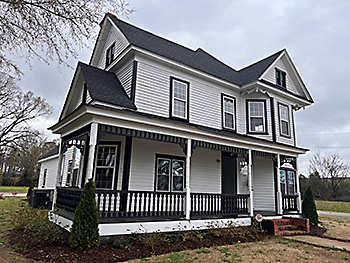
    His home, the E.E. Smith House, is located at 135 Blount Street. The Queen Anne-style house, built in 1902, is located in a historically black neighborhood. Purchased for $100 by Dr. Ezekiel Ezra Smith and his wife, the couple lived in the home for only a short period, eventually renting it out. 
    Still, it holds the enduring history of Smith’s life and work. Now part of the National Register of Historic Places, the upcoming open house is a chance for visitors to be inspired by Smith’s legacy.
    With rich connections to several key black leaders in Fayetteville’s history, both Orange Street School and the E.E. Smith House are bridges to the past. Whether learning what life was like for these figures, hearing of the impact they had on their contemporaries, or observing first-hand their living influence long after their death, these places are opportunities to remember the people who built Fayetteville.
    Attend the Orange Street School open house Saturday, Jan. 24, from 11 a.m. to noon and the E. E. Smith House open house Friday, Feb. 13 and Friday, Feb. 27,  from 10 a.m. to 11 a.m. Both events are free and open to the public, with registration required. 
    Children and adults of all ages are encouraged to attend. Register for either event by calling 910-433-1457.
    (Photo: The E.E. Smith House is a historic landmark in Fayetteville)

  • 10When retired Army Col. Edna Cummings steps into City Center Gallery & Books later this month, she will arrive not only as an award-winning author but as a living bridge between personal memory and national history.
    City Center Gallery & Books, located in historic downtown Fayetteville, will host Cummings on Saturday, Jan. 24, from 3 p.m. to 5 p.m. for a book talk and signing celebrating her memoir, A Soldier’s Life. The book was recently named 2025 Book of the Year by the American Writing Awards, bringing national attention to Cummings’ story of military service and historical advocacy.
    Cummings’ connection to Fayetteville runs deep and will shape much of the discussion during the event. Raised as an Army brat on Fort Bragg in the 1960s, she attended E.E. Smith High School before graduating from Reid Ross Classical School. Those early years, marked by discipline, mobility and exposure to military culture, laid the foundation for a life of service.
    After high school, Cummings enrolled at Appalachian State University and entered the Army ROTC program at a time when few Black students were present on campus and even fewer women were represented. She was the only Black woman in the ROTC program, an experience she credits with strengthening her leadership skills and resolve—qualities that would later define her career as an officer.
    Cummings would go on to serve more than two decades on active duty, rising to the rank of colonel and holding leadership roles across the United States and abroad. During the event, she is expected to speak candidly about navigating military life, single motherhood, personal loss and faith, themes that anchor A Soldier’s Life and distinguish it from traditional military memoirs.
    For Hank Parfitt, owner of City Center Gallery & Books, hosting Cummings reflects the store’s commitment to presenting voices that connect literature with lived experience.
    “Bringing Colonel Cummings to Fayetteville will give our community a chance to engage with someone whose life reflects both service and perseverance,” Parfitt said. “This isn’t just a book signing, it’s a conversation about history, leadership and responsibility.”
    Much of that conversation will center on Cummings’ post-retirement work advocating for recognition of Major Charity Adams and the 6888th Central Postal Directory Battalion, the only all-Black Women’s Army Corps unit deployed overseas during World War II. The battalion was tasked with clearing a massive backlog of undelivered mail for U.S. troops in Europe, a mission critical to morale, yet their accomplishments went largely unrecognized for decades.
    Parfitt said Cummings’ determination to change that narrative will resonate strongly with readers.
    “She saw a gap in our historical memory and committed herself to fixing it,” he said. “Her persistence helped bring long-overdue recognition to women whose service shaped the outcome of the war.”
    Through years of advocacy, fundraising and coalition-building, Cummings played a key role in securing a monument honoring Charity Adams at Fort Leavenworth in 2018 and, later, the Congressional Gold Medal awarded to the 6888th Central Postal Directory Battalion in 2022.
    During the Jan. 24 event, Cummings will discuss her book, reflect on the legacy of the 6888th, and sign copies of A Soldier’s Life. Books will be available for purchase at City Center Gallery & Books, located at 112 Hay St., and may be reserved in advance by calling 910-678-8899. The store recommends early purchase due to expected demand.
    Store hours are 10 a.m. to 6 p.m. Monday through Thursday; 10 a.m. to 8 p.m. Friday and Saturday; and 1 to 6 p.m. Sunday. Downtown parking in city-owned lots and the Franklin Street deck will be free on weekends.
    For Fayetteville readers, the upcoming event will offer an opportunity to engage with a story rooted in their own community—one that stretches from local classrooms to the halls of Congress and continues to shape how military history is remembered.

    (Photo: Edna Cummings, author of A Soldier's Life, will be at City Center Gallery & Books to talk about her memoir and her life in the military. Photo courtesy of City Center Gallery & Books)

  • 9Accusations of secrecy, mismanagement, and withheld documents have fractured the nonprofit Fayetteville‑Cumberland County Dr. Martin Luther King Jr. Committee, putting the future of the taxpayer‑funded MLK Park project in jeopardy.
    Some civic leaders are even calling for committee chair Stanley Ford to resign.
    “I’m hurt and embarrassed by him because of the way that he’s handling this situation,” former committee member Elmer Floyd told Cityview. “All he has to do is show the information that people are requesting.”
    City and county officials warned Friday that unless Ford turns over financial records, bylaws, and membership lists, the MLK Park project could collapse, and millions of taxpayer dollars would have to be accounted for and returned to the state.
    A meeting, called by Fayetteville City Council member D.J. Haire, brought together representatives from the city, county, and the MLK committee. Attendees at Friday’s meeting included council member Malik Davis and Cumberland County commissioners Kirk deViere and Veronica Jones.
    Haire told Ford he expects a full accounting before the city council’s February 2 work session, where the council is scheduled to receive its next update on the park.
    He also urged Ford to provide the same documents to the committee. Several members have said they’ve been left in the dark about the project.
    The MLK committee has a board of directors and a committee of about 30 members led by President Tawanna Branch.
    MLK Park Project Decades in the Making
    The MLK Park project centers on a 120‑foot spire first proposed in the mid‑1990s. The monument would be lit on key dates honoring the late Rev. Dr. Martin Luther King. Over the years, the project has faced repeated setbacks, including the deaths of key advocates and disagreements over where the spire should be built.
    Ford became chair in 2022 after the death of longtime committee leader Wilson Lacy. At that time, the project had secured $2.5 million in state funding. Since then, both the city and county pledged additional support, bringing the total funds for the project to $7.2 million. Once the committee produces bid‑ready construction documents, the county plans to transfer its funds to the city, which will oversee construction.
    In a December article in the Fayetteville Press, Ford said he has spent $352,212 so far.
    Several former and current members said Ford has spent hundreds of thousands of dollars without proper oversight.
    “One of my major concerns is a possibility that some fraud may be taking place,” committee member Rev. Floyd W. Johnson Jr. told CityView.
    In August 2025, Johnson, Floyd, committee treasurer Elison L. Elison, and former county commissioner Charles Evans sent Ford a cease‑and‑desist letter accusing him of:
    • Failing to conduct financial audits.
    • Failing to maintain required officers, including a treasurer.
    • Failing to give proper notice of meetings.
    • Failing to provide timely financial and committee reports.
    • Failing to administer grant funds with transparency.
    Evans, who helped secure county funding for the project, said Ford’s leadership has undermined years of work.
    “It was hell getting the money … For this guy to come along and give such hardship to this community. He needs to go,” Evans said. “If there’s legal action that needs to be taken, so be it, because that’s taxpayers’ dollars.”
    Evans said many committee members are senior citizens and that Ford “has taken advantage” of them.
    “To humiliate the community and to humiliate the name of Dr. Martin Luther King Jr., by carrying this through this turmoil, it’s a shame,” Evans said.
    The letter demanded Ford resign, that a new election be held, and that all financial and operational records be released to the committee. It also warned that Ford’s actions were jeopardizing the spire project and public confidence in the organization.
    While Branch was not part of the group that sent the letter, she told CityView she has repeatedly asked Ford to be transparent about how he has been spending the committee’s funds, and that he has refused to do so.
    Ford denied all of the allegations in response to the letter and to CityView.
    “They are fabricating these stories to you,” he told CityView.
    Ford has accused committee members of holding meetings without him, not returning his calls, and withholding information.
    Ford also said that Floyd and Evans are angry that he turned down their request to pay them as consultants on the project, though he declined to share email records supporting the allegation. Both Evans and Floyd deny they ever asked to be paid and said email records do not exist.
    County Funding on Hold for MLK Park
    County Manager Clarence Grier said the county’s contribution will not be released until Ford provides all requested financial records. The deadline is January 31. The county extended its funding timeline from October 2025 to January to give the group time to produce the documents.
    Ford told CityView he can’t provide certain financial records because he claims they are “confidential” and “a government spreadsheet” that “cannot be copied.”
    DeViere, who wrote the legislation that secured the committee’s original $2.5 million in state funding, disputed Ford’s claim. So did Jones. “That is a lie,” Jones told CityView.
    “Those records are public records,” deViere said. “This committee and the leadership of this committee has to do the things they need to do to bring this project to the city in a bid‑ready package so that it can be built.”
    Jones also questioned Ford’s explanation for postponing the MLK parade, which was scheduled for January 17. Board member Charlissa Davis signed a press release, distributed by Ford, that the parade was indefinitely postponed due to “safety issues.”
    The Fayetteville Police Department said it was unaware of any safety concerns about the parade.
    “What Ford said [about why the parade had to be postponed] was dishonesty,” Jones said.
    Other committee members, including Branch, said they were unaware of any safety concerns and were “blindsided” by the announcement.

    (The MLK Jr. Memorial Park in Fayetteville is located at 700 Blue St. Photo courtesy of City of Fayetteville)

  • 8The Greater Fayetteville Chamber kicked off its first Chamber Coffee Club on Jan. 15 with former North Carolina Governor Pat McCrory discussing North Carolina’s economic competitiveness and workforce development trends through a Q&A session with Chamber President and CEO Nat Robertson. McCrory and Robertson met when Robertson was the mayor of Fayetteville, and Robertson partnered to get bridges repaired after Hurricane Matthew.
    The Government Relations committee of the Greater Fayetteville Chamber also held a reception on Jan. 13 for the Fayetteville City Council, Cumberland County Board of Commissioners and the Cumberland County state delegation.

    City of Fayetteville
    On Jan. 12, the Fayetteville City Council authorized up to $40 million in bonds for infrastructure and public safety projects and the acceptance of a $354,000 grant from the International City/County Management Association for economic opportunity initiatives. Amendments for the Aubrey Hills Apartments loan were approved, and a site on Distribution Drive was rezoned to Light Industrial. Three new subdivision streets were added to the city system for Powell Bill eligibility.
    On Jan. 5, the Fayetteville City Council received a presentation from the Economic and Community Development regarding the redevelopment of the Blount and Gillespie Street site. They were presented with three distinct concepts for the city-owned property, which varied in their mix of public green space, retail and multifamily housing density. Outreach efforts indicated that 61% of residents preferred dense, mixed-use buildings (3–6 stories) while 40% prioritized shaded lounge areas and ADA-accessible natural play spaces. The consensus was to proceed with drafting a Request for Qualifications to vet potential vendors.
    The council will hold its Strategic Planning Retreat on Feb. 3-4.

    Cumberland County
    The Cumberland County Board of Commissioners reviewed a proposed interlocal agreement for Parks and Recreation with the City of Fayetteville. This agreement aims to address financial transparency, fee structures and cost redistribution for shared parks. A formal proposal is expected at their Feb. 12 meeting.
    Fayetteville-Cumberland Parks and Recreation Director Michael Gibson presented a funding request for regional trail expansion to extend the Cape Fear River Trail from the current Fayetteville city limits to Arnette Park. He informed the board that a $1,096,000 FAMPO grant had been awarded for the design of this extension. The project requires a 20% local match of $274,000, bringing the total project cost to $1.37 million. The board unanimously approved the support request.
    Preliminary survey results were also shared regarding a potential joint 911 center with Fayetteville. The joint 911 operations center is one of several options being discussed to address emergency call handling and coordination across the county. The community survey is designed to gather resident feedback on experiences, priorities and considerations related to emergency response and 911 communications, according to county officials. The public comment period remains open through Jan. 25. Residents are encouraged to participate by visiting: www.surveymonkey.com/r/joint911communityinput.
    The board will hold its Strategic Planning Retreat on Jan. 23.

    National Civics Bee®
    The National Civics Bee®, a nationwide initiative led by the U.S. Chamber of Commerce Foundation, will allow middle school students (6th, 7th, and 8th grades) to participate in North Carolina for the first time this year. Through the Greater Fayetteville Chamber, Fayetteville has been chosen as a regional site. Applications for students are officially open, and students have until Feb. 3 to submit.
    For more information about the program, including educator resources and how to participate in the 2026 competition, visit www.faybiz.com/civicsbee.

    About the Greater Fayetteville Chamber
    Advocacy is a cornerstone of the Greater Fayetteville Chamber. Every week, the Chamber dedicates staff to attend City of Fayetteville and Cumberland County meetings as well as monitoring updates on the state and federal levels. We monitor legislation locally, statewide and federally to protect our community’s business interests. With 91% of U.S. adults recognizing a Chamber of Commerce's impact on growth, membership ensures a strong voice shaping policies, driving economic success and building a thriving business community—together. To learn more, visit www.faybiz.com or email jmclaughlin@faybiz.com.

  • 7North Carolina House Speaker Destin Hall (R-Caldwell) had created a 23-member select committee to evaluate potential reforms of the state’s property-tax system. That is a fine idea, a sensible reaction to surging property values and changing fiscal conditions. But members ought not be distracted by out-of-state chatter about repealing the property tax entirely. That is a bad idea, destined to fail.
    Annual levies on the value of residential, commercial, and industries property produce 70% of local revenue in North Carolina. The property tax is stable, reliable, and doesn’t distort economic decisions nearly as much as income or sales taxes do.
    All taxes are paid using past or present income. And all are, by definition, coercive. They take money away from the people who earned it so that governments can fund public safety, infrastructure, education, and other services for which the collective public benefits can be reasonably expected to exceed the costs.
    I’m a fiscal conservative, not an anarchist. I believe government is necessary and provides essential services. I also think government at all levels has a built-in tendency to grow beyond its proper scope, as spending lobbies inside and outside the public sector press for jobs, contracts, and special favors.
    That’s why I favor both legal and procedural constraints on the size of government, including annual expenditure caps based on inflation and population growth as well as referendum requirements for issuing general-obligation debt. Otherwise, the interests of taxpayers will inevitably yield to the machinations of special interests.
    When considering tax alternatives, it’s important not to mix up two different issues: 1) how we should tax and spend, and 2) how much we should tax and spend. Settling one doesn’t necessarily settle the other.
    At any given level of government spending, there are better and worse ways to raise the revenues necessary to finance it.
    For local services in North Carolina, the only practical alternative to the property tax is to raise the sales tax. I might view that tradeoff favorably if North Carolina’s sales tax were broad and efficiently administered.
    It is neither. Even after the General Assembly expanded it more than a decade ago to encompass entertainment, repairs, and some personal services, we still don’t tax medical bills, financial services, and legal services sold to households. Given the lobbying heft of those industries, I doubt the practicality of any plan to pass a genuine retail-sales tax in North Carolina.
    Our property-tax base is too narrow, as well. I don’t think large-scale enterprises benefitting from significant expenditure on public services, such as hospitals and universities, ought to be exempt from the property tax. Again, I’ll remind you that “property” taxes aren’t paid by removing planks or bricks from buildings and chucking them at the tax collector, however tempting that might be.
    They are really a means of taxing the money of people who own property, lease it (apartment dwellers bear much of the incidence of property tax as monthly rent), and work or consume on it (in the form of lower wages or higher prices, respectively). Especially for place-based services such as fire protection and parks, taxes on real estate apportion the costs in a rational manner.
    “The property tax won’t win any popularity contests with homeowners,” wrote Jared Walczak, vice president of state projects at the Tax Foundation, “but it still has an important role to play in public finance.
    Policymakers can and should address taxpayers’ legitimate grievances about out-of-control property tax bills, but they should do so without upending a system of taxation that is more efficient, fair, and pro-growth, and better suited to municipal finance, than any of the alternatives.”
    By all means, let’s make sure North Carolinians can challenge unjust valuations and cash-poor homeowners aren’t dispossessed. Levy limits and circuit breakers make sense. More generally, the General Assembly should continue tax reforms that reduce special carve-outs and broaden tax bases in order to lower tax rates. But replacing property taxes isn’t a realistic option.

    Editor’s note: John Hood is a John Locke Foundation board member. His books Mountain Folk, Forest Folk, and Water Folk combine epic fantasy with American history (FolkloreCycle.com).

  • 4Special Note:
    Again, as tradition will have it, Up & Coming Weekly again proves truth in the cliché: “ Where there is smoke, there’s fire.” Enjoy our perspective on the canceling of the MLK Jr. Parade, then go to page 9 to read Rachel Heimann Mercader’s excellent coverage of this situation in her City View article. Enjoy!
    — Bill Bowman Publisher U&CW

    For more than three decades, Fayetteville has come together each January to honor the life, legacy, and moral courage of Dr. Martin Luther King Jr. The annual MLK Parade organized by the Fayetteville-Cumberland County Martin Luther King Jr. organization, is not just a tradition—it is a civic commitment, a unifying moment, and a reflection of who we aspire to be in our community.
    That is why this year’s abrupt cancellation of the parade is more than a scheduling mishap. It is a profound disappointment to residents, and the Fayetteville community deserves honesty about how we got here.
    The truth appears simple: the parade committee was not organized, prepared, or functioning with the leadership they needed to execute what would have marked the parade’s 32nd year. Instead of acknowledging this, postponing the event, committee member Charlisa Y. Davis sends out a daunting press release implying that the parade was canceled due to community “safety concerns.” This is a claim that is not only misleading but insulting to all the citizens of Fayetteville, including the Fayetteville Police Department, which works hard to keep our city safe. They were not aware of or ever informed of any safety concerns or threats. Even members of the Martin Luther King, Jr. committee were unaware of any safety concerns —or of Davis’s press release itself.
    This raises a troubling question: Why cast a negative aspersion on our community as an excuse when it appears the real issue is internal disorganization? Heaven knows Fayetteville gets enough bad and unfair publicity from out-of-town media.
    The explanation brought forward was that they “didn’t have enough time” to secure permits, restrooms, and security, which is equally baffling. Their former parade organizer, Belinda Bryant, left the organization nearly two years ago. Two years is more than enough time for a functioning organization to regroup, plan, and prepare. Bryant confirmed she had no involvement in the 2025 parade and that other members handled planning last year.
    Let’s be clear: The January 17th MLK JR. parade was not canceled because Fayetteville is unsafe. It was canceled because the Chairman of the Fayetteville-Cumberland County Martin Luther King, Jr. committee, Stanley Ford, failed in his stated responsibilities to do his job. Here is a man, who one year ago, appears on a local community radio show touting how very important the MLK Parade is to the Fayetteville community, then fails to execute it. That failure matters. It matters to the citizens of Fayetteville because the MLK Parade is not a casual event. It is a symbol of unity, progress, and remembrance. It is a day when our community—Black, white, young, old, military, civilian, Democrats, and Republicans—can come together to celebrate the dream Dr. King fought and died for, a dream that is all too often set aside in pursuit of selfish personal agendas.
    To cancel such an event due to internal dysfunction and then attempt to mask that dysfunction behind unfounded claims of public danger is insulting and unacceptable. Even if the parade is rescheduled, the damage is done. A rescheduled event cannot erase the fact that the original celebration—the one that should have honored Dr. King on the national holiday—was lost due to mismanagement. Fayetteville deserves better. Dr. King’s legacy deserves better.
    Our community needs and respects the work of the Fayetteville-Cumberland County Martin Luther King Jr. organization. I hope that its leadership will make the effort to take responsibility and recommit itself to presenting and preserving this parade for future generations, honoring a man who demanded integrity, accountability, and moral courage from all who claimed to lead. Those values are exactly what the committee needs to rediscover.
    Thank you for reading Up & Coming Weekly community newspaper.

  • 6Remember our old friend King Midas? Today, we return to the mystical land of Greek Mythology. What do the Federal Reserve, President Trump, and King Midas have in common? Stick around to learn how King Midas brings them all together into a mélange of greed and power. Sounds boring? No way, Jose. Dead ahead, find a drunken satyr, golden roses, a misbegotten wish, the ears of a jack ass, and Floyd the barber who can’t keep a secret.
    President Trump sicced the Department of Justice to investigate and probably bring criminal charges against Federal Reserve Chairman Jerome Powell over cost overruns on the renovation of the Federal Reserve Headquarters.
    It is no secret that Trump’s fondest wish (other than to scarf up several Nobel Peace Prizes) is to boot Powell out of office so he can install a lackey who will respond to his political pressure to lower interest rates. Fed independence blocks America’s Golden Age.
    King Midas had a rose garden, like the White House’s rose garden, which is now a concrete patio. Midas had the world’s best roses, each sporting sixty blooms.
    People partied hearty back then. One day, Midas stopped to smell the roses and found an old, drunken Satyr passed out in his garden. (Author’s Note: A Satyr has the upper body of a man with goat horns on his head and the lower body of a goat.)
    The Satyr was Silenus, the former teacher and foster father of the God Dionysus. Dionysus was the God of wine, so Silenus came by alcoholism honestly. Midas recognized Silenus, woke him up, and treated him as an honored guest. They partied with adult beverages for 10 days.
    On the 11th day, Midas sobered up and took Silenus back to Dionysus.
    Dionysus was so happy to see his old tutor that he gave Midas a free wish. Midas wished that everything he touched turned to gold.
    Abra Kadabra Alakzam! Wish granted! Midas touched a stick and a stone. Zowie! They turned to gold. Midas was happy as a clam. When he returned home, Midas touched every rose in his garden, turning them to gold like a Grecian Formula Steven Singer. He ordered a feast to celebrate his new power, but uh oh.
    When he tried to drink wine or eat food, it immediately turned to gold, which, while pretty, is indigestible. His daughter came crying into the banquet hall, upset because the now golden roses no longer had their beautiful scent. Midas hugged his daughter to comfort her, unfortunately turning her to gold.
    Midas realized he had not fully thought through his wish for the golden touch. Buyer’s remorse set in. He did not want to starve. He missed his daughter. He asked Dionysus to reverse his wish.
    Dionysus told him to wash in the local river to end the golden touch. He did so, and the river’s sand turned to gold. Midas didn’t want any more gold or riches. He took John Prine’s advice and blew up his TV, threw away his paper, went to the country, built him a home, and ate a lot of peaches.
    One day, Pan, who was a lesser God of music, challenged Apollo, who was the major God of music, to a musical duel like Charlie Daniels’ song “The Devil Went Down to Georgia.”
    The music Judge was a dude named Timolus who smartly named Apollo the winner. Midas was in the audience and loudly claimed that his buddy Pan was the winner. This did not sit well with Apollo.
    Apollo said Midas “must have the ears of an ass” to think Pan was the winner. Immediately, Midas’s ears turned into actual donkey ears.
    Midas was humiliated by being crowned with donkey ears. He hid his ears under a turban so no one would see his shame. Naturally, Midas’ barber Floyd saw his donkey ears when he cut Midas’ hair. Midas told him to keep the ears a secret. Floyd could not keep this gossip to himself. He went out into a field, dug a hole, and whispered into it that Midas has donkey ears. A thick patch of reeds grew up over the hole. The reeds whispered to anyone walking by that Midas has donkey ears.
    Midas became the butt of many donkey jokes by all and sundry. When he could take the ridicule no longer, he drank a Mickey Finn of bull’s blood and arsenic, causing him to expire.
    How does this relate to Trump wishing to control the Fed? If he gets his wish, but the economy tanks due to his putting a flunky in charge of the Fed, Dionysus will not be there to bail him out.
    Be careful what you wish for. Sometimes, you might get it.

    (Illustration by Pitt Dickey)

  • 20To grasp the beauty of a solution, sometimes we have to reverse-engineer the problem that led us to it. And when it comes to learning things the hard way, I’m what you might call a frequent flyer. On this occasion, though, I wasn’t flying—I was driving. To Florida. One way in, one way out. My trip began and ended within a mile of I 95, yet I still had my GPS on—Google Maps on my phone.
    I first learned to navigate by watching my dad unfold those big paper maps you bought at the gas station before a road trip. Lots of red, black, and blue squiggly lines to show you where you were—or at least where you should’ve turned left twenty miles earlier. Later came those spiral-bound atlas books. They felt tidier, and they helped calm my inner traveler (and maybe the family, too).
    Then came the GPS. Those little gadgets had one job, but they did it well. Who can forget, “Make a U-turn when it’s safe to do so”? But now everything’s on the phone. It not only tells us what to do—it asks for our input. “Slow traffic ahead.” “Police reported.” “Left lane closed.”
    Honestly, if it weren’t for all that cool data, I could’ve just asked someone how to get to Florida and been fine: “Head south.”
    I was riding along, content with each update, when a new alert appeared: “Object in road reported ahead.”
    “What kind of object? Which lane?” I scanned the road. Nothing. So I tuned it out.
    Until the truck in front of me swerved.
    And there it was—a three-foot traffic cone dead ahead. Before I could react—bam! Too late.
    Here’s the point: We usually know the difference between right and wrong. We even get warnings along the way—small nudges, gentle alerts. But when no trouble follows, we start ignoring them. We tune them out… until we can’t. Then we replay what we should’ve done differently.
    Maybe the real point here isn’t to fear the warnings—but to thank God for them. He’s not trying to ruin the trip; He’s trying to make sure we arrive safely. So before the crash, before the regret, maybe the wisest move we can make is to simply listen—and steer.

    Editor’s note: Dan DeBruler is a Pastor and teacher, and has served Fayetteville and the surrounding area through Christian radio for more than 25 years.

Latest Articles

  • The Art of Formation
  • Rock’n On the River brings “memory, muscle, music”
  • Colonial ball brings history to life through dance
  • Service Before Self celebrates local heroes with end-of-summer barbecue cook-off
  • Carrying Valor Forward: Medal of Honor Valor Tour connects recipients, reenlisting Fort Bragg soldiers
  • 25th Annual Putnam County Spelling Bee comes to Gilbert
Up & Coming Weekly Calendar
  

Login/Subscribe