
 How to resolve AdBlock issue?







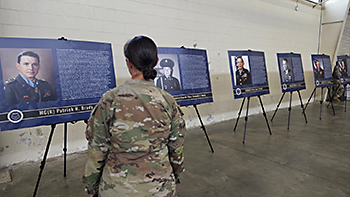
The Fort Bragg stop of the Medal of Honor Valor Tour turned the idea of valor into something lived, shared and carried forward by the soldiers in the room.
Valor is often defined as great courage in the face of danger. But walking into the Medal of Honor Valor Tour at Fort Bragg was a reminder that valor is not simply courage, determination or strength. It is what happens when those things are tested against extraordinary circumstances — when fear is real, sacrifice is required and the possibility of death is no longer abstract.
For the Medal of Honor recipients in the room, that test had already come. Their actions in those moments became part of military history.
That distinction matters.
Courage can be found in many places and in many decisions. Valor is what happens when courage is pushed by the extraordinary.
On Sept. 2, soldiers at Fort Bragg were given the opportunity to see what the result of that test looked like — not in a history book, not only through a citation, but through the men standing in the room with them.
Fort Bragg was called the “center of the universe” more than once throughout the day. The phrase speaks to the installation’s place as home to the Army’s airborne and special operations forces — a place where readiness, response and the possibility of being called into something difficult are part of everyday military life.
That made it especially fitting for the Valor Tour.
Six Medal of Honor recipients had arrived at that “center of the universe” carrying stories of what happened when something extraordinary had already been asked of them.
Before the formal program began, soldiers stopped at displays telling those stories. Photographs, citations and accounts of extraordinary courage lined the walls.
But the men behind them were there.
The six recipients were Maj. Gen. Patrick H. Brady, retired; Col. Walter J. Marm Jr., retired; Command Sgt. Maj. Terry Richardson, retired; Command Sgt. Maj. Gary Lee Littrell, retired; Command Sgt. Maj. Matthew O. Williams, retired; and Spc. 4 Kenneth J. David, retired.
Of the 3,536 service members who have received the Medal of Honor, six were gathered in one Fort Bragg hangar that morning.
When the ceremony began, Lt. Gen. Gregory Anderson, commanding general of XVIII Airborne Corps and Fort Bragg, reminded the soldiers that the recipients had once been young specialists, sergeants and lieutenants standing where they stood.
“Don’t just hear the words,” Anderson told them. “Listen to the heart behind them as well.”
He encouraged soldiers to talk with the recipients, ask questions, share their own stories and “carry a piece of their example” with them.
Anderson also spoke about four points shaping the Army: readiness, warfighting, transformation and people.
In that room, they felt less like four separate priorities than parts of one responsibility.
An Army can prepare, sharpen how it fights and transform how it responds to what comes next. But none of that moves without people — the soldiers who train, lead and make decisions when preparation gives way to something real.
Medal of Honor recipient retired Spc. 4 Kenneth J. David brought the conversation directly to what those people carry with them.
“They were values,” David said of what he considered the most important things he brought home from military service.
He spoke about discipline, responsibility, service, teamwork, respect, honor and courage.
“We often think of courage [as] facing danger without fear, but I have learned that courage comes in many forms,” David said.
Sometimes, he explained, courage is making a difficult decision. Sometimes it is admitting you need help, starting over after something goes wrong or simply getting up and taking the next step.
The Medal of Honor recognizes something extraordinary. But the values beneath those extraordinary acts are not reserved only for the moment that earns a medal.
They are carried.
“The uniform eventually comes off, the years pass, the hair sometimes turns gray, but the values don’t have to disappear,” David said. “They become a part of who you are.”
The ceremony then gave those words a physical reminder.
Shell casings from a salute fired in honor of the Medal of Honor recipients were presented back to them as lasting symbols of the nation’s acknowledgment of their extraordinary valor.
What had first sounded across Fort Bragg as a salute became something they could hold — an acknowledgment of courage already tested, sacrifice already made and valor already proven.
Medal of Honor recipient retired Maj. Gen. Patrick H. Brady then stepped forward before administering the reenlistment oath.
His Medal of Honor recognizes actions in Vietnam that included repeatedly risking his life to rescue and evacuate wounded soldiers.
During his remarks, Brady offered an image that could have easily passed as one powerful thought among many.
I didn’t miss it. I felt it.
America, he explained, has no kings or queens. What it has is a nobility of its own: veterans.
The phrasing created an immediate visual.
Other nations may honor royalty through crowns, titles and inherited position. Brady was pointing instead to people whose distinction came through service.
Veterans.
Brady also spoke about sacrifice. If laying down one’s life for another is among the greatest acts of love, he told the soldiers, then placing yourself in a position where that sacrifice may one day be required carries its own weight.
Standing before him were more than 80 soldiers preparing to choose that position again.
Brady administered the oath, and right hands went up.
The courage represented in that decision is not the same as the extraordinary valor represented by the men standing before them.
It does not need to be for the connection to matter.
Enlisting for the first time is already a choice, whether that decision comes at 18, 20 or 30. Reenlisting comes after basic training, long days, expectations, missed moments, sacrifice and the lived reality of what it means to be a soldier.
The second decision is made with knowledge the first one could not have carried.
These soldiers knew what they were saying yes to, and they said yes again.
After the ceremony, the conversations Anderson had encouraged began.
Medal of Honor recipient retired Command Sgt. Maj. Matthew O. Williams was among the recipients who stayed to share more of his story.
Williams received the Medal of Honor in 2019 for his actions during combat in Afghanistan while still serving on active duty. Receiving the nation’s highest military honor did not mark the end of his Army service.
He stayed.
Williams said he originally planned to serve five years. After finding his place with the Green Berets and the people he trained and served with, he remained for 20.
“Would you join the Army again?” he was asked.
“Absolutely,” Williams answered. “If I wasn’t old and they’d have me.”
That answer landed differently after watching more than 80 soldiers raise their right hands.
Williams said the people and the opportunity to serve kept him in the Army. He wanted to continue doing the work, leading soldiers and serving as long as he naturally could.
The Medal of Honor added another responsibility.
“It’s the heaviest 2-ounce piece of metal that I wear,” Williams said.
The weight, he explained, comes from what it represents and the responsibility of carrying a standard larger than himself.
That responsibility is also part of why the Valor Tour matters to him. Williams described meeting young, motivated service members and hearing how they were preparing to serve as refreshing and a privilege. Sharing his story gives those soldiers something they can carry into their own service.
Then came the voices of soldiers who had raised their right hands.
Devine, a soldier with the 16th Military Police Brigade, was among those reenlisting. His decision came with experience and after spending the day hearing from men whose service demonstrated how far courage, commitment and sacrifice could be tested.
Jawan North, a soldier with the 27th Engineer Battalion, signed on for another six years. It was the first time he had met a Medal of Honor recipient, and he found himself in a room with six.
“It’s just pretty cool to see one of them, see six of them and get to hear what they went through,” North said. “I think that’s a motivation to keep going.”
For North, the uniform is deeply personal.
“It means everything,” he said, adding that he enjoys the opportunity to “teach, train and motivate soldiers.”
North is also the first person in his family to serve. The oath belonged to North, Devine and the other soldiers who raised their right hands. But the room around them mattered.
They had spent the day seeing where courage, commitment and sacrifice had taken the men sitting only feet away. That is where the impact of the Medal of Honor recipients extended beyond the stories told from the stage.
Getting those recipients into the same rooms with soldiers across the country also takes partners.
American Airlines Chief Operating Officer David Seymour said the airline has supported military members, veterans and their families for more than a decade and is participating in its second Valor Tour.
“It’s not just the story; it’s the values that they hold,” Seymour said.
American Airlines’ Flagship Valor makes that connection visible before the recipients ever step off the plane. The aircraft carries a special Medal of Honor livery that Seymour said incorporates six characteristics associated with the medal. The aircraft carried recipients through tour stops including West Point, Fort Bragg and Naval Station Norfolk.
“This is just so important for us to get the Medal of Honor recipients out with the soldiers, so they can hear the stories that they have,” Seymour said.
The Robert Irvine Foundation was another partner helping create that space.
Celebrity chef Robert Irvine, who described himself during the visit as British by birth and American by choice, provided the meal at Fort Bragg. His work on the installation, however, extends beyond one lunch.
Irvine has helped redesign Army dining concepts at eight locations with an emphasis on fresh food — or, as he put it much more plainly, fresh food, “not slop.”
Fort Bragg is part of that effort.
At the time of the Valor Tour, the installation was about 20 days from the expected opening of its new dining hall, designed around that fresh-food approach. His presence offered a glimpse at another Fort Bragg story still unfolding — one that will have its own moment when the dining hall officially opens.
For this story, however, the day came back to courage. Courage can be found in a decision. It can be asking for help, starting again, taking the next step or choosing to raise your right hand one more time.
Valor is different because of what tests that courage. The extraordinary. The danger. The fear. The possibility that sacrifice may require everything.
At Fort Bragg, the Medal of Honor Valor Tour honored men who had already faced that test.
It also allowed the soldiers standing before them to see what remained after the extraordinary moment was over — the values, the service and the willingness to continue giving something of themselves.
Not everyone who witnesses valor will ever face the same extraordinary test.
But those who see what courage can become when tested by the extraordinary may carry its values with them until the moment they are called to use their own.
(Photo: A soldier reads a presentation board about Maj. Gen. Patrick H. Brady, retired, during the Medal of Honor Valor Tour at Fort Bragg on Sept. 2. Photos by Tiffany Haywood)