
 How to resolve AdBlock issue?







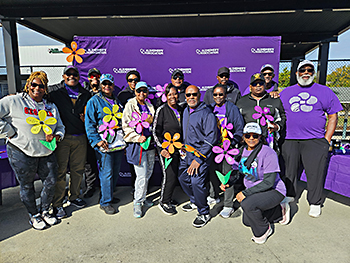
Fayetteville’s Walk to End Alzheimer’s connects personal stories with the support, research and determination driving the fight against the disease.
One mile may not seem like a lot. It is not what you would call a workout. It is not necessarily what you would call a challenge. But when one mile has the ability to carry a family’s story, a family’s hope and a family’s support, that mile means more than the steps it takes to complete it.
On Oct. 24, more than 1,000 people are expected to gather at Segra Stadium for Fayetteville’s Walk to End Alzheimer’s. Each will arrive with a story represented by a Promise Garden flower.
Purple represents someone who has lost a loved one. Yellow is carried by caregivers and those supporting someone living with Alzheimer’s. Orange represents supporters of the Alzheimer’s Association’s mission, while blue is carried by someone living with the disease.
“It is quite surprising just how many blue flowers you’re going to see on walk day,” said Victoria Huggins, senior manager of the Fayetteville Walk to End Alzheimer’s. “It’s so inspiring that so many are brave enough to raise that blue flower high and know they’re not alone in this fight.”
The final flower is white. No participant carries it yet because it represents the hope for the first survivor of Alzheimer’s.
Until that flower can be raised, people like Sara Gilliard Ballard are carrying the stories that explain why the Walk matters.
Known throughout Fayetteville as “Auntie Sara,” Ballard builds, uplifts, supports and encourages others by showing up, sharing and giving.
Her support of the Walk to End Alzheimer’s, however, is different. This one is personal.
Ballard walks for her father, Ulysses Gilliard Sr., better known as “The Mighty Duke.”
“My dad was the baddest dude on the block,” she said.
A Korean War Army veteran and Bronze Star recipient, Gilliard was strong, proud, independent and community-minded. He loved dancing, traveling and following the news. His example taught Ballard the value of serving her community.
When Alzheimer’s entered their lives, it changed the man she knew and made him dependent on her care. It also changed her understanding of her grandmother, whose symptoms had once been dismissed as becoming “senile.” Ballard later recognized that she had likely been living with dementia.
“This became very personal to me,” she said.
The Walk is the Alzheimer’s Association’s signature fundraising and awareness event. Fayetteville’s is one of more than 600 nationwide and 17 in North Carolina. Money raised supports research, advocacy, education and family services.
For Ballard, that journey meant balancing her father’s desire for independence with his need for support. A senior independent living facility gave him his own apartment, structure and check-ins. When he failed to answer one morning, staff found that he had fallen and contacted Ballard. The incident helped confirm that he needed the supervision of memory care.
Ballard said families may believe they can manage every stage at home, but around-the-clock care is more complicated.
More than 210,000 North Carolinians are living with Alzheimer’s, according to Christine John-Fuller, executive director of the Alzheimer’s Association – North Carolina Chapters. More than 338,000 family members and friends provide care for them.
The Association’s 24/7 Helpline, 800-272-3900, connects callers with master’s-level care clinicians and specialists. Using a caller’s ZIP code, they can help locate resources. Assistance may include education about a diagnosis, preparing for difficult conversations, financial and legal guidance, or help as care needs change.
“The Walk is an incredibly powerful day,” John-Fuller said. “It is the jumping-off point for them to realize there’s an entire community to support them.”
That support includes helping families understand what they are seeing. Alzheimer’s is not a normal part of aging. It accounts for approximately 60% to 80% of dementia cases.
Warning signs can include memory loss that disrupts daily life, difficulty completing familiar tasks, problems with planning or solving problems, and changes in mood or personality.
For Ballard’s family, those signs appeared in her father’s home, hygiene, driving and behavior. His refrigerator had become what she described as a “science experiment.” He forgot where he parked his car and eventually began making driving decisions that were no longer safe. At times, he became angry or used language that was unlike him.
“This is not Dad,” Ballard remembers thinking.
The incidents formed a pattern that could not be ignored. Ballard learned to separate the disease from the person she loved.
She now serves on the Walk’s community engagement committee and leads Team Mr. G in honor of her father, grandmother and other families affected by the disease.
“I don’t want to forget,” she said. “Because when you forget stuff like this, you become complacent.”
John-Fuller encourages regular movement, healthy eating, consistent sleep, learning new skills and community engagement. Those habits may support brain health and reduce the risk of cognitive decline, but they cannot guarantee prevention.
The Association-supported U.S. POINTER study, led in part through Wake Forest University, found that lifestyle changes can improve cognition in older adults at risk of decline. FDA-approved treatments are available for people in the earliest stages of Alzheimer’s. Huggins said money raised in Fayetteville is helping “move the needle” toward a world without the disease.
Last year, the Fayetteville Walk raised nearly $182,000. This year’s goal is $205,000, the first time the local event has aimed to surpass $200,000.
Huggins has watched the Walk grow from a few hundred people into an event that turns Segra Stadium into what she calls “a sea of purple.” The Association’s relationship with the Fayetteville Woodpeckers began during the team’s inaugural season.
Fayetteville’s military community extends the Walk’s reach beyond the city. Families have continued participating after being stationed elsewhere, including Germany and Greece.
“It’s not just Fayetteville, but it all leads back to Fayetteville,” she said.
Ballard is raising money and inviting others to join Team Mr. G. On walk morning, she wants the team at Segra Stadium, ready to carry the names and experiences that brought them there.
Check-in begins at 9 a.m., followed by the opening ceremony at 10 a.m. The accessible, one-mile route welcomes participants of all ages and abilities.
Walkers will leave Segra Stadium, travel through downtown Fayetteville and return through the right-field gate before finishing near home plate. Those unable to complete the route can remain inside the stadium and welcome participants as they return.
The day will include the Promise Garden, a tribute wall, children’s activities and local performers. Cheerleaders will carry pom-poms matching the flower colors, including one white pair representing the future everyone is working toward.
Advance registration is encouraged at alz.org/Walk, although on-site registration will be available. Parking will be available in the Hay Street parking garage, and the event is dog-friendly.
One mile cannot erase a diagnosis or undo what a family has endured. But it can carry a name, a memory, a lesson and a promise.
For Ballard, stepping forward is part of honoring the people whose stories she carries.
“You lead from the front,” she said.
At Segra Stadium, each step will help carry Fayetteville closer to the day when someone can raise the first white flower.
(Photo: Attendees at Fayetteville's Walk to End Alzheimer's in 2025 pose with flowers from the Promise Garden. Photo courtesy of Joseph Dwyer)