
 How to resolve AdBlock issue?






The Arts Council's Creative Impact Cohort pairs funding with mentorship and professional development, helping artists like Sterling James bring creative visions to life.
Sterling James has been a musician for nearly as long as he can remember.
At age 9, he picked up the violin, but it wasn’t until he discovered the flute that music truly began to make sense. What followed was a pursuit of understanding music’s history, development and evolution.
"I've always had a thing for music," James said. "It just made me feel more at home anytime I practiced or performed."
That passion eventually inspired an idea: creating a recital that would teach audiences about the history and development of music, not through a lecture, but through live performance. When James learned about the Arts Council of Fayetteville/Cumberland County's Creative Impact Cohort Grant, he saw an opportunity to bring that vision to life while sharing years of musical knowledge with fellow artists and the community.
"This was actually the first grant I ever applied to," James said. "And lo and behold, I actually got it."
The Creative Impact Cohort Grant grew out of a pattern Arts Council staff noticed during the grant application process. Talented artists had strong creative ideas but often lacked the tools needed to write competitive grant applications, develop project budgets and professionally present their work.
"We saw a need for artist development," said Kashia Knight, arts education manager for the Arts Council. "How to write a grant, how to understand the budget, what is an artist's CV, how to best represent their work. These were the things that they were lacking in our mini-grant application."
Rather than ending when grant funding is awarded, the program continues for six months with workshops designed to help artists develop professionally. Monthly sessions cover topics including project management, budgeting, taxes, marketing, promotion, networking and social media while helping participants build sustainable careers as artists.
"The cohort model is important because it includes both emerging and established artists who seek to expand their artistry," Knight said. "They're able to learn together, be accountability buddies and be a resource to one another, creating those lasting networks of artists."
"It gave me a new sense of how to approach things and set things in motion," James said.
For James, one of the most valuable parts of the experience wasn't financial.
"I love my cohort members as well. I got to meet new people and new friends, and now I'm able to connect with other people as far as business is concerned."
Knight said fellow cohort members connected James with other musicians and resources that helped move his recital forward.
Now in its second cycle, the six-month program continues the Arts Council's effort to pair grant funding with long-term artist development. Participants meet monthly for workshops on project management, marketing, networking and other professional topics while developing the projects they proposed as part of their applications.
The cohort is just one part of the Arts Council's broader mission to support artists throughout Cumberland County.
"We care about individual creativity," Sarah Busman, Vice President, Arts Council of Fayetteville/Cumberland County, said. "We want to make sure that we're fostering lifelong learning of the arts ... and we want people to come to Fayetteville and experience the arts."
That commitment also extends beyond the cohort through Arts XL, the Arts Council's arts accelerator at 214 Burgess St. The facility provides workspace for small nonprofit arts organizations, rehearsal and performance space, educational programming and practical resources that help remove barriers for artists and arts organizations.
"It's an opportunity," Busman said. "It's a sort of co-working space for a couple of our very small nonprofit art organizations where they needed a space to work."
She said Arts XL also provides workspace, performance space, educational programming and practical resources that help remove barriers for artists and small arts organizations.
Knight hopes the impact of the cohort reaches far beyond the artists selected each cycle.
"My hope is to increase arts education and artistic excellence in this community through education and self-sustainment," Knight said. "I want people to know these resources exist for them to explore as well and that they, too, can envision themselves in this space."
The experience has already reshaped his approach to music.
"It has taught me to actually become more organized with my practice and to delve more deeply into what I thought I already knew."
That growth will be on display Saturday, July 18, when James presents "The History of Music: History & Development" at 1 p.m. at Arts XL, 214 Burgess St. Admission is free, and no registration is required.
James designed the recital to teach a history of music through performance rather than lecture.
"Not a lot of people can sit there and go through a lecture," he said. "Whereas a lot of people can sit and observe what they hear. That's why I decided to do a concert recital instead of actually just doing a regular lecture."
On July 18, James hopes audiences leave with more than an appreciation for music. He hopes they leave with a deeper understanding of the history behind it.
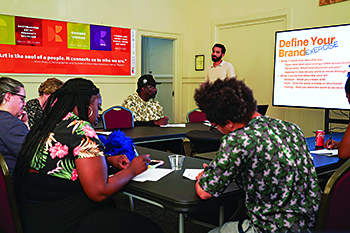
(Photo: Sterling James hosts a Creative Cohort workshop at the Arts Council of Fayetteville/Cumberland County. Photo by Tiffany Haywood)