
 How to resolve AdBlock issue?







Need doesn't have one identifiable look.
It can be the unhoused person seen along the road during a daily commute. It can also be the person sitting nearby in a doctor’s office or standing ahead in line at the bank. Need comes in different forms. It has no respect for a person's appearance, position or circumstances.
I learned that firsthand while reporting on the YMCA of the Sandhills' SUN Meals To Go program, where feeding families is only one part of the impact being made.
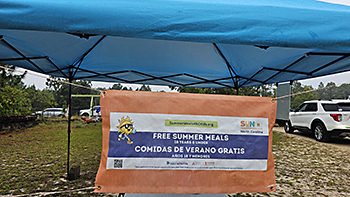
Operating through the USDA Summer Food Service Program, SUN Meals To Go provides children and teens 18 and younger with seven breakfasts and seven lunches each week through a rural non-congregate meal model. Instead of requiring families to travel daily or remain on site to eat, they can pick up a week’s worth of meals in one visit.
For Chealsea Sias, youth development director for the YMCA of the Sandhills, feeding families begins with removing barriers.
Transportation, fuel costs, work schedules and accessibility can prevent families from reaching traditional meal sites. The weekly distribution was intentionally designed to remove those obstacles.
"You can just show up as you are," Sias said. "It's the one thing that we found kind of meets the community needs without asking the community to do too much to get fed."
That flexibility extends beyond parents. Meals are distributed by household rather than requiring the same adult to pick them up each week.
A grandparent caring for children while a parent works can pick up meals. So can another trusted caregiver. Sias recalled one woman who regularly picked up 14 meal boxes because she helped care for several foster children in her community while their families worked or managed disabilities. It was another reminder that every family’s story is different.
That same lesson surfaced during one distribution when a teenage volunteer noticed what appeared to be an expensive SUV waiting in line.
The teen questioned why someone driving such a vehicle would need free meals.
Rather than correcting him, YMCA of the Sandhills CEO Jeff Darling invited him to ask the family about their situation.
The SUV had been borrowed because the family’s own vehicle had broken down. They had four children with special needs and relied on the meal program to help feed their family throughout the summer.
As they walked away, Darling asked the teen what he had learned. He recalled the teen replied with, “I won’t judge anybody in this line again.”
That willingness to look beyond first impressions is one of the lessons YMCA leaders hope their teen volunteers carry with them long after summer ends.
I saw that same commitment firsthand when I visited the distribution site at Word Education Church in Lillington on a rainy Thursday afternoon. Before making the drive, I contacted Sias to confirm the distribution would still take place despite the weather.
Her answer was simple.
The distribution was still happening.
When I arrived, I crossed paths with Sias as she headed out to purchase additional ponchos for the teenage volunteers. Rather than canceling because of the rain, the team adapted. Soon afterward, vehicles began lining up as families arrived for the meals they had come to depend on.
The program has grown dramatically since launching last summer. What began as a pilot expecting roughly 50 meal boxes per week now averages about 520 boxes weekly, surpassing its projected meal total within the program's first month. More than 1,000 meal boxes arrive every other week, and teen volunteers have developed an efficient assembly-line system to prepare, organize and distribute them.
Among those volunteers is Kilry Yarbrough, a 15-year-old student at Freedom Christian Academy who is in his fourth summer with the YMCA. After beginning as a Leader in Training, he is now a Counselor in Training and hopes to mentor younger participants. While volunteering fulfills community service requirements, Kilry said the experience has reinforced lessons his parents taught him long before he joined the program.
“My parents have always preached to me that we’re lucky to have what we have and not to be selfish because not every other family has what they need,” he said.
For Darling, the program's success isn't measured only by the number of meals distributed. It's also measured by the young people who return each year to serve others.
As the YMCA meal distribution prepares to expand into Cumberland County, teens from Cumberland are already volunteering alongside those in Harnett County, learning the system and preparing to help lead future sites.
“Teens mentoring teens has far more impact than adults mentoring teens,” Darling said. “That’s really the goal behind it.”
By the end of my visit, I realized the story of SUN Meals To Go wasn't simply about the meals inside each box.
It is about what happens when a community refuses to let distance, transportation, assumptions or even bad weather keep people from helping their neighbors.
The next time you think you know what need looks like, take a moment to consider the story behind what you see. Then ask yourself how you can help—whether by volunteering, donating or simply sharing information about programs like this one.
“We should never be surprised to learn of people’s needs around us,” Darling said. “We get so lulled into our day-to-day activities and so self-consumed that we don’t see the person in need that’s right next to us.”
(Photo: Families line up at Word Education Church in Lillington to receive a week's worth of breakfasts and lunches through the YMCA of the Sandhills' SUN Meals To Go program. Photo by Tiffany Haywood)