
 How to resolve AdBlock issue?







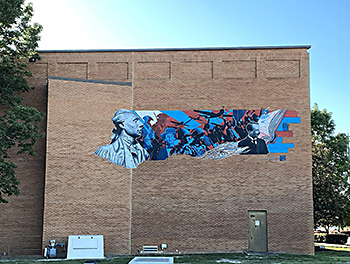
A mural can do something a textbook cannot. It can meet people where they are.
On the side of Cumberland County’s Headquarters Library, Fayetteville’s America 250 mural turns local history into something residents can encounter on the way to work, during a walk downtown or before stepping inside the library. Artist Max Dowdle designed the piece to do more than commemorate a milestone. He wanted it to make people curious about the city they call home.
“I wanted viewers to see that America’s story is made up of many voices, struggles and acts of courage across generations,” Dowdle said.
The mural, located on the Ray Avenue side of the Headquarters Library, is part of Cumberland County’s celebration of the nation’s 250th anniversary. It was supported through the America 250 North Carolina initiative and reflects the county’s broader effort to connect national history with Fayetteville’s own story.
Rather than center the piece on one person or one moment, Dowdle created a visual history that stretches across generations.
The Marquis de Lafayette represents Fayetteville’s connection to the Revolutionary era. But the mural also includes figures such as author Charles W. Chesnutt and Lewis Sheridan Leary, along with soldiers and activists whose lives reflect later chapters in the city’s history.
“My hope is that people leave recognizing that Fayetteville has been part of a larger American story that is still unfolding today,” Dowdle said.
For Dowdle, the project was personal as well as historical.
“I lived in Fayetteville when I was very young, so it’s always had a special place in my heart,” he said.
That connection deepened as he researched the city and its past. What stood out, Dowdle said, was how often Fayetteville found itself connected to larger moments in the American story.
“What stood out was Fayetteville’s deep connection to pivotal moments in American history and its role as a crossroads of different experiences and perspectives,” he said.
Lafayette remains one of the city’s most recognizable historical names, but Dowdle said he was equally interested in those who continued working toward the country’s ideals long after the Revolution. That decision gives the mural a broader purpose.
It does not present American history as something completed in 1776. Instead, it invites viewers to consider what came afterward: abolition, literature, military service, activism and the continuing struggle to define freedom and citizenship.
“Fayetteville’s history is rich, layered and uniquely suited to a mural that bridges past and present,” Dowdle said.
Public art is especially suited to that kind of storytelling.
Museums and historical collections preserve important records, but people usually have to make a decision to visit them. Murals work differently. They become part of the streetscape and place history directly in front of people who may not have been looking for it.
“Murals bring stories into everyday life,” Dowdle said. “People encounter them while going about their daily routines, often sparking curiosity about the histories and people depicted.”
That curiosity is part of what gives public art its value.
A child may notice a face and ask who it is. A longtime Fayetteville resident may recognize a name but learn a part of the story they never knew. A visitor may leave with a broader understanding of the city beyond its modern military identity.
“They serve as accessible entry points into local history, encouraging learning and conversation,” Dowdle said. “By placing history in public spaces, murals help keep those stories visible and relevant for future generations.”
The Headquarters Library is a fitting home for that mission.
The library, located at 300 Maiden Lane, is celebrating its 40th anniversary this year and has become one of the centers of Cumberland County’s America 250 programming. The library’s Local & State History Department has also worked to expand public understanding of the area’s Revolutionary-era history through programs and research projects tied to the Liberty Point Resolves.
Dowdle said the location made sense from the beginning.
“The library is a civic space dedicated to learning, discovery and public access to knowledge,” he said. “It welcomes people from all backgrounds, making it an ideal location for a project centered on history and community.”
In that way, the mural extends the library’s mission beyond its doors.
“The mural extends that mission beyond the building’s walls,” Dowdle said, “and invites visitors to engage with history before they even step inside.”
That may be what makes the project especially fitting for America’s 250th anniversary.
It does not ask Fayetteville simply to celebrate the past.
It asks people to look more closely at it.
And in a city whose history includes revolution, literature, military service, abolition and activism, the mural serves as a reminder that Fayetteville’s story has never belonged to one generation alone. It is still being written.
Visit the Cumberland County website for more information - https://www.cumberlandcountync.gov/departments/library-group/library/america-250-nc/america-250
(Photo: The finished America 250 mural on the side of the Headquarters Library at 300 Maiden Lane, celebrates Fayetteville's place in American history. Photo courtesy of Cumberland County Library)