
 How to resolve AdBlock issue?







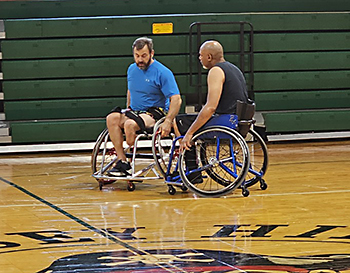
With nearly 30 years in wheelchair basketball, Coach T is passing on the game while leading a 19-2 team toward nationals and a Nov. 7 community fundraiser.
Adaptive sports first came onto my radar a few months ago during a conversation with Katie Smart of Cumberland County Parks and Recreation. She briefly told me about the Fayetteville Flyers and the story of Coach T.
What she told me was enough to make me know I needed to learn more.
A few months later, that curiosity brought me inside the gym at Massey Hill Classical High School. From that viewpoint, the story looked a little different.
Basketball chairs were lined up beside the green bleachers. Players moved smoothly across the hardwood. Basketballs bounced across the floor as drills began. In the middle of it all was Coach T, setting up cones, correcting technique, talking players through drills and preparing a team coming off a 19-2 season.
What stood out to me was that after a few minutes, I wasn't really focused on the chairs anymore.
I saw a basketball team, a team working together, communicating and supporting one another from one play to the next.
Once I had the chance to sit down with Coach T, I understood a little better why the team looked the way it did.
Coach T has been part of wheelchair basketball for roughly 30 years. His path through the sport has included teams in Fayetteville, Lumberton and Raleigh, along with the starts, stops and restarts that came as teams formed, folded and eventually formed again.
That path ultimately brought him back to Fayetteville.
Somewhere along the way, people began treating him like a coach before he officially became one. He said people would sometimes approach him assuming he was the coach because of how vocal he was and how he carried himself on the court.
There is something about a leader that tends to stand out from the rest, and Coach T appears to have grown into the role long before he held the title.
“I just enjoy teaching somebody, just passing on the skills and the knowledge that I already know to help make somebody better,” he said.
He is still active on the court, but now decades of experience are also being passed to those coming behind him.
He spoke specifically about the need to bring younger players into the Flyers as some of the team's longtime players get older. Building for the future, in this case, means making sure another generation learns the game well enough to keep playing it.
Watching practice made it easy to see what that teaching looks like.
Coach T set cones across the floor for drills. He worked directly with players on movement and technique. At other moments, he watched from the side of the court, giving instructions and making corrections as the players worked.
When he watches practice, he said he is looking at shooting technique, chair skills and whether players are understanding what he is trying to teach them.
“Your body becomes one with a wheelchair when you're playing,” he said.
That statement took me right back to what I had noticed while watching practice.
I stopped seeing chairs moving around a basketball court. I saw basketball players moving through drills, reading one another, adjusting and competing.
And Coach T's players aren't only learning. They're winning.
The Flyers finished last season 19-2 after two previous losing seasons. Coach T said he could see pieces of the team's growth throughout the season, but it became especially evident during the conference tournament. Players began making timely defensive plays and producing baskets when the team needed them most.
But his coaching does not stop with shooting, movement and game strategy.
He watches attitude just as closely as technique because he knows whatever happened in a player's life before entering the gym does not automatically disappear when practice begins.
“I'm not just a coach for basketball, but I'm here to give a listening ear,” he said.
He talked about younger players, players adjusting to life after an injury and the importance of being around people whose individual circumstances may be different but who understand pieces of the same journey.
The team includes players whose disabilities came through different circumstances, including gunshot injuries, a motor vehicle accident and amputation. Coach T spoke about how sharing those experiences can matter, especially for someone who may otherwise begin isolating after an injury or major life change.
“What you learn here can prepare you to the next step in life,” he said.
That makes “coach” mean more than the person running practice.
Coach T knows what it takes to compete because he has competed. He knows the technical side of wheelchair basketball because he has spent decades playing it. He also knows there are moments when a player needs something that cannot be taught with cones and drills.
Now the team he is helping build has its sights set beyond Fayetteville.
The Flyers are working toward the national tournament in Phoenix, Arizona. Getting there will require support beyond the players on the court, and Coach T said the team is raising money to help make the trip possible.
That brings this story back to where mine started: learning that adaptive sports opportunities were here in Cumberland County at all.
Access to adaptive recreation is one part of the story. What happens after someone finds that access may be the bigger one.
For the Flyers, it has meant developing players, competing at a higher level, mentoring those coming behind them and turning two losing seasons into a 19-2 record. Now, they are looking toward nationals.
The Flyers will host the Wheelchair Basketball Church Fundraising Event Nov. 7 from 1 to 4 p.m. at Massey Hill Classical High School, 1062 Southern Ave. in Fayetteville. Coach T said participating churches will provide three volunteers who will join two Flyers players to form a team. The teams will compete against one another while raising money toward the Flyers' trip to nationals. Admission is free, donations are welcome and concessions will be available.
For Coach T, though, the larger message is not limited to one fundraiser, one season or even one trip to nationals.
“You may see me with a disability, but I have an ability that comes out of my disability,” he said.
After watching him coach, I understood exactly what he meant.
Coach T knows what it takes to become one with his chair. He knows what it takes to compete, work through challenges and continue learning the game. He also knows what it is like to be the player receiving instruction because he spent decades being that player.
Now he is taking what those years taught him and giving it to somebody else. That may be the most important part of his transition from player to coach.
He is not simply building a team for this season. He is helping make sure there is a team for the seasons that come next.
(Photo by Tiffany Haywood)