
 How to resolve AdBlock issue?





 Let us now praise the most famous man born on Feb. 4, 1819. Come and admire Norton 1, the first Emperor of the United States. Coincidentally, this column’s stain on world literature will appear in print on Feb. 4, 2026, only 207 years after his birth. Better late than never. Today, we salute this great but forgotten man. It is said that history repeats itself. But that would be wrong. Sometimes it does rhyme. There are certain resonances between the reign of Emperor Norton and our own current Fearless Leader, President Trump. Let’s see if you can find them.
The Emperor Norton 1, AKA Joshua Abraham Norton, declared himself Emperor of the United States in 1859. Unsurprisingly, Norton 1 was a resident of San Francisco at the time he became Emperor. San Francisco is famous for attracting colorful individuals. Norton also pronounced himself the Protector of Mexico. Hark the sound of history rhyming, as our current Fearless Leader has declared himself the Acting President of Venezuela, and soon to be the Protector of Greenland, Canada, the Army/Navy football game time slot, some lady’s Nobel Peace Prize, and Minneapolis. Delusions coupled with Executive Directives can be fun.
Only one other person born on Feb. 4 rivals the greatness of Emperor Norton. Our old pal, Ferdinand Magellan born in 1480. Magellan gets credit for being the first to sail around the world in 1522. Coincidentally, he sailed through the Strait of Magellan at the bottom of South America. The odds of Magellan sailing through a Strait named after him are astronomical, yet that is what he did. Kudos. Only Lou Gehrig contracting a disease with the same name as his comes close.
I digress, back to Emperor Norton. After declaring himself Emperor, he issued several fun Imperial Decrees (now known as Executive Orders) during his reign from 1859 to his death in 1880. He issued his declaration of Emperorship announcing to the Citizens of the Union: “At the request and desire of a large majority of the citizens of these United States, I declare and proclaim myself Emperor of the United States and direct the representatives of the different States to assemble in Musical Hall to make such alterations in the existing laws of the Union as may ameliorate the evils under which this country is laboring.” Norton didn’t need no stinking elections to be Emperor. He saw his duty, and he did it. He was restrained only by his own sense of morality.
One of Norton’s first Imperial Decrees was to abolish Congress. He issued a Decree to the US Army to arrest and remove all members of Congress. A little martial law is like eating peanuts. It’s hard to stop at just one Imperial Decree or Executive Order. Bet you can’t Decree just once. His next Decree abolished the United States, making America a temporary monarchy with him as Emperor. He directed the Catholic and Protestant churches to ordain him as Emperor. Sadly, neither the Army nor the churches followed his Decree. He abolished both the Republican and Democratic parties as he was “desirous of allaying the dissensions of party strife now existing within our realm.”
Norton was not going to suffer lightly any insults to his Capital city of San Francisco. He issued a Decree that anyone who “shall be heard to utter the abominable word ‘Frisco’ shall be deemed guilty of a High Misdemeanor and shall pay into the Imperial Treasury as penalty the sum of twenty-five dollars.”
Like our current President, Norton was not just a builder of dreams; he saw the need for infrastructure as well. Norton decreed that a bridge should be built between San Francisco and Oakland. Eventually, his architectural imagination came into fruition in the form of the Golden Gate and Bay Bridges. There remain current but unsuccessful efforts to rename the Bay Bridge the Emperor Norton Bridge.
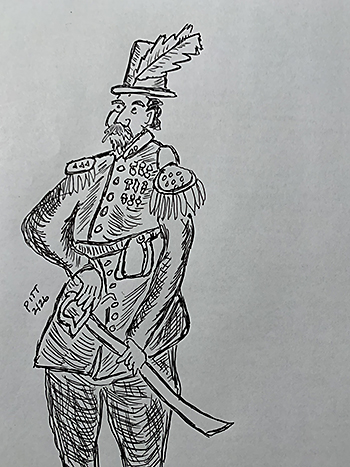
Norton dressed as an Emperor. Military friends donated a uniform to him, which he decorated with various unearned medals, a beaver hat festooned with ostrich feathers, and a fancy walking stick that Bat Masterson would have envied. He roamed the streets, accepting free meals, having edicts printed in the San Francisco paper, and meeting with his subjects to discuss matters of the day. In 1867, he was arrested and underwent an involuntary commitment to determine if he was insane. His arrest caused a huge backlash from his subjects.
A local paper opined: “He has shed no blood, robbed no one, and despoiled no country; which is more than can be said of his fellows in that line (of politics).” The uproar was so great that the San Francisco police chief ordered him released and issued a public apology for the indignity heaped upon the Emperor. Showing regal mercy, Norton issued an Imperial Pardon to the policeman who arrested him.
Unfortunately, even benevolent Emperors cannot live forever. Norton 1 collapsed on a street corner and passed away before he could be taken to a hospital. Now, like Abraham Lincoln, he belongs to the ages.
(Illustration by Pitt Dickey)