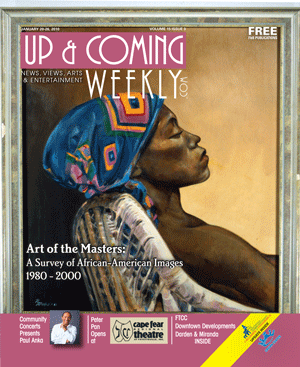
 It’s rare that a body of original works of art is exhibited in Fayetteville, N.C.
It is rarer still, that our community has the opportunity to experience, fi rst hand,
the expansive richness and diversity of African-American art in one exhibition.
Art of the Masters: A Survey of African-American Images, 1980-2000 is such an
exhibit and opens Jan. 22 during 4th Friday at the Arts Council of Fayetteville and
Cumberland County at 301 Hay Street.
It’s rare that a body of original works of art is exhibited in Fayetteville, N.C.
It is rarer still, that our community has the opportunity to experience, fi rst hand,
the expansive richness and diversity of African-American art in one exhibition.
Art of the Masters: A Survey of African-American Images, 1980-2000 is such an
exhibit and opens Jan. 22 during 4th Friday at the Arts Council of Fayetteville and
Cumberland County at 301 Hay Street.
After opening at the Schomburg Center for Research in Black Culture in
New York City, Fayetteville is the traveling exhibit’s only stop in the Southeast
before moving on to Chicago. How the exhibit was scheduled to stop in
Fayetteville is equally relevant — especially when the economy remains a
signifi cant concern for people and businesses.
The Back Story
For Calvin Mims, arts services director at the Arts Council, and Dwight
Smith, instructor of painting at Fayetteville State University, it all began with an
outing last year to the North Carolina Art Museum in Raleigh. The men were
attending a social event hosted by the Durham Friends of African and African-
American Art to unveil the newly purchased sculpture titled Tippy Toes by Allison
Saar at the museum. A crowded event, Mims and Smith left with the idea that
Fayetteville was ready for such an organization.
With the support of Deborah Mintz, president of the
Arts Council, Mims created a steering committee to plan
events and begin the fundraising for the Arts Council’s
new affi liate — Fayetteville’s Friends of African and
African American-Art, known as FAAA.
What began as an effort by Mims, Smith and the
steering committee to collect $25 memberships for the
FAAA grew into major sponsorships by local businesses
and an institution of higher learning to make it possible
for Art of the Masters and its suopporting events to
become a reality in Fayetteville.
Art of the Masters is touring exhibit through the
National Conference of Artists, Michigan Chapters.
Specifi c to the exhibition, Mims had this to say, “The
purpose of bringing the Art of the Masters exhibition
to Fayetteville is to continue our mission at the Arts
Council of educating the community of the breadth
and depth of contemporary creativity in the African-
American community.”
The Exhibit
Visitors to Art of the Masters will experience fi rst hand, the “depth and
breadth” of four generations of artists in the African-American community by
seeing more than 60 original works of art from 36 national and international
artists. Original works by most of the major African-American artists already
included in art-history texts are on exhibit. Works by John Biggers, Elizabeth
Catlett, Jacob Lawrence, Robert Colescott, Betye Saar, Benny Andrews, David
Driskell, Sam Gilliam and many others are there for visitors to the Arts Council
to view not just once, but several times.
To view such a renowned group of internationally known artists is to
celebrate the importance of these works. Halima Taha, art historian at
the Museum of Modern Art, best states this opportunity in the exhibit’s
catalogue introduction: “Within the concluding quarter of the 20th century,
African-American art — specifi cally functioning within the collective activity
of artists, dealers, collectors, curators, auction houses and critics — has
become the most actively sought work by private and institutional collectors
worldwide. Major collectors of American art are recognizing the historic
and aesthetic gaps in their American art collections; and African-American
artists are combining a rich and diverse blend of aesthetic traditions from
Africa, Asia, Europe, the Caribbean and the Americas. Consequently they
are attracting an international audience of collectors to a varied aesthetic
with a historic precedent since 1793.”
The varied aesthetic Taha refers to will become immediately obvious. The use
of patterns in the works of Frank Smith, Murray Norman DePillars, Willis “Bing”
Davis and Shirley Woodson are in contrast to the watery abstraction of Samella
Lewis, the stark realism of Hugh Grannum, or the fl oating “Mumbo Jumbo” of
Betye Saar.
The Educational Component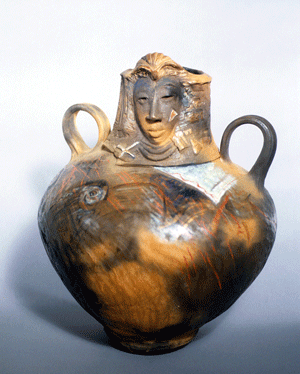
Rosenthal Gallery, on the campus of Fayetteville State University, partnered
with the Arts Council to host an educational component to the exhibition. Thirty
educational panels about most of the artists have been prepared and installed at
Rosenthal Gallerty to educate visitors about the artists, including quotes from the
artists, biographies, their infl uences and references to the styles of each artist.
Visitors to Rosenthal Gallery can read information about the works before
or after they visit the Arts Council to see the original works. While seeing the
abstracted fl oating iconographic symbols of Betye Saar, the educational panel
includes a quote from the artist’s Web site which gives us insight into her
purpose: “I am intrigued with combining the remnant of memories, fragments
of relics and ordinary objects, with the components of technology. It’s a
way of delving into the past and reaching into the future
simultaneously.”
In the case of Sam Gilliam, visitors will learn that he was
part of the late abstract expressionist movement that took
place with a group of painters in Washington, D. C. Gilliam
is attributed as the fi rst artist to paint on stretched canvasses
that hung without the support of stretcher bars.
Collectors, art patrons and students of art history
will be familiar with the themes of Robert Colescott —
satire and social commentary on race, sex and interracial
relationships. But it is North Carolina native John Biggers,
who is most known in this region by the general public.
Biggers was born in 1924 and is one of the pillars of
modern African-American art.
An example of the information you will discover about
John Biggers in Rosenthal Gallery is the following: “…
Biggers became interested in the continent of Africa while
attending Lincoln Academy. The principal, previously a
missionary in West Africa, urged his students to learn and
value African culture. Biggers later attended Hampton
Institute, where his Professor Viktor Lowenfeld, a Jewish
immigrant from Nazi Germany, re-enforced in him the signifi cance of studying
his African heritage. Lowenfeld also introduced him to the art of the Mexican
muralists, a style for which he is best known. While at Hampton, artists and
intellectuals such as Charles White and Elizabeth Catlett, Hale Woodruff and Dr.
Alain Locke infl uenced Biggers’ work.”
His quote on the educational panel in Rosenthal Gallery refl ects the teacher
in Dr. John Biggers: “I … see art not primarily as an individual expression of
talent, but as a responsibility to refl ect the spirit and style of Negro people. It
became an awesome responsibility to me, not a fun thing at all.”
For many that quote rings true, particularly today, about the need for artists,
people in a community and agencies in a community to be responsible for, as the
artist Romare Bearden once said, “Adding to our existing concept of reality.”
Parallel to the meaning of the words of Bearden, Dr. James Anderson,
chancellor of Fayetteville State University, had this to say about the Art of the
Masters exhibit and the educational component in Rosenthal Gallery, “Few
things are more wondrous than the moment when the image of an artist moves
the spirit and opens a new reality to a viewer. The work of each of these
renowned artists represents a national treasure that serves as visual evidence of
the vast range of the human experience. Savor the complexities of color, form
and fi gure with a child’s inquisitive eye and each picture will have a differentmeaning for each viewer.”
The Lecture Series
Another educational component of the Art of the Masters includes a series of
lectures scheduled at Rosenthal Gallery and the Arts Council during the exhibit
by local university art professors. The Chancellors’ Distinguished Speaker
Series at Fayetteville State University is sponsoring a special event, a lecture in
Seabrook Auditorium by the historically important artist David Driskell.
Driskell is a renowned painter, collector of art and is one of the leading
authorities on the subject of African-American art and the black artist in
American society. His paintings can be found in major museums and private
collections worldwide. \Driskell has written several books. His essays on
African-American art have appeared in major publications throughout the world,
and he has written more than 40 catalogues for exhibitions he has curated.
Although Driskell is known for many achievements, since 1977 Professor
Driskell has served as cultural adviser to Bill and Camille Cosby as the
curator of the Cosby Collection of Fine Arts. In 2000, in a White House
Ceremony, Professor Driskell received the National Humanities Medal from
President Bill Clinton.
In addition, a lecture and book signing by Driskell for local- and regionalart
students at colleges and universities has been scheduled at the Arts Council.
The Arts Council is also sponsoring activities for children and has developed a
study guide.
The Schedule
Art of the Masters is a different type of exhibit in Fayetteville that runs from
Jan. 22 to March 6. It is not something you visit once, people in the community
and the surrounding counties have two months to return the Arts Council
or Rosenthal Gallery to refl ect on how, according to Chancellor Anderson,
“An artist moves the spirit and opens a new reality to a viewer.” In addition,
throughout the months of January to early March many free events have been
planned around the exhibition.
Being highly aware of all the effort and work that went into the fi rst year
of FAAA, resulting in the Art of the Masters and its scheduled events, it’s easy
to take the bigger picture for granted. Mintz stated, “The most wonderful part
of FAAA and the exhibit is that it is truly a community endeavor. People from
the community came together to raise the money for the exhibit, develop the
activities and create the educational components — every piece was planned
and undertaken by individuals in the community. It is a community production,
sponsored by the many individuals who joined the $25 membership and
sponsors from organizations and businesses.”
All the activities are free and open to the public. For a complete list of the
events, visit www.TheArtsCouncil.com. Call the Arts Council
at 910-323-1776 for information or to schedule a time to
have a large group tour Art of the Masters at the Arts Council.

 How to resolve AdBlock issue?


