
 How to resolve AdBlock issue?






As the United States marks 250 years since the signing of the Declaration of Independence, Temple Theatre is opening its 2026-27 Mainstage season by returning audiences to the room where the debate over independence unfolded.
1776 The Musical, with music and lyrics by Sherman Edwards and a book by Peter Stone, runs Sept. 10-27 at Temple Theatre, 120 Carthage Street, in downtown Sanford. The Tony Award-winning musical dramatizes the Second Continental Congress and the political maneuvering, arguments, and compromises that preceded the Declaration of Independence.
For director and Temple Theatre Producing Artistic Director Peggy Taphorn, opening the season with 1776 during the nation's semiquincentennial was a natural choice.
“1776 felt almost inevitable for this moment,” Taphorn said. “We are celebrating the 250th anniversary of American independence, and there is no better way for a theatre to participate in that commemoration than by putting the founding of our country onstage and inviting our community to experience it together.”
But the anniversary is only part of the reason for revisiting the musical.
“We didn't choose 1776 simply because the number on the title matches the anniversary,” Taphorn said. “The musical asks a much more interesting question: How does a group of deeply divided people actually create a nation? That question gives the production relevance beyond the historical anniversary.”
The original Broadway production of 1776 opened in 1969. Rather than treating the creation of the Declaration as a foregone conclusion, the musical places the audience inside the political struggle required to make independence possible.
John Adams of Massachusetts, Benjamin Franklin of Pennsylvania and Thomas Jefferson of Virginia are at the center of the story as supporters of independence attempt to persuade a divided Congress to break with Great Britain.
The show was created by Edwards, a former history teacher who spent years researching the American Revolution before developing the musical. Stone later came aboard to write the book, focusing on the arguments and political maneuvering of the Continental Congress. Despite its historical setting, 1776 is not intended to be a documentary.
“Our job isn't to turn the musical into a history lecture,” she said. “Our job is to respect the history while allowing the storytelling, music, humor, and emotional truth of the musical to live.”
The musical presents Adams, Franklin, Jefferson and the other delegates not as marble statues but as people capable of being stubborn, frightened, passionate, vain, funny and occasionally ridiculous.
Taphorn said the actors have been encouraged to ask questions about their characters that history books and portraits cannot necessarily answer: What made them angry? What frightened them? What were they willing to sacrifice? What were they unwilling to confront?
“Those questions make the characters much more interesting—and much more recognizable and relatable,” she said.
Audiences may also recognize something surprisingly contemporary in debates that took place two and a half centuries ago. Regional divisions, competing interests, political stalemates and the difficult balance between compromise and principle are all woven into the story.
“We don't have to force contemporary parallels onto the story. They're already there,” Taphorn said.
The delegates represent different regions and interests. They become entrenched in their positions while believing they are acting in the country's best interest. Somehow, they must determine whether they can move forward despite their differences.
“That is recognizable to us today,” Taphorn said.
However, she does not want the production reduced to an analogy for current politics.
“It's bigger than that,” she said. “It's about the human challenge of governing, of listening to people with whom you disagree, of deciding when compromise is necessary and when a principle is worth fighting for.”
Rather than directing audiences toward a particular conclusion, Taphorn hopes the production gives them room to consider those connections themselves.
“Theatre is at its best when it gives people something to think about rather than telling them exactly what they are supposed to think,” she said.
Producing 1776 during America 250 also means confronting the contradictions embedded in the country's founding. The Declaration's assertion of equality existed alongside a society in which slavery remained entrenched and large portions of the population were excluded from the political rights being debated. For Taphorn, that makes it important that 1776 not become simply a patriotic pageant.
“The Declaration of Independence contains extraordinary language about equality and human rights, while the society creating that document was deeply unequal and depended in part on slavery,” she said. “That contradiction is impossible to ignore, and the musical doesn't allow us to ignore it either.”
Her approach is not to resolve that tension for audiences.
“We want audiences to sit with that discomfort,” she said.
The ideals contained in the Declaration would ultimately be invoked by abolitionists and generations of Americans fighting to expand civil rights, even as the country's founders themselves failed to live fully by those principles.
“We can honor the ideals without pretending the people who articulated them always lived up to them,” Taphorn said.
That complexity is particularly important during a milestone anniversary. Rather than simply asking audiences to celebrate the nation's founding, Taphorn sees the 250th anniversary as an opportunity to examine it.
“These are not people who have everything figured out,” she said. “They disagree. They become frustrated. They make compromises. They have blind spots.”
Instead of presenting a collection of uncomplicated heroes, Temple's production presents human beings wrestling with an enormous idea and making decisions whose consequences would stretch far beyond the room in which they were made.
For Taphorn, theatre offers something that a textbook, museum display or historical document cannot entirely replicate: the sensation that history is happening in front of the audience.
“You can read the Declaration of Independence and understand its significance intellectually,” she said. “You can look at a portrait of John Adams or Thomas Jefferson and know what they looked like. But when an actor stands in front of you and says those words, argues that argument, loses his temper, changes his mind or refuses to compromise, suddenly history becomes immediate.”
That immediacy may be particularly suited to 1776 because, beneath the powdered wigs and familiar names, the musical isn't really about the signing of a piece of paper.
“It's about the messy, frustrating, funny and deeply human process that led to that document,” Taphorn said.
Live theatre also makes that exploration communal. For a few hours, people with different backgrounds and perspectives sit together and watch another group of people—separated from them by 250 years—struggle with questions about government, compromise, ideals and the future of a country.
“For a regional theatre like Temple, that's a wonderful responsibility,” Taphorn said. “We aren't just bringing history to Sanford. We're giving our community a chance to have a conversation about it together.” And perhaps that conversation is the most fitting way to mark 250 years. “If audiences leave the theatre entertained, moved, and perhaps asking a few questions they weren't asking when they walked in, then we've done our job.”
1776 runs Sept. 10-27 at Temple Theatre, 120 Carthage St., Sanford. Mainstage tickets are $40 for adults, $25 for children and students, and $32 for active military members and Lee County educators with ID. Group rates are also available. For tickets and additional information, visit Temple Theatre's website at https://templeshows.org/ or contact the box office at 919-774-4155.
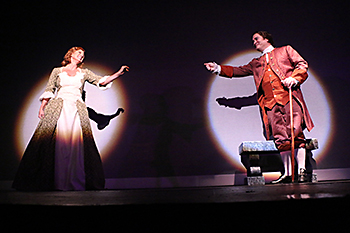
(Photo: Jacob Barton portrays Edward Rutledge in 1776 the Musical. Photo courtesy of Peggy Taphorn)