
 How to resolve AdBlock issue?







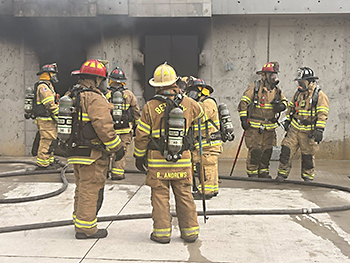 If you've ever considered a career on the front lines of public safety, now is the time — and Fayetteville Technical Community College is ready to train you.
On January 7, 2026, FTCC officially opened Phase II of the J. Larry Keen Regional Fire Rescue Training Facility, marking a landmark moment in emergency response education in North Carolina. The expansion transforms an already impressive complex into one of the most comprehensive fire and rescue training environments in the region and arrives just as demand for qualified firefighters and emergency responders is surging across the country.
According to the U.S. Bureau of Labor Statistics, approximately 27,100 firefighter job openings are projected each year through 2034, driven not just by growth but by the ongoing need to replace retiring professionals. Fire inspectors and investigators face an even brighter outlook, with employment projected to grow 6 percent, faster than the average for all occupations and generating roughly 1,800 openings annually.
The national median annual wage for firefighters stands at $59,530, while fire inspectors earn a median of $75,480 per year. For those ready to answer the call, the opportunity is real, and it starts with the right training.
Phase II introduces several training features designed to mirror the situations responders face every day. Two new live-fire burn buildings — a one-story single-family residence and a two-story apartment structure — were intentionally modeled after the types of properties most commonly found in communities. These structures complement the existing three-story multi-use burn building, giving trainees of all experience levels a diverse, realistic landscape to sharpen their skills in fire suppression, search and rescue, ventilation, firefighter rescue, and incident command management.
Training in lifelike conditions isn't just about realism; it's about survival. Quick, informed decision-making under pressure is what separates good responders from great ones, and FTCC's expanded facility is engineered to build exactly that instinct.
Adjacent to the apartment burn building, a flashover simulator puts trainees face-to-face with one of firefighting's most lethal phenomena. Flashover, the near-simultaneous ignition of an entire room, can occur in seconds and is responsible for a significant number of firefighter fatalities each year. In this controlled environment, students safely observe how fires develop and escalate, learning to recognize the critical warning signs before conditions become deadly.
The expansion goes beyond structural firefighting to prepare responders for some of the most complex emergencies imaginable:
• Aircraft Rescue and Firefighting Simulator — A liquid propane gas-fed prop designed to resemble an aircraft, providing hands-on practice in managing aviation-related fires that demand unique tactics and rapid response.
• Flammable Liquids Fire Training Prop — A 900-square-foot LP gas-fueled concrete training pad where firefighters practice extinguishing fires caused by gasoline or industrial chemical spills and hazards that present distinct and dangerous challenges.
• Fire Investigation Pods — Three dedicated spaces where trainees learn to determine the origin and cause of fires, conducted in partnership with the North Carolina Office of the State Fire Marshal. This collaboration bridges classroom learning with real-world investigative practice, covering fire behavior, evidence collection, and investigative procedures.
Supporting infrastructure added in Phase II, including a warehouse for equipment storage, an open-air shelter, and on-site restroom facilities, ensures the facility can host a wide range of programs comfortably and efficiently. The complex serves not only local departments but agencies from across the region and other states, making it a critical hub for professional development at every level.
The completion of Phase II is more than a construction milestone. It's an investment in the future of public safety and the careers of those who dedicate their lives to it. With a growing job market and competitive salaries, fire and rescue offers a career path that is both financially rewarding and profoundly meaningful.
For more information on enrolling in FTCC's Fire Protection Technology Program or to learn how your fire and rescue department can utilize this world-class facility, visit ftcc.edu/fire-protection-technology, contact Vincent Lewis, director of fire, rescue, and swift water training at Fayetteville Technical Community College by email at lewisv@faytechcc.edu or by phone at 910-486-7472. The facility is located at 775 Tom Starling Rd.
(Photo courtesy of FTCC Fire, Rescue and Swift Water's Facebook page)