
 How to resolve AdBlock issue?







As Americans mark 250 years since the signing of the Declaration of Independence, it is easy to picture 1776 through its famous names and defining moments: Thomas Jefferson and his quill, George Washington commanding the Continental Army, the ringing words of the Declaration, and a collection of colonies preparing to become a nation.
But history was also happening around dinner tables and campfires. The people living through the American Revolution still had to answer an everyday question familiar to us: “What’s for dinner?” The answer depended greatly on who you were, where you lived, and, increasingly, whether you were at home or marching with an army.
There was no single American diet in 1776. Food varied according to geography, season, wealth, and access to ingredients. Colonial cooks worked primarily with foods that could be grown locally, raised on farms, caught, hunted, preserved or imported.
Cornmeal appeared frequently in American kitchens, as did wheat and other grains. Beans, peas, squash, root vegetables and seasonal fruits supplemented meals, while pork was especially valuable because it could be salted or smoked for later use. Fish and seafood were important in coastal communities.
Food preservation shaped the colonial table. Without refrigeration, families relied on drying, smoking, salting, pickling, and preserving foods so they could survive beyond the growing season. Meals could therefore look quite different from the carefully arranged dishes we might prepare today for a Revolutionary War-themed dinner. For many Americans, food was first and foremost practical. For the men serving in the Continental Army, it became a matter of military necessity.
In 1775, the Continental Congress established an official ration for soldiers. The allowance gives us a surprisingly detailed picture of what military leaders believed a soldier needed each day. A Continental soldier's ration included:
• 1 pound of beef, ¾ pound of pork or 1 pound of salt fish per day
• 1 pound of bread or flour per day
• 3 pints of peas or beans per week, or an equivalent amount of vegetables
• 1 pint of milk per day, when available
• ½ pint of rice or 1 pint of Indian meal, or cornmeal, per week
• 1 quart of spruce beer or cider per day, with molasses provided as an alternative
Camp life made food considerably less appetizing than the official ration might suggest. Soldiers stationed in garrisons could have access to freshly baked bread, fresh meat, fruits and vegetables. Soldiers in the field were more likely to encounter durable foods that could survive transportation: salted beef or pork, dried peas and hard bread often known as ship's biscuit.
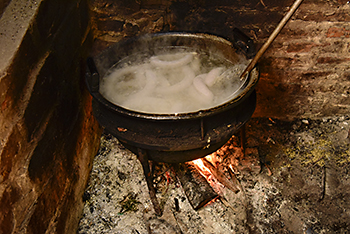
Ship's biscuit was about as basic as food could get. Made primarily from flour and water, the hard crackers were designed for durability rather than flavor. Soldiers generally prepared their own food. Men were organized into small groups called “messes” and shared cooking equipment. A camp kettle might serve six soldiers.
Although meat could be roasted, boiling meat and other ingredients together in a kettle was practical and required relatively little equipment. The result could resemble a simple stew or soup made from whatever ingredients happened to be available.
Supplying thousands of men before railroads, refrigeration, canned foods or modern highways was enormously difficult. Food had to be purchased, collected, preserved and transported by wagon over poor roads while armies continually moved. Salt shortages created another problem. Salt was essential for preserving meat and fish, making shortages of it a threat to the entire military food supply.
Conditions could become desperate. During the Valley Forge encampment, soldiers were officially supposed to receive bread, meat or fish, peas or beans, milk and beverages, along with weekly allowances of butter and vinegar. In reality, the army's supply system struggled to provide them. George Washington warned Congress in December 1777 that without major changes to the commissary system, the army faced three possibilities: starvation, dissolution or dispersal in search of food.
That enormous gap between the ration prescribed by Congress and the food actually reaching a soldier may tell us more about eating during the Revolution than any surviving recipe.