https://www.upandcomingweekly.com/


  • 16Fayetteville Technical Community College works diligently to ensure that students receive a top education that will prepare them for their future endeavors. With programs like the Carolina Student Transfer Excellence Program, or C-STEP, students can get one-on-one educational support to help with their success on campus and prepare them for their academic journey at UNC-Chapel Hill.

    The C-STEP office at UNC-Chapel Hill seeks to admit, identify, enroll and graduate high-achieving, low-to-moderate-income students transferring to Carolina from partnered community colleges, such as FTCC.
    C-STEP allows students to be a part of an Ivy League institute without having to go to Harvard or Yale. Loutricia Nelson works in the University Outreach department at FTCC and proudly works with the program and its participants to give academic advising, coaching and college program preparation to ensure the students’ success.

    In talking with Nelson, you immediately sense her pride in her job and students.

    Even after being accepted to UNC-Chapel Hill, students will continue to meet with Nelson who offers counseling to help keep them successful in their programs.
    Part of C-Step is to have students visit the campus to become familiar with building landmarks, their specific program areas, and faculty and staff. Students also participate in a shadow program where they shadow a current UNC student in their program to see the campus, experience college classes, and begin to network and make friends.

    Talking with some students in C-STEP at FTCC was enlightening. These students display tremendous confidence in their current studies and future success.
    C-STEP students not just work closely with Nelson but also build a community where they can support each other and develop friendships that can be carried with them to UNC-Chapel Hill. When talking with the students, some are in the same programs, so they can find support within themselves and help continue the study habits cultivated at FTCC.

    Nelson teaches these students individualized study habits, time management skills, and timesheet mapping so that they can succeed in their programs and eventually apply their skills with a lifetime career.

    C-STEP students understand the responsibility and dedication it takes to succeed academically as they transition from FTCC to UNC-Chapel Hill and beyond. C-STEP opens doors and opportunities for students to not just succeed on these campuses but also learn to be resourceful and continue to fuel their drive. C-STEP requires students to earn their associate degrees at a North Carolina Community College and then transfer to a Carolina College to complete their studies.
    If you are interested in learning more about C-STEP, please contact Loutricia Nelson at nelsonl@faytechcc.edu.

  • 4aLast Thursday, Gallery 208 launched its 13th year of showcasing the art and the artists of our local community, region and state.

    Our opening exhibit, coordinated by Soni Martin, Professor of Art at Fayetteville State University, is titled States of Mind.

    It is a collection of paintings by Angela Stout, an extremely talented painter, printmaker and sculptor. Angela perfectly exemplifies how the Fayetteville community values, embraces and nurtures the cultural arts. A military veteran, Angela received her Associate of Visual Arts degree locally at Fayetteville Technical Community College and her Bachelor of Arts degree from Fayetteville State University.4

    The exhibit of her works in Gallery 208 is one you do not want to miss. Located at 208 Rowan Street, the Gallery is open and free to the public from 9 a.m. to 4 p.m. Monday through Friday.
    The fine arts are the catalyst for a civilized society. With art comes insight, understanding and tolerance. With appreciation and respect for art and artists, there would be no need ever to mandate Diversity, Equality or Inclusion. Historically and traditionally, that’s what the cultural arts are all about. It is what Angela is all about and what Up & Coming Weekly is all about. Visit Gallery 208 and experience it for yourself.

    Thank you for reading Up & Coming Weekly.

  • cumberland county logo Frustrations among Cumberland County commissioners over the cost of affordable housing came to a head Jan. 17 when they were given a presentation recommending the spending of federal dollars for homeless services.

    The Cumberland County Board of Commissioners met in a packed Room 118 of the Judge E. Maurice Braswell Cumberland County Courthouse.
    Dee Taylor, the county’s Community Development director, briefed commissioners on a proposed Community Development HOME - ARP allocation plan and asked the board to conduct a public hearing to allow for public comment on the allocation plan. However, no one showed up to speak at the public hearing.

    The U.S. Department of Housing and Urban Development through the Home Investment Partnerships (HOME) Program grant allocated $1,435,021 of the American Rescue Plan Act of 2021 funds to Cumberland County. The money is to be used for activities that benefit qualifying individuals and families who are homeless, at risk of homelessness, or in other vulnerable populations.

    Before the county’s DSS can spend any of the HOME-ARP money, it had to prepare a plan that details how the money will be allocated for eligible services, which include building affordable housing, rental assistance, support services such as counseling and legal advice, and paying for a non-congregate shelter. The DSS had to consult with housing and service providers whose clients qualify for the services.

    Responses given by service providers and residents are being considered as to how to best use the HOME-ARP funds to meet the needs of the qualifying populations, according to Taylor.
    Taylor said DSS drew up a survey to get suggestions on how the funds should be used and identified priorities. The survey received 23 responses. DSS also held one-on-one virtual meetings with 10 service providers.

    The majority of the respondents, 44%, opted for construction of affordable housing, 20% recommended rental assistance, and 36% recommended the acquisition or development of non-congregate shelters. Non-congregate shelter is the term used for emergency shelters that provide accommodations such as motel rooms, and limits the spread of COVID-19 among the homeless.

    Community Development completed a draft of the plan and made it available to the public for comment and review between Jan. 13 and Jan. 27. A public hearing on Jan. 17 had to be held during the comment period. After the public has had a chance to review the draft, the final copy of the plan will be submitted to the Board of Commissioners at the Feb. 6 regular meeting, where the board is expected to approve the plan to be submitted to HUD.

    Commissioner Jimmy Keefe again brought up the subject of how much money the county spends on new construction of affordable housing. He suggested taking a new approach to providing homes for the homeless.

    “The old way of doing things is not working,” he told Taylor.

    “We’re spending a lot of money but not getting much of an impact to help the homeless. It doesn’t look like we’re making progress,” he told Taylor.

    Commissioners Veronica Jones and Michael Boose agreed. Both suggested buying existing housing or apartments and foregoing new and more expensive construction. Vice Chairman Glenn Adams suggested the creation of a committee that could help determine whether the county builds new or buys existing property.

    “I’d be happy to sit down and discuss this further,” Taylor replied.

    Rezoning cases

    The board also voted unanimously to grant a rezoning from A1 Agricultural District to RR Rural Residential/CZ Conditional Zoning District or to a more restrictive zoning district for approximately 106.75 acres located east of Hummingbird Place and west of Maxwell Road. The applicant is George Rose who is making the request on behalf of Astrakel International LTD, the property owner.

    The developers are planning to build 168 stick-built homes on the site. The first phase of the development includes 54 lots, and the second phase will be the remaining 114 lots. Initially, the builders wanted to have 232 lots measuring 15,000 square feet but opted for the lesser amount of 168.

    Rose and his attorney, Scott Flowers, spoke in favor of the rezoning; however, three area residents spoke against the proposed subdivision because of the lack of drainage surrounding the property.
    Robin Bridges, who lives on Stedman Road, said the soil on the property is not conducive for a large development and would result in flooding. She presented a petition with 283 signatures against the development. “It’s a poor site and poor plan,” she told commissioners.

    The Cumberland County Planning Board voted 6-3 to deny the rezoning request at the Nov. 15 meeting. However, the Planning and Inspections staff recommended approval of the rezoning because the request is consistent with the Eastover Area Land Use Plan, which calls for “Rural Density Residential” at this location. The planning staff also finds that the request is reasonable and in the public interest as the requested district is compatible to and in harmony with the surrounding land use activities and zoning. The planning board disagreed with the staff’s findings, according to the minutes of the meeting.

    The board also voted to rezone from A1 Agricultural District to R40A Residential District or to a more restrictive zoning district for about 4.01acres located at 2140 Rich Walker Road and an abutting parcel. Bertha Elliott is the owner making the application.

    In this case, the Planning Board recommended approval of the rezoning request from A1 Agricultural District to R40A Residential District at the Dec. 20 meeting. The Planning and Inspections staff also recommended approval of the rezoning request. The Planning staff determined the request to be consistent with the Eastover Area Land Use Plan, which calls for “Rural Density Residential” at this location. Staff also finds that the request is reasonable and in the public interest.

    And the board approved the rezoning from CD Conservancy District to A1 Agricultural District or to a more restrictive zoning district for about 2 acres located on a portion of the abutting parcel east of 7632 Sim Canady Road. Bradley Allee and Lynne Gralewski are the owners making the request.

    The Planning Board recommended approval of the rezoning request at its Dec. 20 meeting. The Planning staff also recommended approval because the request is consistent with the South-Central Land Use Plan, which calls for “farmland” at this location. Staff also finds that the request is reasonable and in the public interest.

    The board also opted not to consider a funding agreement with Hillside - FMHA LLC for the rehabilitation of Hillside Manor Apartments. The county released a “request for proposal” in early spring of 2021 seeking applications from eligible agencies to provide public services (human services), public facilities / infrastructure, and affordable housing developments, according to Taylor.

    A departmental selection committee reviewed all proposals and Hillside – FMHA was one of the agencies selected to receive funding for substantial rehabilitation of 32 units at Hillside Manor, located at 1920 Rosehill Road. Community Development wants to enter into a contract with the agency for a funding amount not to exceed $441,020, according to Taylor’s memo. Development Block Grant funds are available for this project, according to Taylor.

    The staff recommended that the board approve the funding agreement with Hillside-FMHA in the amount not to exceed $441,020 for the rehabilitation of 32 units at Hillside Manor Apartments.
    However, some board members balked at the funding arrangement with Adams suggesting some of the money could be coming from the city of Fayetteville. “They get a whole lot more money than we do,” he said.

    Adams motioned to approve the funding agreement but could not get a second. Keefe countered with a motion to deny the funding request. The motion passed unanimously.

  • 19bThe Woodpeckers season begins April 7, but it is not too early to get the family ready for baseball season.

    Registration is open for the Fayetteville Woodpeckers official kids club for the 2023 season. Bunker’s Buddies Kids Club will have four tiers of memberships available for children 12 and under.

    Children in the Bunker’s Buddies Kids Club will enjoy perks at Segra Stadium. Each tier will offer a personalized ID card, one complimentary reserved or general admission ticket voucher for the child’s birthday, an end-of-the-year Bunker’s Buddies party, and newsletter updates. The tiers gradually increase in the number of perks. The top tier, ‘Home Run’ Membership, will have a member limit of 100 children.

    There are four membership levels available ranging in price from free
    to $75.

    The 2023 Bunker’s Buddies ‘Home Run’ Membership is $75. This level is limited to 100 members.

    • Personalized I.D. card and lanyard
    • Official membership goodie bag, club t-shirt, surprise specialty item
    • One complimentary ticket to 12 Sunday home games
    • One complimentary ticket for the child’s birthday
    • Discounted tickets for up to two parents or guardians for 12 Sunday home games
    • Two complimentary parent or guardian tickets. One on Mother’s Day (May 14) and one on Father’s Day (June 18)
    • Three special club events, plusthe end-of-the-year Bunker’s Buddies party
    • Kids Run Bases express lane access
    • The opportunity to be chosen to deliver game ball before a home game
    • $30 off a reserved birthday package
    • Newsletter updates

    The 2023 Bunker’s Buddies ‘Triple’ Membership is $50.

    • Personalized I.D. card and lanyard
    • Official membership goodie bag and club t-shirt
    • One complimentary ticket to seven Sunday home games
    • One complimentary ticket for the child’s birthday
    • Discounted tickets for up to two parents or guardians for seven Sunday home games
    • One complimentary parent or guardian ticket on either Mother’s Day (May 14) or Father’s Day (June 18)
    • Two special club events, plus the end-of-the-year Bunker’s Buddies party
    • Kids Run Bases express lane access
    • $20 off a reserved birthday package
    • Newsletter updates

    The 2023 Bunker’s Buddies ‘Double’ Membership is $25.

    • Personalized I.D. card and lanyard
    • Official membership goodie bag
    • One complimentary ticket to four Sunday home games
    • One complimentary ticket for the child’s birthday
    • One special club event, plus the end-of-the-year Bunker’s Buddies party
    • Kids Run Bases express lane access
    • $10 off a reserved birthday package
    • Newsletter updates

    The 2023 Bunker’s Buddies ‘Single’ Membership is free.

    • Personalized I.D. card
    • One complimentary ticket for the child’s birthday
    • End-of-the-year Bunker’s Buddies party
    • Newsletter updates

    Bunker’s Buddies Kids Club Sunday dates are April 9, 16, 30; May 14, 28; June 18; July 2, 16, 30; Aug. 6, 20; and Sept. 10. The Fayetteville Woodpeckers return to Segra Stadium for the 2023 season on Friday, April 7, playing against Carolina Mudcats.

    For more information about Bunker’s Buddies or to sign your child up, please visit www.milb.com/fayetteville/fans/kids.

  • tax time N1804P17009H 1 The Cumberland County Tax Administration is reminding residents that Jan. 31 is the deadline for the 2023 annual property tax listing period.

     Listing forms must be updated, signed and returned and must be postmarked no later than Jan. 31 to avoid the 10% late listing penalty, the office said in a release.

    Listing forms may be obtained by going online to cumberlandcountync.gov and clicking on the “Tax’’ button. Download listing forms by clicking on “Forms & Publications.’’ Listing forms may also be obtained in person at the Tax Administration Office on the fifth floor of the Judge E. Maurice Braswell Cumberland County Courthouse, 117 Dick St.

    Forms may be mailed to Cumberland County Tax Administration, P.O. Box 449, Fayetteville, NC 28302 or dropped off at Room 530 on the fifth floor of the courthouse, the release said.

    Tax listings and forms may also be dropped off at box beside the U.S. Postal Service mailboxes in the rear parking lot of the courthouse facing Cool Spring and Russell streets, the release said.

    Taxpayers may also make payments (checks only) using the drop box outside Room 530 near the customer service entrance of Tax Administration, the release said.

    For more information, call 910-678-7507 or visit co.cumberland.nc.us/departments/tax. The email address for tax questions is taxweb@cumberlandcountync.gov.

  • Town of Spring Lake logo The Spring Lake Board of Aldermen is expected to hear a financial update from the Local Government Commission during its regularly scheduled meeting on Monday, Jan. 23.

    David Erwin, the town finance officer and accounting and financial management advisor for the Department of the State Treasurer, is slated to give the midyear report on the town’s financial status, including revenues and expenditures.

    The board hasn’t received an update on the state of the town’s finances since October.

    Alderman Raul Palacios said over the weekend that he is anticipating asking about the 2022 audit status and the 2023 budget timeline.

     Erwin told the board in the fall that the audit might not be completed by the Dec. 1 deadline because they were having to meticulously check records and had to bring on a third person to help the process.

    Taking ownership of financial matters, including completing the 2022 fiscal year audit and participating in the 2023 budget process, were among the goals for Alderman Marvin Lackman and Mayor Pro Tem Robyn Chadwick as well.

    The Local Government Commission took over Spring Lake’s finances in October 2021 amid concerns of potential budget deficits, longstanding fiscal disarray and an investigation of missing money.

     The Local Government Commission and the board have yet to set budget workshops for the new year.

    Also on the agenda is discussion of the interlocal sales tax agreement between the county municipalities and Cumberland County.

    The Cumberland County Board of Commissioners has proposed changing the sales tax collection method from per capita to ad valorem, which would cost each municipality in the county tens of thousands to several million dollars a year. The current agreement, which has been in effect since 2003, expires on June 30.

    At the last board meeting, Mayor Kia Anthony said the mayors in Cumberland County would like to see the agreement postponed for another five years in order for towns to be able to prepare for potential money the municipalities will lose. She said the consensus among mayors is that no one is ready for the change and that Spring Lake would be positioned to lose $1.4 million in sales tax dollars every year.

    “This is a very big deal that is going to affect all of Cumberland County,’’ Anthony said at the meeting on Jan. 8.

    Anthony said the proposed change in the sales tax collection method does not account for a global pandemic and two significant floods in the last several years.

    The board is also expected to discuss abandoned properties within town limits and damaged/missing road signs as well as accept a donation of a generator from the town of Hope Mills.

    The board meets at 6 p.m. at the Spring Lake Municipal Building in the Grady Howard conference room.

  • hope mills logo The Hope Mills Board of Commissioners on Monday, Jan. 23 is expected to hear a request to approve a change order for the new Public Safety building from architect Scott Garner.

     The board meets at 7 p.m. at Town Hall.

    The change order, listed at $2,545, will be the building's 12th, according to material in the agenda packet. A memo states this is a period of adjustment in the new building and requires coordination. The Fire and Police Departments have moved in and occupy the building. The old firehouse was scheduled for demolition on Jan. 21.

    During the adjustment period, several items were needed, such as fail-safe hardware for doors and an adapter for the telephone system to interface with the intercom, the memo states.

     The cost of the adapter is $2,054 and the hardware for the doors is $2,156.

    A part of the change order covers reimbursement to the contractor in the amount of $1,835. The contractor was briefly responsible for the building’s utilities. Duke Energy has since transferred the account to the town.

    Originally, the total of the change order was $13,516. The department received a credit for TV brackets and the water and sewer taps were reused which avoided the cost of new tap fees, the memo states. As a result, a $10,971 credit was applied. This credit brought the total cost down to $2,545.

    The board also is scheduled to hold a public hearing on a voluntary annexation of the Crosspointe Church property at 7050 Rockfish Road. If the noncontiguous annexation is approved, staff would be authorized to begin the initial zoning process to designate the development under the C2(P) Planned Service Retail District.

    Under new business, the board is expected to discuss direction regarding the program for the chapel.

  • police car lights A traffic stop at Carson and Santa Fe drives Jan. 19 led to the seizure of more than 314 grams of methamphetamine, nearly 114 grams of fentanyl, and 142 grams of marijuana, according to the Cumberland County Sheriff’s Office.

    Kenneth Jerome McMillian Jr., 32, was in a black Dodge Charger when he was stopped by deputies about 2 p.m. Thursday, according to a news release. Colt, a Sheriff’s Office canine, alerted deputies to the presence of narcotics, the release said.

    Deputies seized 57 grams of methamphetamine and nearly 5 grams of fentanyl from the vehicle, the release said.
    The Sheriff's Office Narcotics Unit searched two residences that are known to have been occupied by McMillian — one in the 400 block of Wilder Drive and an apartment in the 3600 block of Dornoch Drive, the release said. Narcotics agents seized nearly 257 grams of methamphetamine, 109 grams of fentanyl, and 142 grams of marijuana, according to the news release.

    McMillian was charged with possession with intent to sell or deliver marijuana; two counts of trafficking in methamphetamine; and two counts of trafficking in fentanyl, the release said.

    McMillian was held at the Cumberland County Detention Center on a $125,000 secured bond. He was scheduled for a first appearance in court Friday afternoon.

    The Lee County Sheriff's Office and federal Department of Homeland Security assisted with the arrest.
    Anyone with information about the case is asked to contact the Sheriff's Office Narcotics Unit at 910-677-5525 or CrimeStoppers at 910-483-TIPS (8477) or http://fay-nccrimestoppers.org.

  • FPD logo Homicide detectives are investigating the death of a 1-year-old child Sunday morning, Jan. 22 on Blue Street, the Fayetteville Police Department said in a news release.

    Officers responded to the 700 block of Blue Street in reference to an unresponsive child at approximately 7:17 a.m., the release said.

    When officers arrived, emergency medical personnel were administering life saving measures on the 1-year-old inside an EMS vehicle. The child was pronounced dead at the scene and was taken to a local hospital, the release said.

    The cause of the child's death is unknown at this time and will be determined by the Office of the Chief Medical Examiner, the release said.

    This is an isolated incident, and there were no other children in the home, the release said.

    Anyone who has information about this investigation is asked to contact Detective R. Vernon at 910-729-2525 or Crimestoppers at 910-483-TIPS (8477).


  • JailCellDoors Anthony Willis is a free man now, almost 27 years after murdering Benjamin Miller, the owner of the former Uncle Ben’s Country Store on the outskirts of Fayetteville.

    Willis has been free since March 24, two weeks after Gov. Roy Cooper granted him and two others executive clemency. All three were juveniles when they received sentences of at least 20 years in prison. Willis was sentenced to life in prison without benefit of parole.

    Willis was just 16 years old in 1996 when he walked into Uncle Ben’s with a pistol in his pocket. He said he had no intention of killing Miller. He just wanted to rob the store so he could have enough money to get his speakers out of hock.

    But when Miller reached for something behind the counter, Willis fired his gun, hitting Miller in the head and leaving him to die. Willis was quickly caught, convicted and sentenced.

    Not long ago, it would have been almost inconceivable to believe that Willis would not die in prison. Two years before he was sentenced, the state approved the Structured Sentencing Act of 1994, which gave little to no leeway to any sentences imposed.

    The United States remains the only nation that sentences people to life without parole for crimes committed before turning 18. But recent U.S. Supreme Court rulings, buoyed by reams of studies about the development of the adolescent brain, have led to commutations and pardons for juvenile offenders in North Carolina and throughout the country.

    Duke University’s involvement

    Willis’ case has been at the forefront of the handful of juvenile sentences that have been commuted in this state.
    His prison release was largely made possible through the work of the Duke University School of Law; Duke professor Jamie Lau, who leads the NC Clemency Project; and Adelyn Curran, a former Duke law student who volunteered for the pro bono Clemency Project.

    Lau said Willis was brought to his attention by the late Anthony Spearman, former head of the North Carolina chapter of the NAACP. At that time, Lau said, he had been looking for prisoners to participate in the NC Clemency Project who had served considerable time and had shown a clear path toward rehabilitation. Now, he said, those prisoners find him.

    “When Rev. Spearman brought Anthony to my attention, a couple things stood out: One, I mean he had a record of rehabilitation unlike anything I've ever seen: (college) degrees, work within the prison walls that, you know, got him support of people who were officers involved in corrections that typically

    wouldn't support a person for clemency one way or another.

    “So given that history of rehabilitation, it was clear that he was someone that we wanted to get involved with and see if we could help out.”
    Willis becomes model prisoner

    Anthony Willis wasn’t always a model prisoner. When he arrived behind bars, he said, he was still a bitter teenager, filled with anger, fear and hate.
    Speaking by telephone from his new rental home in Charlotte, Willis said it took about three years, a newfound faith in God and encouragement from community prison volunteers to begin to find a path forward.

    It might have been easier not to try at all. What hope can a teenager find sitting in prison with a life sentence and no prospect of parole?

    But Willis persevered. He said he earned college degree after college degree — five in all — including a master’s. He learned sign language to assist a deaf prisoner. He volunteered to work individually with other prisoners. He held seminars and led plays. Other prisoners began to call him Smiley, because he was seldom seen without his big, toothy grin.

    The wisdom that the community volunteers had passed on to Willis was now being paid forward by a man who seemingly had nothing to gain but his own self-esteem.

    Although Willis didn’t realize it at the time, there was also another reason at play.

    “I listened to the advice because that's the No. 1 thing that allowed the governor to choose me for my release, Because if I would have done all those other things that everyone else around there were doing, I’d still be in prison today,” he said.

    Now on the outside, Willis dedicates much of his life to returning to prison and teaching others to follow a similar path.
    Cindy Cottle, a forensic psychologist in Raleigh who specializes in juvenile-sentencing cases, has never worked with Willis but is familiar with his story. Cottle is among those who think that the brain doesn’t reach full maturity until the mid-20s and that Willis’ outstanding record in prison suggests he has been rehabilitated.

    “Some people might say, ‘Oh, I'm going to participate in this program or this class or get this certificate so, you know, that will look good when I go to the parole board,’’’ Cottle said. “(Willis) didn't have that as an option. He just did it anyway. So without that — hope for that — it makes it more impressive.”

    Willis becomes first case

    Lau, the Duke professor and head of the NC Clemency Project, began working with Willis long before Cooper signed the Juvenile Sentencing Review Board into law in April 2021. Lau said Curran, then a Duke law student doing volunteer work for him, began preparing a packet that included more than 30 recommendations for clemency on Willis’ behalf.

    “As this packet was being finalized — it was literally in its near final form for the governor's clemency office — when the governor's executive order created the Juvenile Sentencing Review Board, which was kind of a glimmer of hope for us because we knew that he had been sentenced for a crime he committed as a juvenile and thought it would be an ideal case for review,” Lau said.

    Willis’ case received a number — JSRB 001 — as the review board’s first case.

    “It was reviewed and the recommendation was made to the governor by the Juvenile Sentencing Review Board to commute Anthony’s sentence, and he received that commutation in March of 2022,” Lau said.

    Willis on the outside

    Willis’ commutation follows a long line of Supreme Court decisions beginning in 2005 establishing that “children are constitutionally different from adults in their levels of culpability.”

    In 2018, Jim Ammons, Cumberland County’s senior resident Superior Court judge, responded to those rulings and resentenced Willis, making him eligible for parole. It would take four more years before his sentence would be commuted.

    When Willis got out of prison, he went to live with a pastor and his wife, Thomas and Sharon Burger, who helped him get a job and get on his feet. He now lives in Charlotte, in his own apartment. He just bought a new car.

    Willis said he has the equivalent of three jobs now. He works remotely full time as an administrative assistant for a telecommunications company. He said he works part time for a group called NC Cure, which advocates on behalf of prisoners. He also provides transportation to people going to and from a memory center. He said he also volunteers at a homeless shelter once a month, shares his story in churches, and returns to the prison where he last stayed to give encouragement to inmates.

    “It's so humbling because anytime I go back to the prison, although I can't go inside I can come to the gate, and they all stand at the gate yelling my name. And you're just seeing how grateful they are that they haven't been forgotten,” Willis said. “I don't do it for accolades. My goal is for them to see that once they're released, they can do the same thing. You don't have to forget those people.”

    Willis said his next goal is to start a nonprofit organization, which he plans to call the Smiley Vision Initiative. He said the organization will help people leaving prison re-enter society.

    ‘Adolescents are impulsive by nature’

    Cottle, the forensic psychologist, contends that research shows that a juvenile who has committed a horrendous crime is capable of change.

    “Adolescents are impulsive by nature,” Cottle said. “They are more emotionally driven, their decisions are based more on emotion, and that is directly related to the brain science.”

    Cottle said a juvenile’s frontal lobe is not as activated or used as efficiently as that of someone in their mid-20s. They are less likely to rely on rational decision-making and are more likely to be influenced by their peers, she said.

    “It doesn't mean that they're completely incapable of understanding what they're doing and are completely at the mercy of emotion or whatever,” Cottle said.

    “But it does mean that they are less capable of that type of reasoning than an adult.”

    In several U.S. Supreme Court cases, the justices have ruled that “children are constitutionally different from adults in their level of culpability” and that the severest punishment must be reserved “for the rarest of juvenile offenders, those whose crimes reflect permanent incorrigibility.”

    Little risk of reoffending

    In North Carolina, 95 juveniles have been sentenced to life in prison without benefit of parole, said Ben Finholt, director of the Just Sentencing Project at Duke University School of Law. Of those 95, 88 remain in prison.

    Only one North Carolina person has ever had a sentence of life in prison without benefit of parole overturned: Kolanda Wooten served 19 years for her role at age 17 in a Wayne County murder. Her sentence was commuted in December to time served.

    Willis had been resentenced to life with benefit of parole four years before he received his commutation.

    Research shows that Willis and Wooten are unlikely to offend again.
    A study by Montclair State University in New Jersey found that only six of 174 juveniles who were sentenced in Philadelphia to life in prison without benefit of parole were rearrested after their release. Of those six, four had their charges dropped.

    By comparison, the study notes, an estimated 30% of people charged with homicide offenses are rearrested within two years of release.
    Another study, this one by Finholt and other researchers in 2020, shows that North Carolina is among nine states that have imposed the majority of juvenile life-without-parole sentences.

    The study, titled “Juvenile Life Without Parole in North Carolina,” examined 94 juvenile cases in which life-without-parole sentences were handed down in this state. At the conclusion of the study, 48 remained sentenced to life without parole and 45 had been resentenced to life with benefit of parole.

    According to the study, 81% of those receiving a sentence of life without parole were Black, which the study called a “highly disparate” rate.

    The study also found that Cumberland County led the state in juvenile life-without-parole (JLWOP) sentences between 1994 and 2018. Such sentences in the state have rapidly declined, the study noted, partly because of the recent U.S. Supreme Court decisions.

    “In a time in which JLWOP sentences are not permitted in any other country in the world, and in which JLWOP sentencing has greatly declined in the U.S., it is time to reconsider the use of JLWOP where it remains, as many states have already done,” the study concludes.

  • Diamond Lynnette Hardaway Former President Donald Trump was among the approximately 600 people who attended a celebration of life for Lynette Hardaway on Saturday, Jan. 21 at the Crown Theatre in Fayetteville.

    Hardaway teamed with her sister Rochelle Richardson as social-media and cable-TV commentators Diamond and Silk. Hardaway died on Jan. 8 at the age of 51.

    Trump entered the stage with Silk by his side. The place erupted at their presence.

    “This is one of the greatest tributes I’ve ever seen,” he said during an 85-minute speech. “You have a lot of people watching (remotely). The world has lost one of its brightest stars.”

    At center stage, a small table had been placed with a portrait of a smiling Hardaway and a pair of her golden shoes complemented by green plants and floral displays.

    Hardaway and her sister have been among Trump’s most ardent supporters since he launched his first presidential campaign in 2015, remaining faithful to their beloved president over the years since.

    Diamond and Silk, who are from nearby Hoke County, came to prominence as celebrities on the political right with their sassy, energetic videos and pointed political commentaries via YouTube, Facebook, Twitter and other social media platforms.

    The 3 ½-hour service featured emotional words from members of Hardaway’s family, including her son, Paris; inspiring gospel music from the Everett Family Gospel Ensemble and the N.C. Rally Team Choir, the signature Leonard Cohen song “Hallelujah” as performed by Waylon Jennings’ son, Whey Jennings; personal testimonies from people from her inner circle; Lara Trump’s retelling of the Diamond and Silk story; and Trump’s speech that paid tribute to both Diamond and his own doings in the Oval Office.

    This was a fervent pro-Trump service made up of largely older people whose cellphones captured the moment.
    The audience loved it when organizers twice played a Diamond and Silk video from 2015 that made jokes about a presidential debate that was hosted by then-Fox anchor Megyn Kelly.

    It was a good example of their humorous but bossy ad-libbing schtick.

    “Leave my man Donald Trump alone,” Diamond blurted out.

    Another one of their videos poked fun at President Joe Biden when he fell off a bicycle.

    “This is not a sad day. This is a happy day. We’ll see Diamond again,” the fans inside the building were told.

    Throughout the service, those seated were told that Hardaway was intelligent, a great storyteller, intuitive, a talker, a giver, possessed with a stream of energy and penchant for rhythm and rhymes.
    Commentary from both Trump and Silk brought up what they said was a rigged election and that he was actually the current president.

    “So sharp. So smart. So cute,” Trump said of Hardaway.

    “Diamond was not afraid,” he said. “She was very wise. There was nobody like her.”

    He noted how the duo had taken a lot of heat over the years supporting him. Earlier, Silk said the criticism was largely from the Black community for their devotion to the former president.

    Unlike Trump’s previous trips to Fayetteville for political rallies, when demonstrators gathered to object to Trump’s appearance and his politics, only one protester could be seen outside on the grounds of the Crown Complex or inside the theater.

    The former president was scheduled to return to Palm Beach, Florida, following the service.
    North Carolina Lt. Gov. Mark Robinson stirred up the audience with his words from the pulpit.

    “You know, I remember the first time I turned on my social media and I saw these young ladies speaking,” he said to exuberant applause. “I cannot tell you how proud I was. To see somebody who looked like me. Who believed like me. Who spoke like me. Who was unafraid like me. To stand up for truth. Stand up for righteousness. To stand up in the face of the ignorance we see today. Stand strong. So today we honor her. Honor her memory. I can tell you she lives on in the hearts and minds of those who loved her. Her voice will live forever.”

    Diamond’s son, Paris, said he was an only child and that his mother was a single parent to him. “Her legacy will continue to live out,” he said, before having to be comforted by the rest of the Hardaway family who stood behind him.

    He thanked Trump for “letting the light shine on his mother and his aunt, Silk Richardson.’’

    During his speech, Trump spoke of things he has previously discussed, including the fake media, his accomplishments in office, how inflation and immigration have gotten out of hand under Biden, and how he had built up the military and done so much for the African American community in the United States.

    “You’re bringing out the best in me,” he said to hearty applause.

    Before his departure, Trump said of his administration, “We had it right. We had it so right. We have to get it right. We have to get it so right.

    “We wouldn’t have been successful without Diamond and Silk.’’

  • SSG Smith Jimmy A 3rd Special Forces Group (Airborne) soldier was killed Jan. 18, in a shooting in Raeford, according to a media release from the U.S. Army Special Operations Command.

    Staff Sgt. Jimmy Lee Smith III, 24, was pronounced deceased by emergency medical services upon their arrival at the scene.

    Local law enforcement officials in Hoke County are investigating the case.

    “Jimmy was a tremendous teammate and paratrooper,” said Col. John D. Bishop, commander of 3rd Special Forces Group, 1st Special Forces Command (Airborne).

    “He was an outstanding culinary specialist and an absolute asset to 3rd Group. More importantly, he was a great human being. Like all members of 3rd Group, Jimmy and his family will always be part of the ‘The Tribe.’ Our thoughts, prayers and condolences are with his loved ones, friends and teammates through this incredibly difficult time.”

    Smith’s leadership and camaraderie left an impact on his team.

    “Jimmy was more than just an NCO, he was a mentor, a shoulder to cry on, a comedian at times, but most of all a great friend,” said Spc. Roenice Todd, a Group Support Battalion member. “It was truly an honor to be able to learn from him.”

    Staff Sgt. Michael Zapata, a friend, added, “Staff Sgt. Smith was a leader, a go-getter, and a great friend. He was the example of what a paratrooper should be and touched the lives of hundreds of other soldiers and paratroopers in the process. Paratroopers don’t die, they simply slip away. See you at final manifest.”

    Smith joined the Army in 2016 and served in the 2nd Infantry Division at Camp Humphreys, South Korea, and in the 82nd Airborne Division at Fort Bragg, before arriving to 3rd Special Forces Group (Airborne) in March 2020.

    Smith served with distinction as a culinary specialist in the Group’s Support Battalion.

    Smith deployed to Jordan in 2020 in support of Operation Inherent Resolve. His awards and decorations include the Army Commendation Medal (with four oak leaf clusters), Army Achievement Medal (with four oak leaf clusters), Army Good Conduct Medal (with one oak leaf cluster), National Defense Service Medal, Global War on Terrorism Service Medal, Global War on Terror Expeditionary Medal, Army Service Ribbon, Korea Defense Service Medal, the Non Commissioned Officer Professional Development Ribbon, Army Service Ribbon, Overseas Service Ribbon, and the Army Parachutist Badge.

  • NC history center logo Nationally known historians who are helping plan exhibits for the proposed N.C. History Center on the Civil War, Emancipation & Reconstruction will return to Fayetteville next week to lead public forums to gain feedback on what content should be included.

    Gerard Eisterhold, whose firm was contracted to design the exhibits, will be joined by historians and professors affiliated with the Smithsonian Institution, UNC Chapel Hill, and other universities.

    Forums are scheduled at 10 a.m. and 7 p.m. Monday, Jan. 23 in the multipurpose room at Mount Sinai Missionary Baptist Church, 1217 Murchison Road. The church is across the street from Fayetteville State University.

    Additionally, panels depicting exhibit designs will be on display next Tuesday through Friday at Mount Sinai for the public to review and leave written comments. Hours will be 10 a.m. to 5 p.m. Jan. 24-28.

    In October, organizers held similar forums at Mount Sinai church and displayed panels at Highland Presbyterian Church on Hay Street.
    Using feedback from those sessions, history center organizers revised their plans for the exhibits.

    Feedback from next week’s forums “will be a continuation of that effort,” a news release said.

    Eisterhold’s firm, Eisterhold and Associates, is headquartered in Kansas City, Missouri.

    His previous design work includes exhibits for the National Civil Rights Museum in Memphis; the International Civil Rights Center and Museum in Greensboro; the National Museum of the United States Army at Fort Belvoir; and the Rosa Parks Museum and Children’s Annex in Montgomery, Alabama.
    Gerard Eisterhold will lead the two presentations on Monday. He will be joined by a team of historians who are working on the Fayetteville history center.

    Plans call for the N.C. History Center to be built on the grounds of the U.S. Arsenal at the Museum of the Cape Fear Historical Complex off Hay Street. It will use the site of the arsenal — which was destroyed by Union troops led by Gen. William Tecumseh Sherman in the closing days of the Civil War — as “a jumping-off point to examine the war as it affected all North Carolinians,” the release said. civil war reconstruction file

    Organizers say it will be a teaching museum and not a collecting’ museum.

    “It will use existing scholarship from universities, coupled with first-hand accounts of North Carolina families, to examine, for the first time, what an entire state faced as the result of the Civil War,” the news release said. “It will communicate that knowledge in person and online so that schoolchildren — and all of us — may learn from it.”

    The center is being built with funding from the state, Cumberland County and the city of Fayetteville.
    Once completed, the N.C. History Center on the Civil War, Emancipation & Reconstruction will be owned by the state of North Carolina and operated by the History Museums Division of the N.C. Department of Natural and Cultural Resources.

    The historians scheduled to participate in Monday’s forums include:

    Spencer Crew, the first African American director at the Smithsonian Museum of American History; former interim director of the Smithsonian’s African American Museum of History and Culture; and professor at George Mason University.

    Harry Watson, Atlanta Distinguished Professor of Southern Culture at the University of North Carolina at Chapel Hill, who is the former director of the UNC Center for the Study of the American South. His research interests include the antebellum South and the relationship between race and class under slavery.

    Jeffrey Crow, former director of the N.C. Division of Archives and History and former deputy secretary of the N.C. Department of Natural and Cultural Resources. He has written about and lectured widely on North Carolina history as it relates to the Civil War and is the author of “A History of African Americans In North Carolina.”

    Vernon Burton, professor of history at Clemson University and author of “The Age of Lincoln.” He is the co-author with civil rights lawyer Armand Derfner of

    “Justice Deferred: Race and the Supreme Court,” a survey of race-related cases in the U.S. Supreme Court. Burton also delivered the keynote address at the groundbreaking and ribbon-cutting of Phases 1 and 2 of the history center in June 2021.
    Marcus S. Cox, dean of the College of Humanities and Social Sciences at Fayetteville State University. Cox joined the FSU faculty last summer, coming from New Orleans. He was a fellow at the National World War II Museum and associate dean of the College of Arts & Sciences and founding director of the African American and Diaspora Studies Program, both at Xavier University. Cox specializes in African American civil and military history, the modern civil rights movement, African American history and U.S. history post-1945.

  • Diamond Lynnette Hardaway Former President Donald Trump said in a video statement that he will be in Fayetteville on Saturday, Jan. 21 for a memorial tribute to Lynnette Hardaway, who teamed with her sister as social-media and cable-TV commentators Diamond and Silk.

    Hardaway, who was from Hoke County, died Jan. 10 at age 51. The cause of death has not been reported.

    Hardaway and her sister, Rochelle Richardson, have been widely recognized as ardent supporters of Trump.
    Hardaway was known as “Diamond,” and Richardson, as “Silk.” They used social-media platforms and appeared on cable channels including Newsmax and Fox, gaining a following in support of conservative political causes.

    “Diamond lived a life founded on her passion and love for all humanity,” Trump said in a video posted online. “They were with me from the beginning and never wavered.”

    The celebration-of-life ceremony will be at 4 p.m. Saturday at the Crown Theatre, 1960 Coliseum Drive. Doors will open at 3 p.m., and seating is on a first-come, first-served basis, according to online accounts.

    Reservations can be made at Diamond Celebration of Life https://pss.nucleuspages.com/events/celebration-of-life-honoring-lynette-diamond-hardaway.

  • DR Kimberly Johnson Cumberland Family Academy, the district’s family engagement outreach arm, is kicking off the new year with a family fun night.

    Cumberland County Schools’ elementary school students, along with their families, are invited to attend “Family Reading Fun” with Nationally Renowned Children’s Author Dr. Kimberly Johnson, on Thursday, Jan. 19 at William H. Owen Elementary School. The school is located at 4533 Raeford Road in Fayetteville.

    Families can arrive at 5 p.m. for a pizza party and will have the opportunity to mingle and take photos with local school mascots. The reading session begins at 6 p.m.

    Dr. Johnson’s high-energy, interactive “Family Reading Fun” session will provide families with tips and suggestions on making reading fun while helping students become better readers. Families will leave with strategies to implement at home to help encourage a love of reading.
    Pizza, books and other giveaways will be provided while supplies last. Space is limited, so families are encouraged to register today: https://bit.ly/readingfunnight.

    A children’s author and educator, Dr. Johnson is passionate about education and literacy. Originally from Shelby, N.C., Dr. Johnson is currently a professor at Clemson University and has authored 18 children’s books. She visits schools throughout the U.S. speaking to children and adults about literacy and writing. She grew up in a household with grandparents who could not read or write, yet they encouraged her to be the best person she could be! Now, she has committed her life’s journey to “empowering our children to know that they can succeed, no matter what their circumstances are.” Learn more about Dr. Johnson here.

    About Cumberland Family Academy

    Cumberland Family Academy (CFA) provides FREE workshops and educational events for the families of Cumberland County Schools (CCS). As part of its strategic plan, CCS launched CFA during the 2020-21 school year. From research, we understand that students achieve more when families are involved in their education. The purpose of the CFA program is to provide families with tools to support the success of their children’s education and to bring schools, parents/guardians, families, and community organizations together as equal partners. For more information on CFA, visit www.familyacademy.ccs.k12.nc.us.

  • 14 Sweet Tea Shakespeare is scheduled to perform “20,000 Leagues Under the Sea” Jan. 20 until Feb. 5, every Friday, Saturday and Sunday, at the Fayetteville Pie Company, starting at 7:30 p.m.

    Tickets are $40 and include a dinner with pie. “20,000 Leagues Under the Sea” is a retelling of the classic Jules Verne tale.

    Sweet Tea Shakespeare is a theatre and music company based in Fayetteville, Raleigh, the wider North Carolina region, and online. Sweet Tea Shakespeare strives to create simple, elemental, magical performances and to share delight in the wonder of story, song and stagecraft.

    Judson Clark, director of marketing and media at Sweet Tea Shakespeare said, “Don’t miss out on Fayetteville’s most innovative theatre event yet! Our talented cast will use their signature wit and charm to bring Jules Verne’s classic tale to life like never before.”

    The audience will experience cutting-edge theatre technology that combines immersive sets, a curated menu by Fayetteville Pie Company, and exclusive streaming access. Whether viewers join us in-person or online, “we guarantee you’ll be mesmerised by this thrilling tale of high-seas adventure and epic discovery,” he said.

    “20,000 Leagues Under the Sea” tells of Dr. Pierre Aronnax, a professor who leaves New York to investigate reports of an unusual sea monster sighted offshore.

    To the surprise of Dr. Aronnax and his companions, the creature turns out to be a submarine, a burgeoning piece of technology at the time of the novel’s publication. When Dr. Aronnax’s ship is destroyed by the submarine, he is taken aboard and meets the brilliant and enigmatic Captain Nemo. Nemo’s creation, named the Nautilus, patrols the world’s waters unbound to any sovereign country, diving to the deepest and most mysterious reaches of the world’s oceans.

    Born from Nemo’s desire to resist governmental authority and civilization, the Nautilus is used mainly to conduct research under the sea, as well as to provide a home for Nemo, who wishes to live independently of the world’s countries.

    As with other productions, Sweet Tea Shakespeare will add their own unique take on the story that will no doubt entertain audiences. The Fayetteville Pie Company is located in the Westwood Shopping Center.

    For more info, visit www.sweetteashakespeare.com

  • 12Gallery 208 opens its first exhibit of the new year with States of Mind: Paintings by Angela Stout on Jan. 19.

    A painter, printmaker and sculptor, Stout is an artist who chooses to investigate the portrait as a subject in her work. Visitors to the exhibit will experience a less obvious theme as the likeness of each individual dissipates into moments of discovering our humanity — one portrait at a time.

    Seeing a body of work by Stout is a palatable experience, a contradiction between the physicality of paint and illusion — feelings are conjured. We experience each work as a comprehensible moment; although abstracted, the artist evokes an emotion, something familiar.

    Stout practices the art of camouflage. We are enamored by the skills to create a likeness, yet a feeling emerges from the artist’s manipulation of material, illusion and the physical. An image on canvas or paper has the potential to evoke a type of certainty, often a dichotomy.

    In the painting titled “Deterioration,” a fair-haired young woman looks intently at the viewer through the lens of a yellow-green filtered pictorial environment.
    The surface of the 36”x 36” painting on canvas has been deliberately scratched, the surface marred in a way that the flat illusionistic layers of paint physically separate away from the painted surface.
    The marred mark-making begins to move across the figure — color and paint are released from the surface — the figure remains motionless. A feeling emerges as we experience the physicality of the paint in contrast to a transfixed illusionary figure suspended in spatial disorder.

    Seeing “Deterioration” viewers will have their own interpretation of meaning. For me, Stout has created a situation, and I find myself responding with empathy to the fixed figure in the painting, I feel moved to say “just breathe.”

    In comparison, the artist limits herself to the talent of illusionistic painting to evoke meaning in the blue painting titled “O.” Duality is present. Stout has masterfully created hard and soft at the same moment.

    We experience the hardness of cold in contrast to the soft supple flesh of the individual. The figure exists in a state of contrast: grace and hardship, obscurity and specificity, flatness and texture.

    “O” is an example of how the artist balances the theoretical and the emotional. The artist explained how she created a technical problem to resolve. 12a

    “In this painting, it was to focus on balancing the achromatic with the chromatic, without it being noticeable. Since emotion is central to my work, it was important to create a feeling of coldness, an emotional or physical aspect of being cold.”

    We naively enjoy Stout’s work without knowing a process has always taken place to resolve a complicated technical order. If we look closely at the painting titled “Suppression,” the order is more obvious. A male figure stretches the edge of an American flag across his face just below his eyes. As he gazes upward the softness of the flag hangs below his clenched hands.

    Examining the technical, we see that the young man is painted in tones of grey, whereas the flag is painted in saturated colors. The red and blue are in strong contrast to the greys. The implied diagonal movement of the stripes and arms directs us to the eyes as a focal point. The white of the background, stars and stripes are flattened patterns. Without spatial reference, the white is strategically used as composition, but also holds the figure between foreground and background.

    An extensive exhibition record, “Suppression” was exhibited in an international online competition in Milan, Italy, in 2020. Collaborating with photographer Neysa Wellington, the M.A.D.S. Milano competition call for art was to celebrate the art of photography and how photography is a resource for painters.

    In the exhibit, Wellington’s photograph was exhibited with Stout’s interpretation of Wellington’s photograph. The result for Stout was the painting titled “Suppression.”

    At the height of COVID, Wellington and Stout’s submissions were accepted; both were part of the online exhibition, their works projected outside the gallery on monitors during the epidemic. Visitors to States of Mind will see a body of work by a well-known local painter but also an artist who regularly creates prints.

    12bOriginally from Warren, Ohio, Stout is a disabled veteran who lives in Broadway, North Carolina, and has soared to success after completing a four-year art degree in 2020. After earning an Associate Degree in Visual Art from Fayetteville Technical Community College, she completed a Bachelor of Art in Studio from Fayetteville State University.

    Upon leaving the university, Stout had already developed a clear path for the direction of her works of art.

    She stated: “All my art focuses on evoking feeling. I focus on the portrait, but they have underlying social themes. In addition to the philosophical concerns in my work, I maintain a romantic view of beauty in the world around me.”

    After completing six art history courses in her program of study, Stout was also clear on those artists, living and deceased, who would influence her own work.

    Stout commented, “I am connected to modern and historical art methods. My love of painting is inspired by Baroque artists Michelangelo Caravaggio and Rembrandt. Other major historical influences are Henry Ossawa Tanner and John Singer Sargent. Modern influences are Gerhard Richter, Kehinde Wiley, and Cindy Sherman.”

    The newest works by Stout are regularly exhibited at the Cape Fear Studios in Fayetteville.

    Stout teaches what she has learned about painting and clay modeling in the continuing education program at Fayetteville Technical Community College. In her filled painting classes, students learn what visitors to Gallery 208 will see: Stout understands the properties of color and how to apply them in a work of art. The public is invited to attend the opening reception for an artist whose work always tells us something about ourselves and the world around us.

    When visitors to the Gallery spend time with the work, they will come to understand how the paintings by Stout go far beyond a relative or exact likeness of an individual. Stout’s work, like any good work of art, is in the work’s potential to tell us something about our culture in an enlightening and collective context.

    States of Mind: Paintings by Angela Stout opens on Jan. 19 from 5:30 to 7 p.m. at Gallery 208. The exhibit will remain up until March 24. The Gallery is located at 208 Rowan Street in Fayetteville. Gallery hours are Monday through Thursday, 9 a.m. to 4 p.m. For more information call 910-484-6200.

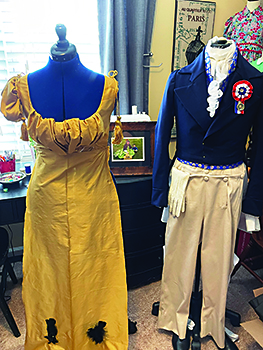
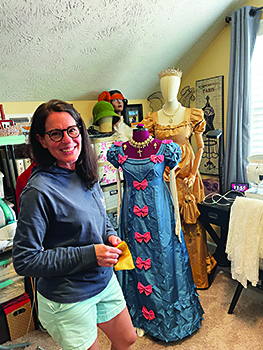
  • 17Fashion has a lot of uses. It can be practical, it can be pretty, it can be silly and it can also tell us a lot about history.

    From designs to textiles, clothes and how we wear them can reflect the state of the world. That reflection will be clear in the new exhibit at the Fayetteville History Museum.

    “Bits and Baubles: Curated Fashion Items from our Collection” opened last week. The exhibit looks at a variety of women’s clothing and accessory items from the museum’s collection. Each item on display has a connection to women’s fashion. Museum staff have had a shopping trip of sorts through the museum’s stored collection but have also brought in a few personal pieces from their own pasts.

    “The museum has a distinct collection of things that aren’t on display and sometimes come out on rotation. And so we’ve been able to peek back behind the closed doors and go through and pick out some things that have been on display that have some unique stories to tell. And so we thought that would be fun,” Heidi Bleazey, the historic and natural resources manager for the Fayetteville History Museum, said.

    The exhibit title refers to “bits” as in tidbits of local fashion history, customs of the past and local textile mill history. The “baubles” will be on display in the main entrance gallery of the museum, as well.
    Bleazey says that the exhibit is not a comprehensive look at fashion, it does have a few standouts for local impacts of fashion.

    “We have some information on probably one of the most famous stories here in Fayetteville, the Capitol Department Store, or taking it way back to Colonial North Carolina and talking about the Edenton Tea Party,” Bleazey told Up & Coming Weekly. “Not only did the women of Edenton boycott tea, but they boycotted imported fabrics which must have wreaked havoc on their wardrobe — their patriotic statement of support for the colonies against the taxes imposed by the British,” she said.

    There will also be information about the impact that African Americans had on the local fashion world of Fayetteville as well as Massey Hill and the textile factories.
    Another aspect of the historical exhibit is that it can be interactive. If people have their own historical fashion items hidden in an attic or closet somewhere, they are encouraged to add it to the museum’s collection and put on display.

    The exhibit is located in the main museum gallery and is free to the public. The Fayetteville History Museum is open Tuesday through Saturday, from 10 a.m. to 4 p.m. The Fayetteville History Museum is located at 325 Franklin Street in downtown Fayetteville.

    The museum is part of the Historic and Natural Resources of Fayetteville Cumberland Parks and Recreation. For more information, visit www.fcpr.us/historymuseum or call 910-433-1457.


  • 9The new year is only two weeks old, and it didn’t take long for Methodist University to begin garnering national and international attention.

    Higher Education Digest, an independent higher education magazine with a wide-spread international audience, recently promoted Methodist University as one of 10 “must-watch” North American colleges and universities in 2022. MU was the only university from North Carolina on a list that featured Oklahoma State, San Diego State and three others from the U.S.

    “MU is honored to be featured on this well-respected list,” said Minnu Paul, director of MU’s Global Education.

    “Our University is constantly working to create an experience that engages, enriches, and empowers our students’ lives. The strong leadership from MU has led to a stout educational system that supports all of our students, especially our international students. This ranking solidifies the fact that we are a globalized campus.”

    The magazine’s writers point to a number of MU’s successes and attractions, including its thriving city atmosphere (nestled between the Appalachian Mountain Range and North Carolina coastline), MU’s ranking as the No. 1 most diverse university in North Carolina, the more than 80 types of undergraduate and graduate programs, and the top 16% ranking nationally
    in The New York Times for overall economic mobility.

    The story says Methodist University is “helping unleash the full potential of an individual’s mind... and committed to an ecumenical spirit that respects diversity and recognizes the dignity and worth of all human beings.”

    The Higher Education Digest also touches on why Methodist University is known as one of the top institutions for international students.
    Currently home to students from more than 50 countries and six continents, MU provides a dedicated Global Education staff who can support international students’ unique social and financial needs.

    The article goes on to highlight the University’s Campus Engagement Office and One Stop as additional staff resources for international students.

    “Plus, non-international staff and people in the Fayetteville community are welcoming and supportive of international students,” said Paul. “They donate in kind, monetarily, they pick up students from the airport, and they provide a home away from home in various ways.”

    To read the entire feature, visit www.highereducationdigest.com/december-2022-10-must-watch-north-american-colleges-universities-in-2022/

    About Methodist University

    Methodist University is an independent, four-year institution of higher education with approximately 2,000 students. MU offers more than 80 undergraduate and graduate degree programs (including doctoral-level options) on campus and online. MU has been named the "No. 1, Most Diverse University in North Carolina," features 20 NCAA intercollegiate sports (with nearly 40 team national championships). To learn more about Methodist University visit methodist.edu.

  • 5 Our American culture swims in “isms,” and we assign values, positive and negative, to them.

    For example, capitalism and individualism are good. Racism, sexism, classism, sizeism, socialism, fanaticism, egoism — all bad. Others, including nationalism, skepticism, Americanism are more in the eye of the beholder — positive for some people and negative for others. Buckle up your linguistic seat belt as we are about to hear a lot in 2023 about another ism, ageism.

    At this writing, Americans have one declared presidential candidate for 2024, Donald Trump, who is staring down his 77th birthday. We have another presumed candidate, incumbent President Joe Biden, who celebrated his 80th in November. Clearly, neither man can be considered what my father always called “spring chickens,” but is that important, and if so, how important?

    The World Health Organization says ageism “refers to the stereotypes (how we think), prejudice (how we feel) and discrimination (how we act) towards others or oneself based on age.”

    We all commit ageism, mostly without thinking about it. We treat children differently than adults. We discount the views of many teenagers and young adults, assuming they do not have the knowledge or life experience of adults. And, like it or not, we too-often assume that elderly people are not as competent as they
    once were.

    I am not as old as Trump or Biden, but neither am I the mother of school-age children and working woman I once was. Increasingly, people I do not know, sales people especially, address me as “Miss Margaret,” something that did not happen in earlier years. I understand that it is meant to convey respect, but to me at least, it feels like a diminution based solely on age.

    At the same time, it is true that we all change as we age, certainly physically, and for many people, mentally. That reality is going to be a topic as we head into the 2024 presidential campaigns.

    Americans, including politicians, are living longer, and our elected leaders, particularly at the national level, are older than ever. In addition to Biden and Trump, former House Speaker Nancy Pelosi is 82, and widely considered among the most effective Speakers in American history. U.S. Senator Mitch McConnell, a leader who keeps an iron grip on Republicans in that chamber, will be 81 next month.

    These geriatric politicians, like them or loathe them, are clearly competent, their ages notwithstanding. So, what should we demand from all our presidential hopefuls of all ages? At the very least, we must expect health records, not merely a blanket statement from some doctor that “this guy is healthy as a horse.”

    We should recognize that generally speaking, we are all healthier if we eat well and exercise our bodies regularly, and that certainly includes presidential candidates. And, because we do not know yet who will throw his or her name in the ring, it is worth remembering that statistically, women outlive men in the United States.

    American presidents have not been especially forthcoming about their health. Woodrow Wilson had a severe stroke while in office, and many historians believe his wife became the de facto president for the final months of his term.

    Franklin Roosevelt suffered from heart trouble and high blood pressure and was crippled by polio before his presidency, though he was rarely photographed appearing compromised. John Kennedy, our second youngest president and widely seen as healthy and vibrant, actually suffered from serious physical and occasionally life-threatening conditions.

    As we move toward the 2024 election, Americans have every right to expect candor about health from all our candidates, especially those who aim to be president. If they are asking for our trust and support, we should expect no less from them.

  • 18In 2022, Americans spent $33 billion on a variety of weight loss products and diets.
    Marketers know the advantage of targeting the consumer, especially after a holiday season for sales. One commercial advertises a weight loss of five pounds per week. Extreme weight loss turns your system into a state that is not beneficial for long-term sustainability. any times, calories are dramatically cut to the point that the person is hungry all the time and lacks the energy for activities.

    A slow approach to calorie reduction with good food choices is a better way for weight loss and sustainability. Drastically cutting calories can be satisfying on the scale and the way your clothes fit, but dropping several sizes quickly can play havoc on your metabolism.

    It is hard to maintain the deficit when your body is not getting the fuel it needs for activities. In the long run, the drastic weight loss could end up with weight gain after the diet is over. Weight loss is not a one-time main event, it is a lifestyle change in conjunction with exercise.

    Health guidelines for weight loss suggest cutting your calories by a least 500 calories per day which should equal a one-pound-per-week goal that is safe and realistic.

    A registered dietician is a recommendation for guided weight loss, but taking a look at the consumption of what you eat during the day can be a good guideline for the start. Be honest with yourself about your overall consumption each day. Do you think your calories add up from sodas, sweets, chips and dip? They are good but they do not offer any nutritional benefits. Eating processed foods also adds calories to the diet as well as driving through the fast-food restaurant. You don’t have to go cold turkey and avoid everything in your diet.

    Punishing yourself by denying something that you enjoy is not the way to lose weight. Still enjoy that favorite burger or chicken but cut down on the number of times that you go to get that favorite sandwich or latte! Eliminating the amount of processed food will be a start to a healthier you.

    The American diet has increased in overall consumption of plate size over the past 10 years and has almost doubled in the amount that is served in restaurants.
    The old saying to eat everything on your plate in today’s environment can lead to weight gain and obesity. Overall, in 2022 the national range for all ethnicities was a staggering 41.9%. It is the second cause of health decline with cigarette smoking number one. As we gain weight it settles around our heart and lungs and is known as visceral fat and puts strain on our hearts, lungs and joints.

    What can you do to shave those calories without going on a drastic diet? Outside of beginning to shave the empty calories, portion control is a great way to begin. Make the plate serving on a salad plate instead of a dinner plate and avoid second helpings. Add more vegetables to your plate and add foods high in fiber such as apples, green beans, nuts and lean meats such as chicken and fish for your omega3. When dining out take half of your meal home!

    The bottom line is that starving yourself is not a healthy way to lose weight. There are many fitness apps available for monitoring your caloric intake such as My Fitness Pal, as well as the Dash eating plan.

    Live, love life with moderation and exercise.

  • 7The Defense Department recently launched a 12-week paid fellowship program to expand employment opportunities for eligible military spouses.

    The Military Spouse Career Accelerator Pilot program provides spouses of currently serving members of the U.S. Army, Navy, Marine Corps, Air Force and Space Force, to include active, reserve and National Guard components, with paid fellowships at civilian employers across various industries and locations.

    This program directly addresses DOD's Taking Care of Our People directive to expand spousal employment. DOD continually reaches out to the force to better understand their concerns and improve how we can best support them and their families on a broad range of issues. It also supports the Spouse Education and Career Opportunities program's overall goal of providing information, tools and resources to assist spouses in finding meaningful career opportunities.

    "The military spouse career accelerator pilot is a game changer for career ready military spouses," said Patricia Montes Barron, deputy assistant secretary of defense for military community and family policy.

    "The department has partnered with Hiring our Heroes to provide robust and meaningful fellowship placement that could lead to full-time employment. Military spouses have made it clear that meaningful employment is essential to their quality of life. We hope this program provides them a strong start to solid employment opportunities."

    Expanding Spousal Employment Opportunities

    Military spouses who are accepted into the program will be placed with host companies that match their location and work experience, among other factors. Spouses will receive in-person or professional training and mentoring. At the end of the fellowship, spouses who excel in the program may be invited to join the host company as a direct hire.

    This program will run for three years, and applications will be accepted throughout the length of the program, with new opportunities available each month. The first cohort of fellows will be placed with their host companies starting in January 2023.

    Spouses can find more information about eligibility and learn how to apply for this unique opportunity on MySECO, the website of the Spouse Education and Career Opportunities program.
    https://myseco.militaryonesource.mil/portal/article/military-spouse-career-accelerator-pilot

    Connecting Employers With Skilled Talent

    By partnering with the fellowship program, employers gain access to a pipeline of military spouse fellows that are equipped with education, transferable skills and experience in a variety of roles and industries. They represent a diverse population faced with challenges finding and maintaining careers due to frequent relocations.

    Employers who are accepted into the fellowship program will receive the following benefits:

    • •Early access to a diverse pool of a highly skilled and educated workforce
    • •Free opportunity to connect directly with military spouses – the program is fully subsidized by the Defense Department and is free to employers to participate
    • •Recognition opportunities through promotional activities and social media engagement
    • •Opportunity to bring military spouses who excel in the fellowship on board as a direct hire after the program is completed

    Employers can apply to participate on a rolling basis throughout the length of the program. This program is provided at no cost to employers with the Defense Department providing compensation for all military spouse fellows.

    Employers who are interested in hosting a military spouse fellow may visit the Hiring Our Heroes website to learn more https://www.hiringourheroes.org/employers/hosting-a-fellow/mscap-host-interest-form/
    Spouse and employers with additional questions about the program can contact mscap@uschamber.com.

    About Military Community and Family Policy

    Military Community and Family Policy is directly responsible for establishing and overseeing quality-of-life policies and programs that help our service members, their families and survivors be well and mission-ready. Military OneSource is the gateway to programs and services that support the everyday needs of the 5.2 million service members and immediate family members of the military community. These DOD services can be accessed 24/7/365 around the world.

    About Spouse Education and Career Opportunities

    The Defense Department established the SECO program to provide education and career guidance to military spouses worldwide, offering free comprehensive resources and tools designed to help spouses meet their career and education goals. This program also offers free career coaching services six days a week. For more information visit https://myseco.militaryonesource.mil/portal/.

  • 10 washingtonFayetteville Technical Community College recently announced that Dr. DeSandra Washington has been named Vice President for Academic Support and Diversity, Equity and Inclusion Services.
    In this capacity, Dr. Washington will oversee several departments, including Library Services, the Student Learning Center, University Outreach, Parents for Higher Education and the Male Mentoring Success Initiative.

    She will also lead the newly established Diversity, Equity and Inclusion services.

    In this capacity, she will provide leadership over the implementation of DEI initiatives to facilitate a learning environment centered around equity, inclusive excellence and celebration of human diversity.

    Dr. Washington began working at FTCC in 1998 as the Basic Skills Counselor. Since that time, she has served in several roles, including Director of Counseling and Admissions, Dean of the Spring Lake Campus and Associate Vice President for Academic Support.
    Dr. Washington has served on several committees at FTCC including the Southern Association of Colleges and Schools Commission on Colleges tenth-year reaffirmation committee, the SACSCOC fifth-year reaffirmation committee, the Mighty Minority Male committee and the Student Appeals committee.

    Due to her work with serving and supporting minority students, Dr. Washington was selected as an Engaging Excellence in Equity Fellow, sponsored by the Bill & Melinda Gates Foundation. To continue the practice of transforming lives, she was honored to be a part of the 2020-2022 William C. Friday Fellowship for Human Relations.

    In 2021, Dr. Washington was afforded the opportunity to complete the Diversity and Inclusion Certificate Program through eCornell at Cornell University.

    Dr. Washington earned her Bachelor of Arts in Criminal Justice and Master of Arts in School Personnel from North Carolina Central University. She earned her Doctor of Education in Educational Leadership at Fayetteville State University with a specialization in higher education.

    Dr. Washington is a dedicated community servant and says one of her greatest joys is helping others.

  • 11Cumberland County Schools’ Student Services department was recently awarded just over $5 million through the Mental Health Service Professional Demonstration Grant Program.

    The district applied for the grant in collaboration with RTI International. The award is administered through the U.S. Department of Education's Office of Safe and Supportive Schools. This year’s competition was highly competitive; more than 185 applications were received, and only 67 proposals were awarded.

    This grant will allow CCS to implement the Alliance for Leading and Learning (ALL) Program. The funding will be used to partner with Fayetteville State University and the University of North Carolina at Pembroke to create a diverse pipeline of highly qualified school-based mental health professionals, meeting the needs of approximately 50,000 CCS students in pre-kindergarten through grade 12.

    “We are excited about receiving this grant and providing additional resources to meet the needs of the whole child,” said Dr. Natasha Scott, the district’s executive director of Student Services.

    “Through a robust collaboration with higher education partners, we look forward to increasing the number of school-based health professionals in the district, which will ultimately help our students thrive in the classroom and in life.”

    The program will allow graduate students from FSU’s and UNCP’s master’s programs in social work and students from UNCP’s master’s program in school counseling to provide mental health care while earning important experience and credit hours in a supervised environment.

    Additionally, this program will focus on recruiting individuals from diverse backgrounds. The ALL Program will promote inclusive practices by developing the knowledge, skills and dispositions of school-based mental health professionals to use practices that encourage inclusivity and remove unconscious bias.

    This will ensure that all CCS students receive the support they need, echoing CCS’ goal of providing a safe, positive and rigorous learning environment that prepares lifelong learners to reach their maximum potential.
    For more information on Cumberland County Schools visit www.ccs.k12.nc.us/.

Latest Articles

  • Take advantage of the community services at FTCC
  • It comes down to rhythm
  • Making changes that last
  • From Detroit to 910: Celebrating the King of Beats
  • Encountering history: Guided cemetery tour highlights Revolutionary War-Era heroes, events
  • Reconnecting with real life: A conversation with Amy Grant
Up & Coming Weekly Calendar
  

Login/Subscribe