- Details
-
Wednesday, 08 July 2026
-
Written by Katie Herring

When school lets out at the end of May, most kids are jumping for joy and can’t wait for weeks on end of sleeping late, trips to swimming pools, vacations, camps, and more. But for a lot of kids in our community, being on break from school means missing out on the availability of a reliable lunch Monday through Friday. The Cumberland County School Child Nutrition department is on a mission to fill that gap for most of the summer for as many kids as possible.
From June 1 through July 31, Child Nutrition Services provides free lunches to kids 18 and younger at locations throughout Cumberland County. There is no income requirement to receive these free meals. They are offered on a first-come, first-served basis; no registration required. Children must be present to receive a meal, and the meals must be eaten on site.
These meals provide kids with important nutrients needed to support growing bodies, but are still fun foods that kids want to eat. Each meal includes vegetables, fruit, and cold milk. A complete menu of what meals are served on which days throughout June and July can be found on the Child Nutrition Services website.
Meals are available at the following locations:
• Cliffdale Rec Center @ 6404 Cliffdale Rd., Fayetteville
• College Lakes Elementary @ 4963 Rosehill Rd., Fayetteville
• Hope Mills Municipal Park @ 5766 Rockfish Rd., Hope Mills
• Kiwanis Rec Center @ 352 Devers St, Fayetteville
• Lake Rim Elementary @ 1455 Hoke Loop Rd., Fayetteville
• Massey Hill Rec Center @ 1612 Camden Rd., Fayetteville
• Mendoza Park @ 1774 Little River Rd., Spring Lake
• Roy Turner Park @ 4623 Blanton Rd., Fayetteville
• Smith Rec Center @ 1520 Slater Ave, Fayetteville
• Spring Lake Library @ 101 Laketree Blvd., Spring Lake
• Spring Lake Rec Center @ 245 Ruth St, Spring Lake
• Sunnyside Elementary @ 3876 Sunnyside School Rd., Fayetteville
• Walker Spivey Elementary @ 500 Fisher St, Fayetteville
• Westover Rec Center @ 267 Bonanza Dr., Fayetteville
Meal distribution times do vary at different locations, but are all between 11 a.m. and 1 p.m. For specific pick-up times at the location nearest you, check the Child Nutrition Services website at www.ccs.k12.nc.us/page/child-nutrition-services.
In addition to locations and meal times, you will also find additional information about each location. Many meal locations are at schools and recreation centers that also have activities for kids and families to enjoy while they are getting their lunches, such as playgrounds, splash pads, and gymnasiums. Not all locations have additional amenities, so be sure to check out the website for details.
While summer should be a time of rest and fun for school-aged kids, it’s hard to enjoy the free time when you are hungry. And the reality for many families is that they depend on meals provided at school to fill gaps in what is available at home, from August through May. Cumberland County Schools wants to make sure to continue to fill those gaps, even when the classrooms are empty. This is why each summer, the Child Nutrition Services works hard to get meals distributed to kids who need them, all around Cumberland County. For additional information, check https://www.ccs.k12.nc.us/page/child-nutrition-services or call 910-678-2502.
When school lets out at the end of May, most kids are jumping for joy and can’t wait for weeks on end of sleeping late, trips to swimming pools, vacations, camps, and more. But for a lot of kids in our community, being on break from school means missing out on the availability of a reliable lunch Monday through Friday. The Cumberland County School Child Nutrition department is on a mission to fill that gap for most of the summer for as many kids as possible.
From June 1 through July 31, Child Nutrition Services provides free lunches to kids 18 and younger at locations throughout Cumberland County. There is no income requirement to receive these free meals. They are offered on a first-come, first-served basis; no registration required. Children must be present to receive a meal, and the meals must be eaten on site.
These meals provide kids with important nutrients needed to support growing bodies, but are still fun foods that kids want to eat. Each meal includes vegetables, fruit, and cold milk. A complete menu of what meals are served on which days throughout June and July can be found on the Child Nutrition Services website.
Meals are available at the following locations:
• Cliffdale Rec Center @ 6404 Cliffdale Rd., Fayetteville
• College Lakes Elementary @ 4963 Rosehill Rd., Fayetteville
• Hope Mills Municipal Park @ 5766 Rockfish Rd., Hope Mills
• Kiwanis Rec Center @ 352 Devers St, Fayetteville
• Lake Rim Elementary @ 1455 Hoke Loop Rd., Fayetteville
• Massey Hill Rec Center @ 1612 Camden Rd., Fayetteville
• Mendoza Park @ 1774 Little River Rd., Spring Lake
• Roy Turner Park @ 4623 Blanton Rd., Fayetteville
• Smith Rec Center @ 1520 Slater Ave, Fayetteville
• Spring Lake Library @ 101 Laketree Blvd., Spring Lake
• Spring Lake Rec Center @ 245 Ruth St, Spring Lake
• Sunnyside Elementary @ 3876 Sunnyside School Rd., Fayetteville
• Walker Spivey Elementary @ 500 Fisher St, Fayetteville
• Westover Rec Center @ 267 Bonanza Dr., Fayetteville
Meal distribution times do vary at different locations, but are all between 11 a.m. and 1 p.m. For specific pick-up times at the location nearest you, check the Child Nutrition Services website at www.ccs.k12.nc.us/page/child-nutrition-services.
In addition to locations and meal times, you will also find additional information about each location. Many meal locations are at schools and recreation centers that also have activities for kids and families to enjoy while they are getting their lunches, such as playgrounds, splash pads, and gymnasiums. Not all locations have additional amenities, so be sure to check out the website for details.
While summer should be a time of rest and fun for school-aged kids, it’s hard to enjoy the free time when you are hungry. And the reality for many families is that they depend on meals provided at school to fill gaps in what is available at home, from August through May. Cumberland County Schools wants to make sure to continue to fill those gaps, even when the classrooms are empty. This is why each summer, the Child Nutrition Services works hard to get meals distributed to kids who need them, all around Cumberland County. For additional information, check https://www.ccs.k12.nc.us/page/child-nutrition-services or call 910-678-2502.
- Details
-
Wednesday, 08 July 2026
-
Written by Jaime Bishop
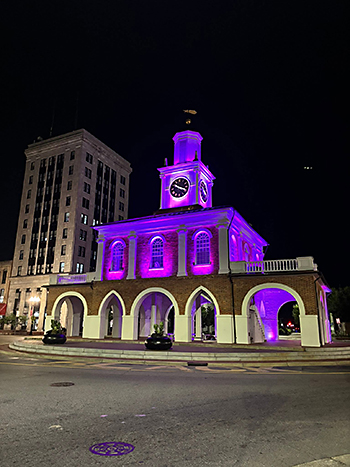
For one night in June, Fayetteville took on a different glow.
Several city landmarks were illuminated in purple, joining communities across the country in recognizing Alzheimer’s & Brain Awareness Month. The color served as more than a visual display; it was a reminder that millions of Americans are living with Alzheimer’s disease and that countless families in Cumberland County are quietly navigating the daily realities of memory loss, caregiving and uncertainty.
While June’s awareness campaign has ended, the work continues.
The Alzheimer’s Association is already preparing for the 2026 Walk to End Alzheimer’s, scheduled for Oct. 24 in downtown Fayetteville. Months before participants gather at Festival Park, organizers are encouraging businesses, churches, civic organizations and families to begin forming teams and raising support for what has become the world’s largest fundraiser dedicated to Alzheimer’s care, support and research.
According to the Alzheimer’s Association, more than seven million Americans are currently living with Alzheimer’s disease, and nearly 12 million family members and friends provide unpaid care for loved ones facing dementia. In North Carolina alone, more than 210,000 people are living with the disease, a number expected to rise as the state’s population continues to age.
For Kara Harrington, Senior Director of Marketing and Communications for the Alzheimer’s Association in North Carolina, awareness begins with helping communities understand that Alzheimer’s is not simply a normal part of aging.
“Every person who registers, donates or participates in the Walk to End Alzheimer’s helps move us closer to our vision of a world without Alzheimer’s and all other dementia,” Harrington said.
That mission extends well beyond a single October morning.
The annual walk funds research aimed at improving treatment options while supporting local education programs, caregiver resources, community outreach and the Association’s free, 24-hour Helpline. For many families, those services become a lifeline after receiving one of life’s most difficult diagnoses.
The Fayetteville walk has grown steadily over the years, bringing together hundreds of participants whose reasons for walking are deeply personal. Some honor a parent or grandparent. Others remember spouses, siblings or lifelong friends. Many walk alongside loved ones who are still living with the disease, creating moments of hope in the midst of a difficult journey.
The community’s commitment to raising awareness will continue throughout the summer.
The Fayetteville Woodpeckers are once again partnering with the Alzheimer’s Association by hosting an Alzheimer’s Awareness Night, Aug. 28. The event will combine America’s pastime with opportunities to educate fans about brain health, available resources and the importance of supporting research that could one day lead to a cure.
Community partnerships like these have become increasingly important as advocates work to reach individuals who may not otherwise seek information about Alzheimer’s until it affects someone close to them.
For Harrington, one of the Association’s greatest strengths is its ability to bring people together around a shared purpose.
“The Walk to End Alzheimer’s is about hope, community and making sure no family faces this disease alone,” she said, encouraging residents to become involved.
That message resonates throughout Cumberland County, where caregivers often shoulder tremendous emotional, physical and financial responsibilities while caring for loved ones whose memories gradually fade.
The Alzheimer’s Association estimates that family caregivers contribute billions of dollars in unpaid care each year. Beyond the financial impact lies the emotional weight of watching someone slowly lose the ability to recognize familiar faces, recall treasured memories or complete everyday tasks independently.
Those realities make awareness efforts like Fayetteville’s purple landmarks especially meaningful. They encourage conversations that many families postpone until a diagnosis forces them to confront the disease.
Organizers say the Walk to End Alzheimer’s offers more than fundraising. It creates a visible reminder that no caregiver walks alone and no family has to navigate Alzheimer’s without support.
As October approaches, organizers hope to see new teams joining longtime participants in downtown Fayetteville. Whether walking in honor of a loved one, in memory of someone lost or simply in support of future generations, every participant helps advance research while strengthening local services for families living with dementia.
The purple lights that briefly illuminated Fayetteville have gone dark, but their message continues to shine.
This October, hundreds of footsteps will once again carry that message forward one mile, one family and one memory at a time.
For more information, or to start a team, visit https://bit.ly/4gRMCvT

 How to resolve AdBlock issue?