https://www.upandcomingweekly.com/


  • 21ScholarDenise BrownDenise Brown

    Jack Britt

    Bowling

    Sophomore

    Brown is in the top 15 percent of her class with a 4.08 grade point average. She was chosen to the all-conference bowling team last fall.


    22ScholarDeAndreDe’Andre Swinson

    South View

    Wrestling

    Senior

    Swinson placed second in the state in his weight class in the recent individual wrestling championships, finishing 44-4 this season. He posted a 3.5 grade point average.

  • 20FootballBill sochovkaAfter a variety of changes in format and location, the annual Cumberland County Football Jamboree will return to its roots this fall.

    Vernon Aldridge, student activities director for the county schools, announced recently that the jamboree is headed back to high school fields, scheduled for a two-day run on Aug. 9-10 at Cape Fear High School and South View High School.

    The field will include 24 schools, a number of them from outside the Cape Fear region. Recent jamborees have been held at Fayetteville State with a field half the size of this year’s

    Aldridge has set an ambitious goal for the event, hoping to grow it into a major showcase for football in Cumberland County that will also help bring in money for the schools.

    “I was part of the original group that put on the first jamboree,’’ Aldridge said. “The last few years we were matching up county teams against one another. One of the things I got from the coaches was they wanted to scrimmage people they didn’t get an opportunity to scrimmage.’’

    Aldridge cast a wide net, sending an e-mail to every high school athletic director in the state. Response was overwhelming and he wound up having to turn schools away. He opted to go with 24 teams and the two-day format.

    The next step will be getting community support. “We’re looking for the business community to jump on board and help sponsor it,’’ Aldridge said. “We’d like to get to the point where we offer a $500 scholarship to each of the 24 schools. We’ll need the support of the business community to do that.’’

    Aldridge is working with a committee he created that includes football coaches, athletic directors and retired Pine Forest High School principal Cindy McCormic. He’s made no promises, but he’s working toward the goal of seeing the scholarship dream become a reality at this year’s jamboree.

    Coaches Jake Thomas of Cape Fear and Bill Sochovka of Pine Forest are both pleased with the direction Aldridge is trying to take the jamboree.

    “Having more out of county teams to come in I think will bring in more people,’’ Thomas said. “It will also help our teams to have more pride now that it’s Cumberland County vs. out of county teams.’’

    While the purpose of scrimmages for coaches is to help put a team together, Sochovka said they’ve also got to appreciate the need for the public to get a look at the teams.

    “It’s important to have that showcase,’’ Sochovka said. “We all need to understand that’s the main goal. There’s more to football than X’s and O’s. Vernon has a good plan in place and we have to embrace it.’’

    Here is the schedule for this year’s jamboree. There will be two scrimmages in progress during each session, with a pair of teams competing on either half of the field:

    Aug. 9, at Cape Fear

    6:30 p.m. – East Columbus vs. Farmville Central; Pfafftown Reagan vs. Overhills

    7:30 p.m. – Triton vs. E.E. Smith; Union Pines vs. Douglas Byrd

    8:30 p.m. – Richmond Senior vs. Cape Fear, West Johnston vs. Terry Sanford

    Aug. 10, at South View

    6:30 p.m. – Hoke County vs. Gray’s Creek, East Montgomery vs. Westover

    7:30 p.m. – Northern Nash vs. Pine Forest, Eastern Wayne vs. Jack Britt

    8:30 p.m. – Lee County vs. South View, Southeast Raleigh vs. Seventy-First.

  • 19HSBasketballThere’s a feeling of nervous anticipation for Cape Fear High School athletic director Matt McLean, like the coach who’s a little surprised to find his team holding a narrow lead headed into the fourth quarter of a game.

    The reason for McLean’s excitement is the Wells Fargo Cup points standings for the Mid-South 4-A Conference entering the spring sports season. The cup is awarded to the conference school with the best overall athletic program, based on points awarded for order of finish in all official conference sports.

    Cape Fear, which has closely pursued Jack Britt for the award the last two years, is ahead of the Buccaneers 66-61.5 entering the final months of the school year.

    Spring is traditionally a strong season for Cape Fear, with the softball and baseball teams leading the charge. But McLean is taking nothing for granted.

    “We’ve made a point since I’ve been here to push kids to participate in multiple sports,’’ McLean said. “A lot of our football players were involved in wrestling and basketball. That helped our winter sports.’’

    Cape Fear won an East Regional title in wrestling and the boys’ basketball team won the Holiday Classic basketball tournament for the first time in school history.

    But it was in the fall Cape Fear showed its biggest jump, led by the football team’s run to the state 4-A championship game. “We scored 41 points this fall,’’ McLean said. “Volleyball, soccer, football and cross country all earned more points than in the past. Those were big jumps for us.’’

    McLean’s goal for the end of the season is for Cape Fear to score at least 100 points in the Wells Fargo chase. That would be seven points up from the school’s previous high. “If we get to 100, we could live with that, whatever place it puts us in,’’ he said.

    Some of the school’s better athletes think the drive to succeed in all sports has helped increase both participation and enthusiasm.

    Chris Matthews, one of the stars of the football team, wrestled in the winter and now is competing for the tennis team. “You see somebody is successful and you’ve got more of an urge to join that organization,’’ Matthews said. “The future possibility of success has led to more people joining the team.’’

    Madeline Shook is a champion swimmer for the Colts who also ran cross country and is on the girls’ soccer team this spring.

    “I think coaching has improved,’’ she said. “There have been some new coaches come in and carry things along. A lot of the coaches stress playing different sports because it helps in different areas.’’

    “Even at the 4-A level, you need your best athletes participating in more than one sport,’’ McLean said.

    The focus for all the teams is to finish the spring strong. Shook said the keys to doing that are simple. “Keep a good attitude and be motivated,’’ she said.

  • 18WannaPlayOk. Confession.

    I used to hate Christian music. 

    Well, not hate... more like get sick of/bored with/tired of exponentially quickly. That’s hard to say for someone who now works in Christian Radio (and loves her job, by the way). 

    Christian music has typically been 5-7 years behind what’s currently trending on pop stations around the country. I just could not get past the fact that everything sounded the same. Every song was like the one before it, and I knew as soon as I heard one single note, even without hearing any lyrics, that it was a Christian song. They had a certain “sheen” to them. As someone who loved Jesus and music, this bothered me, so much so that I wouldn’t listen to a Christian radio station throughout my college years.

    However, in the last decade, Christian musicians have upped the ante, and dare I say Christian radio programmers. Don’t get me wrong – there have always been artists who have “pushed the envelope” - believe it or not, there was a time when Christian radio stations thought bands like Third Day were “too aggressive.” Crazy, right? We’ve come a long way, to say the least.

    I’m proud to be a part of an industry that isn’t striving to “keep up with the Jones’s,” but rather seeks to remain relevant – and is actually doing a pretty good job at it. Hey, its made me a convert. I love it. It’s family-friendly, relevant-sounding and Jesus-honoring – a triple whammy.

    I like to play this game I made up with folks who don’t particularly like Christian music. It doesn’t really have a name. I can’t come up with anything shorter than “What-Christian-Artist/Band-Sounds-Like-Your-Favorite-Artist/Band?” - it doesn’t really roll off the tongue, so I don’t think it will catch on, but I digress...

    Think you don’t like Christian music? Think you won’t like our station? Willing to try it out?

    Let’s play “What-Christian-Artist/Band-Sounds-Like-Your-Favorite-Artist/Band?” 

    Like Coldplay? Try Bryan and Katie Torwalt.

    Like Tupac? Try Lecrae.

    Like John Cougar Melancamp? Try John Tibbs.

    Like Michael Buble? Like Ed Sheeran? Wonder what they’d sound like together? Try David Dunn.

    Like Tori Kelly? Try Hollyn.

    Like Beyonce? Try Blanca.

    Like Mumford & Sons? Try Carrollton. 

    Like Paramore? Try Veridia.

    Like Chain Smokers? Try Joshua Micah.

    Like The Script? Try Unspoken.

    Like Maroon 5? Try Lincoln Brewster.

    Like Adele? Try Lauren Daigle.

    Like country music? Try Hillary Scott (from Lady Antebellum) or Micah Tyler.

    Like Switchfoot? Try Switchfoot. (That was just for giggles.)

    Now I’m not saying you will get a carbon copy of your favorite band – that would totally negate the first point I was trying to make here, that Christian music is able to contend with mainstream music in its originality and musical authenticity. However, the list goes on and on. The beauty of a Christian radio station is there’s something for everyone. Try Christian 107.3. You just might discover a new favorite. 

  • Everybody can pack up their stuff and go home. Comic book movies have officially peaked with Logan (137 minutes). This one is the benchmark, the film all other comic books are going to be measured by for years to come. Finally, a Wolverine movie that doesn’t suck out loud. I managed to avoid crying, though I admit I had to work for it. 

    17LoganSo, thank you Deadpool, for demonstrating that R rated comic book movies are box office gold. Thank you, James Mangold — the second Wolverine movie sucked only slightly less than the first Wolverine movie, but I realize you had to practice with Wolverine before you could make him awesome. Thank you, Hugh Jackman, because after 17 years with the character you went out on a high note (not that I believe you’re never going to play Wolverine again). Thank you, classically trained Shakespearean actor Patrick Stewart for never thinking you were too good for the X-Men when you were so clearly born to play the role of Professor X. Thank you Simon Kinberg, for wiping X-Men: The Last Stand out of the continuity in X-Men: Days of Future Past.

    There is only one glaring flaw, and I admit I loved Logan so much I didn’t see it. I like to think I would have eventually realized it when I sat down to write the review, but my husband got there first. Spoiler, by the way. Seriously. I mean it — this might ruin your enjoyment of the film. I am drawing this out, because I read so fast that I usually read the spoiler that follows the spoiler alert even when I don’t want to. Here it is. X-23 (Dafne Keen) is a clone of Logan, created by The Essex Corporation (Mr. Sinister!) using the sample of Wolverine’s blood obtained in the post-credits sequence of Age of Apocalypse. My husband proposed that, since her skeleton was coated with adamantium, when she hit her next growth spurt she was going to be an immovable force fighting against the adamantium’s unbreakable object. My theory? The scientists in charge left most of her skeleton free of the metal so she can still grow (as was explained in the source material), but since her hands and feet are both coated (areas of the body dense with joints), her continued growth is problematic. See kids — there is no comic book movie so realistically grounded that science can’t ruin. Science!

    If you skipped ahead once you read the Spoiler Alert, you might want to put the review down now. I can afford to burn words identifying minor plot holes because I don’t want to reveal too much of the plot — sometime it doesn’t matter, but watching Logan will be a purer, more visceral experience if you don’t know what you’re in for. If you’re already spoiled —  then you know Professor X isn’t doing so well. And when the most powerful mutant mind on the planet develops a brain disorder what do you do with him? Logan locks him up in a collapsed water tower and medicates the snot out of him. How is that not textbook elder abuse?

    This is crucial. I have been reading comics since I was six (my first comic was Uncanny X-Men 233) and studying sociology for the last 24 years or so, and it never occurred to me to ask what you do with mutants suffering from degenerative diseases that affect their ability to control their powers. Alzheimer’s, for instance, is not a mere fading away into past memories. It involves periods of rage. And we know in both the comics and film franchise, Professor X has more than a little bit of repressed anger, in addition to being a world class jerk at least 70 percent of the time. Hint: physical restraints and medication don’t offer a long-term solution to the problem, and every time Wolver-George and Professor Lenny got started on that boat they plan to buy I had visions of Charles Xavier going to that rabbit farm.

    By and large, the X-Universe is a brilliant place to hang out these days. Logan was frankly amazing, and Legion manages to consistently surpass the MCU television tie-ins (Yes. Even AKA Jessica Jones). I can’t wait for X-Men to tackle the Dark Phoenix saga again.

    Now playing at Patriot 14 + IMAX.

  • 16FTCCVetsIf you are a service member exiting the military, you may find yourself asking where the next chapter in your life is going to take you and what it entails. Have you been contemplating what your next move is going to be and how you will utilize the experience gained in the military? Have you wondered what type of career you will choose and if it will be your lifetime career? Have you asked yourself if you can live a comfortable life and be financially sustained without obtaining a degree? Stop asking so many questions! The answer is simple: go back to school and get a degree. If you are a veteran or dependent of a veteran and determined to make the best of your future, the All American Veterans Center at FTCC is here to help you get started. 

    The FTCC All American Veterans Center is proud to serve military veterans and dependents as they pursue educational goals. The center was created to honor veterans and to provide a location where veterans can gather, find assistance, and receive the support necessary to ensure success at FTCC and beyond. The center is operated by a team of veterans and dependents from all branches of the military who have a passion to serve their fellow veterans. The team answers questions, guides and assists in taking the first step and helps make a smooth transition into college. Staff members are available to provide educational benefits information needed to make the right decision. Even the work study staff members are veterans and can help alleviate “new student” concerns and anxiety. They make the enrollment process easy, and some work-study staff members have worked in the Veterans Center since their first semester. All are important in the success of the Veterans Center and serving veteran students. 

    The All American Veterans Center offers a relaxed atmosphere where veterans have an opportunity to engage in conversation with other veterans. It offers currently enrolled veteran students a place to relax and have a cup of coffee before and in between classes. The Center also offers students the opportunity to use computers to complete homework or to study with fellow veterans. 

    While the primary focus of the Veterans Center is to provide students the tools they need to be successful in accomplishing their educational goals, the staff makes every effort in obtaining information on other resources the veteran is in need of. Volunteers from Patriot Outreach are faithfully at the center to offer veterans informational assistance and resources. 

    Bring your list of questions, and let us help you get moving. The All American Veterans Center is located inside the General Classroom Building at the Fayetteville campus of FTCC. Visit soon and put your educational benefits to work for you — at FTCC. 

  • 15HarlemThe Harlem Globetrotters will perform Monday, March 27, at 7 p.m. at the Crown Coliseum. 

    Orlando El Gato Melendez and I had a conversation about their upcoming performance and life as a Globetrotter. 

    How does it feel to be the first Puerto Rican player for the Harlem Globetrotters? 

    It is something amazing. It is crazy because the first time I saw the Globetrotters was on Scooby Doo Saturday mornings. To go from there to growing up and watching basketball and becoming a Globetrotter is out of this world. Now I am going beyond just being the first Puerto Rican player, and I am representing all of the Hispanics and Latinos around the world. We are the best basketball team in the world, so for me, it is a privilege and honor to represent not just Puerto Rico but all Hispanics the right way and in a positive manner. 

    What is the process to become a Harlem Globetrotter?

    First, there is a recruiting process that a lot of other guys have gone through. In my case, I got recommended by a professional coach that I knew when I was playing professional basketball in Puerto Rico. We bumped into each other, and he asked me did I want to be a Globetrotter, and I said yes. I got the call to go to the tryouts and also had a complete full job interview. The guys interviewing you are former Globetrotters who are legends. They know everything about you and want to make sure you are a good person. 

    What should we expect when the Globetrotters come to the Crown March 27?

    We have been going for 91 years now, so you will see some of the old stuff which is stuff we remember when we were kids. We are going to bring young people to dance on the court. It is always fun to bring all of the family to a Globetrotters game. 

    What are some of the things that the Globetrotters do for children?       

    The best thing about being a Globetrotter is that lots of people do not know what we do outside of the court. We visit schools and hospitals around the nation and outside of the U.S. We have a program called the “ABCs of Bullying Prevention,” and we talk to kids in schools about how to deal with bullying in school, outside of school and social media. We have another program called “Smile Patrol,” and we visit different hospitals to give the kids smiles, our tricks, and jokes because they cannot attend the games. We love it! 

    Tell me one thing about yourself that people would be surprised to know.

    When I’m not playing basketball, I am an interior designer and DJ. These are things I always wanted to do when I was a kid. I always liked to draw and design things. I was always playing with Legos and building different things. The music part was always there for me because my grandpa had a nice collection of records. 

    For more information about the Globetrotters visit www.harlemglobetrotters.com. 

     For ticket information call 438-4100. 

  • 001COVER

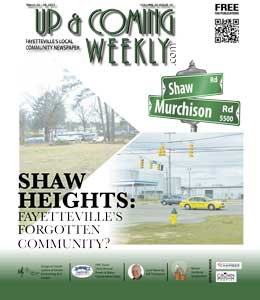
  • 001COVERShaw Heights is a hot topic right now. There is legislation pending in Raleigh calling for its annexation. But is it the right thing to do for the city? For the citizens and landowners of Shaw Heights? Sharon Valentine and Jason Brady weigh in.

    I got a text the other day from someone I consider a “tuned in” citizen. Part of the text read like this: “… Danger! Shaw Heights sh#t storm on the horizon.”

    He was referring to the proposal by local legislators that Fayetteville annex the Shaw Heights and Julie Heights subdivisions.

    He is right. The mere mention of annexation or proposing the forced taking of land and making it part of Fayetteville is like rubbing salt on road rash. In this case, it’s akin to ripping off a scab and dousing it with rubbing alcohol. Ouch! Let it heal.

    For those new to the community or lived in a cave for the past decade, here’s the simplified back story on the complex issue of annexation.  From 1960 through 1983 Fayetteville could not annex “citified” areas into the city like other North Carolina towns. Local lawmakers and volunteer fire chiefs got the General Assembly to exempt Cumberland County towns from the 1959 statewide annexation law. That law said, “… what is urban should be municipal.” It allowed towns to annex without giving the people being annexed a say in the matter.

    So, Fayetteville lobbied the General Assembly to change the annexation exemption for Cumberland County. Even the daily newspaper’s editorial staff got on the bandwagon. Their persistence paid off, and the General Assembly, in 1983, gave Cumberland County towns authority to annex under the statewide law. At first, Fayetteville nibbled away at smaller annexations. From 1984 to 1988, Fayetteville annexed adjacent urban pockets, comprising 3,000 to 6,000 people.But the pendulum took an extreme swing the other way. The result: the Big Bang annexation of 2005. It scarfed up 27 square miles, 42,000 residents, and dragged them into the city.

    The pushback was huge. Court battles between Fayetteville and anti-annexation groups ensued. But only the more affluent Gates Four Country Club prevailed. Lawyers for both sides are still getting billable hours. The Big Bang ended political careers. And in 2011, the General Assembly said no more forced annexations in North Carolina, unless people living in those areas want to be annexed. So, it was a surprise that Rep. Elmer Floyd filed House Bill 109, which according to the General Assembly website says is “an act adding certain described property to the corporate limits of the City of Fayetteville.”

    If the Fayetteville City Council agrees, annexation would happen in 2018. But like the Shaw Heights and Julie Heights community, the City Council is divided. Council members are scheduled to go on the record on where they stand this Wednesday, March 22. The area comprises 630.89 acres of dilapidated houses and trailers speckled with some nicer, well-kept homes. Most of the houses were built right after World War II and during the Vietnam War. A 2008 county land use plan refers to the area as “showing age and decline.”

    Murchison Road borders the area on the east, Bragg Boulevard on the west, and Fort Bragg and the recently completed leg of I-295 on the north. To the south is Fayetteville. Some ask why it was left out of the 2005 Big Bang annexation? Some claim Fayetteville excluded Shaw Heights because the area wasn’t worth it. In other words, it would cost more to provide services than the area could produce in taxes. Former city manager Roger Stancil said the city did not annex Shaw Heights because the county could get water and sewer to the area through a grant from the Rural N.C. Center if the area was not annexed. It never happened.

    So, why annex now? Floyd, Fayetteville’s former Human Relations director, recently told a gathering of citizens that the 1,300 residents deserve enhanced services. Councilman Kirk DeViere says the area needs to be developed to city standards. The I-295 interchanges will make the area ripe for commercial development. Others say it’s a chance for the city to establish an attractive gateway for traffic coming off I-295. Still others see a less honorable motive. A few Republicans question whether the sudden interest in Shaw Heights and Julie Heights might be about adding more registered Democrats to the city voter rolls.

    Floyd, a Democrat, sponsored the bill. Fellow Democrats Reps. Billy Richardson and Marvin Lucas co-sponsored the bill. On the Senate side, Sen. Ben Clark, also a Democrat, filed the Senate’s version of the bill. Political watchers point to the past two mayoral non-partisan elections, Mayor Nat Robertson, a Republican, won his first election in 2013 over Democrat Val Applewhite by only 250 votes. In 2015, he won by about 673 votes. Adding another 500 registered Democrats could affect future city elections. Finally, some among those annexed in 2005 fear that the Shaw Heights annexation will affect the schedule and available money for getting PWC water and sewer.

    Mayor Robertson’s opposition centers on economics. He says the area consists of people who least can afford the taxes and fees that come with annexation. He says the services the area needs are available through the county. It’s the county that has failed those neighborhoods. Councilman Bill Crisp agrees. He objects to forced annexation, period. Crisp was among those who fought the City in court over the 2005 annexation before becoming a member of City Council.

    According to Robertson, the city projects the area will provide roughly $200,000 in annual revenues. The county’s projection is even less. But PWC’s cost to put water and sewer in the area will be $7 to $10 million. “The area has issues, but why does the city have to come to the rescue?” Robertson asked. Councilman Ted Mohn thinks he has a solution. It’s called extra territorial jurisdiction. It’s where the city has jurisdiction for law enforcement and development standards.

    In an email to fellow council members and city management, Mohn said the ETJ would protect the money for the Big Bang sewer construction. Also, ETJ would let the city provide incremental city services as budgets allow. The ETJ would start on July 1 and total annexation would happen in 2020. So far, “mums the word” on his proposal, Mohn said.

    — Jason Brady

    There is an adage: “everyone has a lobbyist except the poor.” And that theory will have been proven out with the fate of Shaw Heights and the decision of City Council to proceed with annexation. This painful reminder of political expediency and discrimination will test our political conscience and shine a light on the mayor and the council on what is more important — political careers or the common good.

    There should be no argument on moving ahead with the annexation because Shaw Height presents Fayetteville with a tremendous opportunity.  As we hurtle toward the development opportunities provided by the I-295 Loop at the Murchison Road exchange, Shaw Heights is Fayetteville’s new “Gateway.” Traffic patterns will direct visitors from I-95 and Spring Lake onto Murchison and into

    the Downtown with the baseball stadium, the museums and local attractions.  And as a lightly-populated rental area with open tracts of land, the economic forces could not be more aligned to solve problems associated with poverty and pivot to Fayetteville’s “new 2026 image.”

    But maybe not! It appears that neither the city or the county have moved since the 2008 county plan to update and plan for the growth that has been

    indicated on the maps since the initial approval of the loop. And let’s be honest, the attraction of private investment and its interest in the Shaw Heights potential is accelerating the need for the zoning, permitting and incentives that are imperative to good economic development and positive growth.

    Why has there not been ongoing discussions and planning over the past 10 years rather than the county and city in a “stare down” on who will take responsibility for convening the debates on the Shaw Height suburbs, particularly when it is a “win-win” for both the city and the county?

    While rumors of a commercial hotel being built and local developers looking at the numerous ways “to make a buck,” PWC is brooding over the size of sewer line pipes that would serve the present neighborhood rather than addressing a plan that would promote commercial development. And the road improvements on Shaw Mill Road in the NC Transportation Plan and the wetland area that would have to be addressed in zoning action are still a footnote. Where are our local boards and commissions that meet on a regular basis to look at issues that impact “good growth?”

    Certainly, cost is a huge consideration as well as the bonds that would have to finance certain municipal improvements. But it is time to begin to poke our heads out of our respective silos and see who is out there.  Developers will certainly have to pay part of the “freight” like sewer line hookups, compliance with the UDO, etc. if Shaw Heights is, in fact, part of Fayetteville.

    But isn’t this area part of the acreage being considered by the council for our large sports complex: soccer fields, baseball diamonds, tennis courts, a competitive swimming pool—all the things that attract teams and competition from around the state. And have we not already approved bonds to fund this complex in the recent Parks and Recreation Initiative?

    The bottom line is still that the least among us deserve acceptance and assistance as part of the total community, and turning our backs one more time (whatever the rationalization) is unacceptable.

    Is Fayetteville ready to be the community envisioned in the 2026 initiative?  If our elected officials cannot step up to the plate of annexation, then it is time to recruit a new team.  Fayetteville is losing two top talents of the council—Ted Mohn and Bobby Hurst.  And our “wise man” Bill Crisp is silent on his plans on running.  

    The deadline then falls on us — the residents, the taxpayers and the local supporters to find a mayor that puts purpose ahead of politics and a Council

    that serves in the “interest of the common good.” 

    — Sharon Valentine

  • 13AllAmericamOn March 25, from 10 a.m. to 1 p.m., the USO of North Carolina, Fort Bragg Center and the Downtown Alliance will host a fundraiser called the All-American Fayetteville Challenge to support their work assisting the local military members and their families. “There is a reason we do fundraising. We saw 135,000 service members and their families at two of our three centers last year. It takes a lot of resources to operate at this high level. We fundraise to keep our doors open and to continue operating at the high level that our military members expect,” Renee Lane the Sandhills Region Director of the USO of North Carolina said. 

    The All-American Fayetteville Challenge is essentially a giant scavenger hunt for teams of two. “It is a cross between the Amazing Race and a scavenger hunt. We are always looking for new ways to engage the public to support local military members. The USO of North Carolina is this conduit in the state and locally,” Lane said.

    Firstly, teams check in at Festival Park, which is where the last standing USO building was in Fayetteville. Then teams use a smartphone to access a webpage that guides them through the scavenger hunt. The hunt features landmarks and businesses in Downtown Fayetteville. At each key location downtown, the teams must complete a challenge and collect challenge tokens. Points will be tallied to complete the challenge and determine the winning teams. Winners will be announced at a light lunch at the Fayetteville Area Transportation Museum. The teams with the highest point tally win. First-, second- and third-place teams will receive gift baskets. 

    A fully-charged smartphone is a vital part of this adventure. It will allow participants to access the website connected to the event. This website details the key locations where challenges must be completed as well as restrooms and supporting businesses that can be visited to collect extra points. The website will also keep a digital tally of points that participants collect along the way. 

    Tickets to participate are $30 and can be purchased at 

    https://www.eventbrite.com/e/all-american-fayetteville-challenge-tickets-31423765328. Teams must be made up of two persons, and there is a limit of 100 teams. Tickets also include swag bags filled with items from various downtown businesses and sponsors. These bags will be collected at the initial check in and can also be used to collect items during the scavenger hunt. 

    Another fun way to explore the city is the All-American Historic Tours. The Downtown Alliance has partnered with S and S Carriage Rides to provide historic tours by horse-drawn carriage every month from March to November. Normally these historic tours are on the second Saturday, but this month, they have been moved to March 25 from 1 to 4 p.m. to help the city celebrate the All-American Weekend. 

    The 45-minute tours focus on Fayetteville’s early Colonial and Revolutionary War-era history. “The tours visit sites as early as Cool Springs Tavern, which was built in 1788. It is the oldest man-made structure in Fayetteville. They also see Liberty Point, which is where 55 patriots signed the Liberty Point Resolves and pledged their lives and fortunes to American independence. This happened a year before the Declaration of Independence,” said Hank Parfitt, an event organizer with the Downtown Alliance. 

    The departure point for the historical tours is 222 Hay St. Tickets are $25 per person, $20 with military ID and $15 for children under 12. For more information or to reserve tickets visit www.visitdowntownfayetteville.com or call (910)222-3382. Carriages can accommodate 10 to 12 people, and there will be four tours from 1 p.m. to 4 p.m. 

  • 12GardenThis spring has been unusually fast in coming, which has caused gardeners to both wiggle their toes in anticipation and clutch their hearts for fear of a devastating freeze. 

    If this describes you, then you are most likely a deep-rooted lover of growing things and should attend the Master Gardener Spring Symposium 2017, organized by the Cumberland County Extension Master Gardener Volunteer Association. The event will be held Saturday, March 25, at the Cumberland County Agriculture Extension Center.

    The CCMGVA is made up of people who are truly passionate about gardening. Judy Dewar has been a volunteer with the organization for 13 years. She is currently the “chair, table and leg” for the Spring Symposium. She said she fell in love with gardening “100 years ago” in the backyard with her Dad – where he only let her do the weeding. 

    Sandra Williams, registrar for the Symposium, shared what she loves about CCMGVA: “I relish the knowledge of those that have been in the volunteer program for years … It is great to share our common (love) of making things grow successfully with our community.”

    Dewar, Williams and everyone involved in organizing the Symposium have selected speakers who share this genuine passion and have unique expertise and skills to share. Roger Mercer, Mike McGrath and Bryce Lane will speak, and Brienne Arthur will be present for a book signing.  

    Like Dewar, local guru Roger Mercer traces his love of gardening back to early experiences with his Dad. “We created beautiful gardens wherever we moved, and we lived in about 17 houses before I got out of high school,” he said. At the Symposium, Mercer will offer his extensive knowledge on day lilies and camellias as well as general gardening knowledge, using the Garden of Eden as his theme. “It’s about love. Gardens are a way of loving each other through shared experiences of natural beauty. We all carry our image of the Garden of Eden. It’s a place of peace, beauty and tranquility to be in … I think that’s why (it’s) such a powerful metaphor.” 

    Mercer cares for 6.5 acres and grows about a quarter of a million plants each year, including 2,000 of the best plants to grow specifically in the Cape Fear region. He is here for the community in his daily life, not just as a speaker at large events. He welcomes those who are interested in seeing his property to give him a call and set up a time to visit. “It’s kind of one of my mission in life to help people have prettier gardens,” he said. He means it.

    Organic gardening expert Mike McGrath will travel to Fayetteville from Philadelphia, where he hosts the nationally syndicated public radio show You Bet Your Garden. He is also the former editor-in-chief of Organic Gardening magazine, as well as the author of books on tomatoes, composts, seed collecting and kitchen gardening. He currently serves as the garden editor for WTOP News Radio in Washington, D.C., a position he has held for more than a decade. From 1993 to 1997, he appeared monthly as the garden expert for the Saturday morning edition of NBC’s The Today Show. McGrath will speak twice at the Symposium, with talks titled Everything You Know About Compost Is Wrong and Gardening on the Edge.

    Horticulturist Bryce Lane hosts and produces “In the Garden With Bryce Lane” on UNCTV, and has won two mid-south Emmy Awards for that work. With 30 years of teaching experience and numerous local, regional and national teaching awards under his belt, he is also a professor emeritus at NC State, and teaches courses for various organizations like the Raulston Arboretum. He has worked with CCMGVA for over 30 years of the 36 years he’s lived in North Carolina. “Gardeners are the happiest, friendliest people I know … I am a teacher at heart and therefore seek out opportunities to share my knowledge and enthusiasm for horticulture,” he said. 

    Brienne Arthur will be present for a book signing of her new book, “The Food Scape Revolution,” which describes how to create a beautiful, edible garden dispersed amongst your poppies and roses.

    This is the third year that members of CCMGVA have orchestrated a Spring Symposium, which is made possible by the Fayetteville PWC and 15 other generous community sponsors. Registration for the full day costs $50. Garden-related vendors and special garden interest groups will be available for browsing throughout the day. Attendees can also take a guided tour of the Master Gardener’s Demo Garden between sessions. The event is almost sold out! Register online at https://form.jotform.com/Mastergardener1/registration2017. 

  • 11BiblicallyAt Carolina College of Biblical Studies, we exist to disciple Christ-followers, through biblical higher education, for effective servant leadership. The question is often asked, “What’s that look like?” Recently, I sat down with graduate William Wallace to see how CCBS affected his life and find out what he’s doing since graduation. 

    Korver:Welcome William. How did you find out about CCBS?

    Wallace: I attend New Life Bible Church, and I found out my pastor went here in the 70s. I had been going to the church about five or six years... I liked the way he taught and it just always was kind of in the back of my mind. He taught the Bible very, very well; he was very confident in the way that he taught. Finally, I engaged him in conversation. He told me where he went to school and that’s what started it. One day I dropped by and enrolled in a “How to Study the Bible” class.

    Korver:You’re a veteran? Which branch of service and how many years?

    Wallace:I spent 25 years and 8 months in the United States Army. I came in 1990. I started off at Fort Bliss as a private, and I retired at Fort Bragg on Jan. 31 of this past year.

    Korver: From the time you enrolled at CCBS until you graduated, how long were you here?

    Wallace: It was almost five years … it was a little over four. It was, I guess, about the traditional amount of time, but it was kind of a tough mix in between doing CCBS and work.

    Korver: So, you were managing a full-time job — a career — and being almost a full-time student?

    Wallace: Early on, it started where I could only do classes in the evening, so I would do one or two classes. But as I got a little more comfortable and my job got a little bit more comfortable with allowing me time off, I started to do a few more classes in the evening. I was getting ready to retire, so the workload was beginning to decrease a little, so they began to give me a little bit of time off in the morning so I could do one class in the morning.

    Korver: Now I’m asking a hard question here — out of all the 60 or so classes you had at CCBS, which one affected you the most and how so?

    Wallace: Not a hard question... homiletics.

    Korver: Homiletics is…?

    Wallace: The study of how to preach. That was what I believe my calling was. That’s kind of what I wanted to do and once I took the first class, I knew it. I liked the structure of the class. I liked the blending of hermeneutics... the way the class was delivered was great. That was, by far, the most influential for me.

    Korver: And they affected you in the sense that you were better able to craft and deliver a sermon?

    Wallace: Absolutely. Before then [I was] just kind of self-taught... a lot of books had been read. But the ability to have some structure applied, timing, research methods. It helped a lot. It appealed to my military side, too, because the way the course was delivered was very structured.

    Korver: Since you graduated, how has God used what you learned here in the classroom in your ministry at the church or on Fort Bragg at your job?

    Wallace: Well at New Life Bible Church I’ve gotten the chance to assume some more responsibilities — I teach a New Life Bible Institute class. I teach a few more Bible study classes. It’s made me more confident. I would almost say it’s strengthened my relationship with Christ. It just gave me a confidence in God’s word — that it is in fact true, and it does in fact work. Because I believe our life is completely filled, and should be completely governed by Christ, it has helped me at work. It has given me more confidence at work. It has helped tremendously.

    Korver:Outstanding. Now you know this, higher education is not free. When you were a student here, how did your tuition get paid?

    Wallace:It was a mixture for me. The military was allowing soldiers to transfer their G.I. Bill to family members. I had done that already before I even started here. So, it was a mixture of tuition assistance and out-of-pocket. If I had to give it a percentage, about 40 percent of my complete time here was tuition assistance and the rest out-of-pocket.

    Korver: If you had to do it all over again, would you?

    Wallace: For me, Dr. Korver, I would probably stay on the same track. I don’t know if I was spiritually mature enough [before] to really have the “sticktoitiveness” that I had at the point when I started. I think for me, that point in time was great. I was active in a local church, I was at a different place financially in my life, spiritual maturity was strong. So, I think for me it was a good mix of time.

    Korver: Well, we’re really proud of you. Thanks for taking time to be with us today. God’s blessings to you. 

  • 10WaterWaterOver the years, Fayetteville has had an abundance of fresh, usable water. We are truly blessed to have the Cape Fear River basin in our backyard. However, like the rest of the world, the demand for fresh water has never been higher, and that demand will continue to grow.

    Historically, cities have flourished being near an abundant amount fresh water. Yet we do little, if any, long-range planning for our river and/or our ground water. We have also put enormous pressures on our water supply. We have not looked at our water as it is; we have not utilized it to its fullest potential and we CERTAINLY have not placed any buffers (nor have we done any long-range planning) to protect or to ensure we have both the quality and quantity of water for future demand.

    The interbasin transfer of the Cape Fear System has resumed, and alarmingly, is growing. This flies in the face of common sense. Why and how does an upstream city get to take and use water from one basin, then replace it in another basin, i.e., the Neuse River basin? It is illogical, unless the increased capacity allows them to take more from the Neuse River, getting double use of the same water at the expense of those downstream.

    What does it matter? We have “water – water everywhere,” as the poem goes. But like the poem also says, we soon may have “nary a drop to drink,” or “nary a drop” to use. This would be a tragedy, as water is essential to life, essential to growth, and is the life’s blood and identity of a community. It does not take a crystal ball to see the conclusion of unrestricted interbasin transfer.

    1. As Wake county grows, so grows the demand for more water. A basin has finite capacity. When an upstream user takes from that capacity and doesn’t replace it, the downstream users have less to use. This affects the ability of those downstream to grow, it detracts from economic recruitment – hence, a smaller pool of high-paying jobs.

    2. A smaller capacity creates more pressure on ground water and on existing capacity, which makes treatment of water impossible.

    3. It takes more water to treat water.

    Interbasin transfer is just part of problem. Run-off, ground water contamination and failure to buffer our rivers are costing us daily in terms of unavailable, unusable water. It is estimated by 2030, half to two-thirds of our water will be unusable. If this is the case, we can only blame ourselves because we need to respect the laws we pass.

    1. We continued to build neighborhoods with septic tanks and inadequate storm water run-off. They affect our ground water, which goes into our river. 

    2. The failure to buffer and plan for the use of our water fails to protect this resource and show we don’t fully understand just how valuable our water is. It is a finite resource.

    3. Our quality of life and ability to survive depends on our water supply. Yet we continue to take it for granted.

    4. Fayetteville is the only city on a major river which, heretofore, did not have a major magnet center fully utilizing its river’s natural beauty.

    Finally, Fayetteville has a river overlay zone whose purpose was/is to attract people downtown and utilize the river. Every city that has done this has flourished — Chattanooga, Tennessee, Elizabeth City, New Bern, Wilmington, San Antonio to name a few. In doing so, they grew their tax base, created jobs, improved quality of life and made the river what it ought to be: priceless.

    However, lawmakers, whose priority is to put loyalty to contributors over citizens served, have failed our river and its economic generator before it started. Water is not only essential to life, it is essential to growth, quality of life and is the life blood of a community. We must stop interbasin transfer, protect and buffer our basin abd use common sense by re-using our water wisely. Laws must be respected to matter. Ironically, we have laws in place to restrict interbasin transfer and run- off. We even have a river park zoned overlay. Yet, when laws and regulations are ignored, they are no longer laws, they’re just words.

  • 09Fugitive Patrick GatsonPatrick Earl Gatson, 32, robbed a woman a month after he was released from prison in mid-February, said Fayetteville Police Lt. Todd Joyce. “He knocked her to the ground and snatched the woman’s purse,” Joyce said. Gatson was being sought by authorities for that robbery the night he was shot and killed by police. Joyce said the woman’s purse was found in a trash can at his apartment. Members of the FPD’s Violent Criminal Apprehension Team went to Gatson’s home to arrest him for the robbery, said Interim Police Chief Anthony Kelly. He lived at a horseshoe-shaped apartment complex of three buildings on North Street. Gatson holed up in his apartment and told police he wasn’t going back to prison, officials said, and repeatedly threatened to kill any officer who approached him. 

    Kelly said Gatson was shot following an eight-hour standoff, “when the situation presented itself.” A special tactics officer had positioned himself in the attic of the apartment. He came down from the attic and found the fugitive in a closet of a bedroom. Kelly said the officer turned and ducked out of the way when he spotted the subject holding a rifle. Early reports were that Gatson chased the officer from the bedroom but did not fire at him. Kelly said two officers used “nonlethal weapons,” and a third fired his gun when the subject pointed the rifle at them. 

    However, the chief could not precisely describe the sequence of events, nor could he say which of the officers fired the fatal bullet. The SBI continues to interview the officers involved and view video footage of the body cameras worn by the 60 policemen on the scene, the chief said. An internal affairs investigation is being conducted in addition to the SBI probe. That is standard procedure in officer-involved incidents.

    The officers placed on administrative duty are Joseph Delpizzo, 44, Shawn Collins, 42 and Aaron Hunt, 28. Kelly said Delpizzo and Collins are 19-year veterans of the force. Hunt has been with the department for seven years. Police crisis negotiators and family members pleaded with Gatson repeatedly over the course of the eight-hour standoff. “We did everything in our power to end this peacefully,” said Capt. Darry Whitaker, one of the crisis negotiators.

    Residents of the apartment complex at the corner of North and Drake Streets were evacuated soon after the drama unfolded. T.C. Berrien Elementary School, which is next to the apartments, was locked down until school was dismissed about 2:30 p.m. Kelly said officers were careful not to take any aggressive action while school was in session. Residents returning home from work late in the afternoon could not enter the cordoned off area. A van arrived on the scene so residents and their children could get out of the cold. Police had hamburgers and fries brought to them from a fast food restaurant.

    Chief Kelly opened the news briefing last week saying he is praying for all those involved in “this unfortunate incident.”       

  • 08RapeClosureFayetteville Police have cleared an 11-year-old cold case. Nearly two dozen dated rape cases have been cleared by the Cold Case Sexual Assault Unit of the FPD’s Special Victims Bureau, said Lt. John Somerindyke. The department filed charges last week against a double murderer who’s serving a life sentence in state prison. Keith Devon Manuel, 40, is accused of raping the victim at her home near South Reilly and Cliffdale Roads on August 26, 2006. 

    “Manuel broke into the residence while the victim was inside,” said police spokesman Lt. Todd Joyce. Additional forensic testing not available at the time of the crime resulted in charges being filed. Manuel is charged with 1st-degree rape, 1st-degree sex offense, 1st-degree kidnapping and 1st-degree burglary. “Manuel was already in custody before these charges were taken out and is currently serving a life sentence in prison for the murder of Jessica Morgan and the murder of Alfreda S. Jones,” added Joyce. The double homicide occurred in the county and was investigated by the Cumberland County Sheriff’s Office.

    “There are about 200 cases … reported between 1984 and 1999 that are still unresolved,” said  Somerindyke. He made that statement in the fall of 2015 and said they had “taken out warrants in 21 cold rape cases” since then. The unit began operating in early 2015. The department received a $363,000 federal grant two years ago to turn up the heat on accused rapists.           

  • 07FtBraggBusinessFairFort Bragg will host an Acquisition Forecast Open House Wednesday, March 28, at the Cumberland Hall Auditorium on the campus of Fayetteville Technical Community College. It will be held from 8 a.m. until noon. Fort Bragg contracting officers and staff will present and discuss their anticipated procurement needs and contracts for the remainder of federal fiscal year 2017, which ends Sept. 30. Additionally, the district director of the U.S. Small Business Administration and representatives of the General Services Administration will be on hand to provide program updates for attending business people. 

    “Any business that wants to do work for Fort Bragg or other bases should attend this event,” said Scott Dorney, executive director of the North Carolina Military Business Center. “This acquisition forecast provides a unique opportunity for business representatives to speak directly with contracting officials about upcoming projects, as well as the products and services that their businesses can provide to military installations in our state,” Dorney added. The event is free, but pre-registration is required. Because of seating restrictions, admission will be limited to the first 275 registrants to sign up. Two attendees per company may take part. Information and official online registration are available on the business center website: http://www.ncmbc.us/micc-fort-bragg-acquisition-forecast-open-house-march-29 or by phone at 910-678-0190 or 910-678-0049.

  • 06Red Light EnforcementThe City of Fayetteville is one of the few large cities in North Carolina to restore red-light cameras on city streets to prevent intersection traffic accidents. State law says net proceeds from the fines must go directly to the Cumberland County Board of Education. “Since it was executed in March 2015, the red-light camera program has provided approximately $1.1 million net to Cumberland County,” said Mayor Nat Robertson.

    “While the purpose of the red-light camera program is traffic safety, the money generated at these city intersections could go a long way to demonstrably improving both pedestrian safety and recreational facilities,” the mayor said in a letter to Board of Education Chairman Greg West. Currently, the school board puts the money in its general fund. It’s not the first time a member of City Council proposed asking the school system to earmark red-light camera funds for a special project. Mayor Pro Tem Mitch Colvin spoke of dedicating the money for the special needs of young children. City Council never acted on the idea. For that matter, it has never seriously discussed asking the school board to spend the fine funds in ways preferred by city government. Robertson disagrees: “The purpose of the letter to Chairman West was consistent with the thought of some councilmembers as we have previously discussed,” he said. 

    Councilman Kirk deViere, who ran against Robertson in the 2013 mayoral race, said Robertson’s letter to West was inappropriate because it did not represent a consensus of City Council. “This letter makes it sound like you have consensus from council when you stated ‘we request’ in the third paragraph of the letter,” said deViere. Robertson specifically asked that the school board “adopt a policy designating all future red-light camera proceeds to further the City’s efforts in the extension of sidewalks and enhancements to shared recreation facilities at schools located inside the city limits of Fayetteville.” His letter concludes, “I make this request on behalf of the entire City Council and look forward to your positive response.” West has not responded as far as we know. Robertson was surprised at deViere’s response to his request. “Honestly, I can’t speak on Kirk’s political motivations, but to me, there is no reason to compromise on doing the right thing for the people I represent,” Robertson said.

    Modern red-light camera systems are sophisticated and expensive. American Traffic Solutions contracts with Fayetteville to operate the growing number of covered intersections. Officials said it costs about $100,000 to construct a single video/still camera operation. Violators are fined $100, 30 percent of which goes to the company. The balance is paid directly to the school system. Violators receive letters which say in part. “Based upon images captured by the automated system, your vehicle was determined to have committed a red-light violation. As the vehicle owner, the Notice of Violation is mailed to you.” 

    There is an appeal process during which violators are shown still photos and persuasive videotape of the violations.

  • 05FayVA insigniaThe director of Fayetteville’s Veterans Affairs Medical Center says a critical performance audit on veteran wait times by the VA inspector general’s office was outdated and inaccurate. “The team reviewed a small sample of appointments from 2014,” said FVAMC Director Elizabeth Goolsby. “Discrepancies identified by the inspector general on patient wait times resulted from the IG’s use of a methodology that was inconsistent with VHA policies at the time of the audit,” she added. Goolsby responded to criticisms raised by U.S. Senators Richard Burr (R-N.C.) and Thom Tillis (R-N.C.). The Veterans Health Administration is the component of the Department of Veterans Affairs that implements the medical assistance program of the VA through the administration and operation of VA Medical Centers, Outpatient Clinics, Community Based Outpatient Clinics and VA Community Living Centers.

    Burr and Tillis sent a joint letter to Secretary of Veterans Affairs David Shulkin last week in response to what they called “a troubling inspector general report (released earlier this month) on veteran wait times.”  The letter said, in part, the senators were concerned that ”across the VA’s Mid-Atlantic Healthcare Network actual wait times were drastically different than what had been reported” by VA medical facilities in Asheville, Durham, Fayetteville, Salisbury and in Virginia. In their letter the senators said. “The IG found that facilities did not consistently conduct scheduler audits, and so we ask you to require that an individual … is responsible for ensuring that the required scheduling audits are completed as prescribed.” 

    Goolsby replied “All scheduling audits and follow-up training atthe Fayetteville Veterans Affairs Medical Center were compliant with VHA requirements.” She stated this in response to an inquiry from Up & Coming Weekly. 

    The actual IG report was dated January of this year but contained outdated findings. Goolsby noted that Burr and Tillis relied on the IG audit of a small sample taken three years ago which concluded “Veterans…deserve to be seen more quickly…and Congress, veterans, and the American public must be able to trust that the wait time information being provided by VA is accurate. That we, once again, cannot trust VA data is more than disappointing,” the Senators wrote. The letter was also signed by U.S. Senators Johnny Isakson (R-Ga.), Mark Warner (D-Va.), Tim Kaine (D-Va.), and Jon Tester (D-Mont.).

    Goolsby released current wait times: “We are pleased to say that VA’s most recent wait time data reveals as of Feb. 15, 2017, the average wait time for veterans to receive an appointment at the Fayetteville VAMC is 3.63 days for primary care; 14.88 for specialty care; and 5.45 for mental health; this is down from Dec. 15, 2014 figures of 29.02 days for primary care; 19.07 for specialty care; and 7.35 for mental health,” the director outlined. “Additionally, we offer same day service for primary care and mental health for veterans with urgent needs,” she concluded.  “Fayetteville VA remains committed to providing our Veterans high quality, safe patient care, in a timely manner. This is care these  veterans have justly earned,” Goolsby emphasized.

  • 04NewsDigestComputerized Traffic Signal System Coming to Fayetteville 

    A computerized traffic signal system is coming to Fayetteville, thanks to a $6.4 million contract awarded by the North Carolina Department of Transportation. It will replace the system destroyed by Hurricane Matthew flooding in October. The citywide project will update the signal system at approximately 275 intersections. Division Six Construction Engineer Randy Wise said the new system “will assist the City of Fayetteville and NCDOT to more quickly respond to issues and better coordinate the signal system timing.” Fulcher Electric of Fayetteville was awarded the contract. Work will begin as soon as April 3 and should be complete by Oct. 15, 2019.

    Solving Cybercrimes

    The Fayetteville Police Department has been awarded a $40,000 grant by the Governor’s Crime Commission in support of the department’s cybercrimes unit. The funds will be used to purchase equipment for forensic investigations involving digital devices. Updated software and hardware are needed to keep up with the ever-changing climate of today’s technology. The Fayetteville Police Department partners with the State Bureau of Investigation’s Computer Crimes Unit and its internet Crimes Against Children Program. “FPD’s Cyber Crimes Unit is a vital resource for … agencies in the local area,” said police spokesman Lt. Todd Joyce.

    Citywide Cleanup

    The annual Fayetteville Beautiful citywide cleanup is slated for Saturday, April 1, 2017. Volunteers are asked to arrive at the entrance to Cross Creek Park on Green Street between 8 and 9:30 a.m. Supplies will be distributed at that time. They include:  orange trash bags, T-shirts, gloves and bottled water. Residents who want to volunteer can sign up online on the interactive map at www.fayettevillebeautiful.com. 

    Medal of Honor Day Observance

     Fayetteville’s Airborne & Special Operations Museum Foundation is honoring three Medal of Honor recipients March 25, 2017, at 10 a.m. in the Yarborough-Bank Theater at the museum. State Rep. John Szoka (R-Cumberland) is the keynote speaker. This year’s highlighted recipients are PFC Charles Neilans DeGlopper, Private Joe Gandara and LTC Robert George Cole. DeGlopper posthumously received the Medal of Honor for his heroic actions and sacrifice of life during the early stages of the Battle of Normandy in World War II. He was also the only World War II soldier from the 82nd Airborne Division to receive the award for action during the Normandy Campaign. Gandara, a member of the 507th Parachute Infantry Regiment, was awarded the Medal of Honor in recognition of his heroic actions June 9, 1944, in Amfreville, France. With his unit pinned down, Gandara advanced alone toward the enemy position and destroyed three hostile machine gun positions before he was fatally wounded. Cole received the Medal of Honor for action above and beyond the call of duty June 11, 1944, in France. LTC Cole’s unit was pinned down by withering enemy fire. He charged on and led the remnants of his battalion across open territory to the enemy.

    Fayetteville Law Firm Expands

    The Richardson Firm, a Fayetteville-based law practice, announces the association of two new lawyers: attorneys Keischa Lovelace and Heather Rattelade. Lovelace comes to Fayetteville from Raleigh where she had her own practice. She focused on representing claimants in civil litigation matters, including workers’ compensation and Social Security disability. Before that Lovelace served as deputy commissioner and claims administration director for the North Carolina Industrial Commission. Lovelace earned her J.D. degree with honors from UNC-Chapel Hill. Before law school, she was a teacher in Wake County after graduating magna cum laude from N.C. State University.

    Rattelade earned her law degree at North Carolina Central University in 2008, but her experience began years before. She assisted capital defense teams as a mitigation specialist before and during law school. Rattelade began her career as an attorney with the Law Offices of Bruce T. Cunningham, before founding her own firm in 2010 to focus on fighting for individuals’ civil rights. “I decided to join The Richardson Firm because their philosophy is closely aligned with my mission to protect and promote vital constitutional and civil rights,” Rattelade said. She co-authored articles published in the North Carolina Central Law Review, and has given lectures on post-conviction investigations and flawed forensics at Duke Law School, Campbell Law School and North Carolina Central School of Law. “Keischa and Heather bring a wealth of experience to our firm,” said Attorney Billy Richardson. 

    Community Development Action Plan Update

    The 2017 Cumberland County Community Development Annual Action Plan is available for public review and comment at 10 locations around the county through April 13. Following the review period, a public hearing will be held at the Cumberland County Board of Commissioners meeting April 18 at 6:45 p.m. in Room 118 of the Courthouse. The action plan can be reviewed at these locations:

    ·   Community Development Office, 707 Executive Place

    ·   East Regional Branch Library, 4809 Clinton Road

    ·   Falcon Town Hall, 7156 Southwest St., Falcon

    ·   Godwin Town Hall, 4924 Markham St., Godwin

    ·   Hope Mills Branch Library, 3411 Golfview Rd., Hope Mills

    ·   Linden Town Hall, 9456 Academy St., Linden

    ·   North Regional Branch Library, 855 McArthur Rd., Fayetteville

    ·   Spring Lake Branch Library, 101 Laketree Blvd., Spring Lake

    ·   Stedman Town Hall, 5110 Front St., Stedman

    ·   Wade Town Hall, 7128 Main St., U.S. Highway 301 N., Wade

    Annual community development action plan updates address the priority needs of affordable, safe, decent housing to low-moderate income residents, the homeless, those at risk of becoming homeless and the special needs population. The draft plan can be seen at www.co.cumberland.nc.us/community_dev.aspx.

  • 03KarlOCAREThe Affordable Care Act, routinely referred to as Obamacare, was signed on March 23, 2010. Referring to the program, “Obamacare Summary” at Obamacare.net says, It was created “to make healthcare more affordable and easily accessible to a wider range of Americans.” Seven years later, Obamacare is failing terribly. Some describe it as imploding. Amazingly, many in America, including politicians and general citizens, are vehemently opposing Republican efforts to repeal and replace this legislation. Protests are raging across the nation. 

    One has to wonder how it can be that so many people want to keep in place a program that is not working anywhere near what was promised and is on the verge of total collapse. The possible explanations include, but are not limited to: individuals expecting society to provide health care for every citizen, no matter a person’s failure to act responsibly; citizens not understanding the perilous state of the program; the general entitlement mentality that has taken up residence in our country. Whatever the reason or reasons for this unfathomable demand by some to keep Obamacare in place, somebody needs to tell the whole truth about the danger it poses. 

    I contend that politicians do not tell the whole truth regarding Obamacare and what can reasonably be done by way of repealing and replacing it. The critical word in that statement is “reasonably.” This assessment is especially true of Republicans, but also falls at the feet of Democrats and independents. As is the case with so many challenging issues facing our nation, these politicians are so focused on winning re-election and holding onto power that they hesitate to speak any truth that jeopardizes re-election or retention of power. 

    Elected politicians and those who benefit from close ties to them speak to the “safe” talking points for repealing and replacing Obamacare. Some of these safe talking points follow:

    1. Contrary to President Obama’s promise, participants have not been able to routinely keep their doctor or their plan.

    2. Annual premium savings to families are not averaging $2,500, as was promised.

    3. Following from “Obamacare’s implosion” by Stephen Moore:

    a. “In 2017 about one in five Obamacare enrollees will have only one insurance plan to choose from. One third of counties have only one insurer. That’s a lot of choice and competition. It’s like what Henry Ford said about the Model T, you can have it in any color as long as it’s black. This contraction of the market is going to get worse in a hurry, which is why Hillary Clinton wants a ‘public option,’ which will soon be your only option.”

     b. “The few remaining Obamacare defenders meekly say that most people are not facing 22 percent premium hikes because most Americans are in employer plans. But those employer plans are starting to see the same rising price pressures.”

    c. “Instead of 24 million covered as promised, the number is half that, or 11.4 million. The vast majority of Americans who have gotten health insurance under the new law were dumped into Medicaid. This is a welfare program for people with very low incomes. Shouldn’t we define success in America when fewer, not more people are receiving welfare?”

    4. Businesses that have more than 50 full-time employees must provide health insurance for them. To avoid this requirement, some businesses are employing more part-time personnel and, thereby, avoiding the coverage requirement. This adversely impacts full-time employment rates and employee income.

    Those are some of the talking points that politicians and their surrogates will address because they are palatable to citizens. On the other hand, what follows are some of the not-so-palatable Obamacare considerations that are not addressed directly. Doing so gets to the whole truth:

    1. The mandate that every American purchase health insurance or pay a penalty unless they get an exemption is absolutely essential to Obamacare. Premiums from the healthy are needed in order keep premiums reasonable for the sick. 

    2. Among far too many, there is the conviction that health care is a right. Reference after reference states that nowhere in the Constitution is health care presented as a right. This “health care as a right” mindset should be factually challenged because allowing it to take even greater hold in the thinking of Americans further complicates successfully addressing the issue. The high hurdle in addressing the “health care as a right” issue is in the courts and legislators repeatedly stretching the Constitution to provide rights not stated therein. Regarding this matter, Gregory Curfman said this in an article titled, “King V. Burwell and a Right to Health Care:” “The Constitution itself does not stipulate a general right to health care, but a patchwork of rights to certain aspects of health care have emerged over time from both constitutional and statutory law.”

    3. As harsh as it might sound, open and honest discussion of fairness should be brought into the deliberations. Is it fair to Americans who act responsibly that they are made to financially support others who do not? There are those who, through no fault of their own, fall on hard times. I am not talking about them. Consider the person who, by their choosing, drops out of free public school, pursues no marketable skill, repeatedly makes destructive life choices and shows no effort to turn his or her life in a positive direction. Should taxpayers be required to provide health care for that person? 

    4. Governor Roy Cooper, D - North Carolina, is pushing for Medicaid expansion as allowed and promoted under Obamacare. Many states have done the expansion and, politically, doing so probably wins votes. However, I contend Stephen Moore, in the article, “Obamacare’s implosion,” tells the whole truth when he writes: “…Medicaid is such a bad insurance program — with many doctors and treatment centers refusing to take Medicaid enrollees — that the health results of those in the program are barely better than for those with no insurance at all.” 

    5. Mainstream media makes every effort to present Obamacare in a positive light by focusing on individuals who benefit from participation and giving full coverage to those who protest in favor of keeping the program. There must be much more visible telling of the stories of those caught in the implosion of Obamacare. An example is the situation of Leslie Kurtz, as told in an article by Tom Murphy and Meghan Hoyer, titled “What if there’s no affordable insurance to buy?”

    “Leslie Kurtz needed three plates, eight screws and a big assist from her insurer after breaking every bone in her ankle while white water rafting. Coverage she purchased through a public insurance exchange established by the federal health care law paid $65,000 toward surgery and the care she needed after the 2015 accident. But that protection may not exist next year because insurers have abandoned the Knoxville, Tennessee resident’s exchange. As of now, Kurtz has no future coverage options, and she is worried.”

    6. In the great press for all Americans to have access to health care, I hardly hear any mention of the doctor shortage faced by this nation, even before Obamacare, and now exacerbated by implementation of this program. The result is that we have more people seeking care from a pool of too few doctors. The result has to be doctors spending less time with patients, increased physician burnout and more than usual early retirements among doctors. This condition has to be addressed and made a factor in determining the direction of health care in America.

    The point of what is presented above is that Obamacare is “imploding,” while individuals and groups across America protest vociferously to keep the program in place. Congressional Democrats are contributing absolutely nothing to finding a way to put in place health care that works. Instead, they are fighting “tooth and nail” against Republican efforts to repeal and replace Obamacare. All of this opposition is given credibility in the thinking of many Americans because it is treated empathetically by mainstream media. This is a formula for creating a mess — and a mess is what we have in Obamacare.

    Correcting or cleaning up a mess requires confronting and responding to the whole truth of the situation. The call here is for people in positions of leadership to put aside boundless pursuit of political position and power … then tell the American people the whole truth about what is possible, reasonable and financially affordable by way of health care in this country. Some call for citizens to “speak truth to power.” This is one of many instances where people in positions of power need to speak the whole truth to citizens. 

  • 02ShawTo annex, or not to annex. 

    That is the question.

    With a respectful nod to William Shakespeare and his angst-ridden creation, Hamlet, to annex Shaw Heights or not is indeed the question staring Fayetteville City Council members in the face. We can only hope they will be less tortured about their issue than poor Hamletwas about his.

    The situation is this. Shaw Heights is an unincorporated neighborhood totally surrounded by the city of Fayetteville, running between Murchison Road and Bragg Boulevard.  It is poverty stricken, with only about 14 percent of the residences occupied by their owners and fully one-third of residences vacant, many in significant disrepair. In other words, Shaw Heights is an area that has tipped from residential and is ripe to become something else. 

    But what?

    That answer is unlikely to be anything positive unless Shaw Heights becomes part of the city of Fayetteville, receiving city services and the attentions of a professional city staff, both of which could promote development of a long-neglected area of greater Fayetteville. Shaw Heights has tremendous potential. It is on the border of a major new road system, paid for not by Fayetteville but by the state and federal governments. About 40,000 vehicles travel this roadway every day, moving easily between Fayetteville and Fort Bragg. This makes the area ripe for economic development, and, indeed, professional developers are already circling. Private sector investment in Shaw Heights could turn a down-on-its-heels ugly duckling into an economic swan.

    In addition, as residents moved away from Shaw Heights and nothing much replaced them, the area has become largely a blank canvas awaiting the next good — or bad — thing. Controlled development of the area will build both Fayetteville and Cumberland County’s tax bases and provide meaningful commercial and residential development as well as green space.

    Fayetteville’s City Council members continue to hem and haw about this annexation, citing concerns about North Carolina’s involuntary annexation provisions. Partisan politics may well be at play as well. Shaw Heights’ annexation is a major issue, but how it is playing out brings up a larger issue that Fayetteville residents talk about in private but one which is rarely raised publicly.

    Let’s call it the vision thing.

    Observers of government at all levels see this all the time. Some of those we elect to represent us have a clear picture of where they want our community/state/nation to go, and they pursue plans and policies to achieve their goals. Other elected officials are literally clueless. They have few pictures or plans to advance their communities. In many cases, their decision-making depends not on the merits of an issue but on other factors, first among them whether their decision would keep them in the good graces of their constituents. These elected officials may be very nice people. Most are, in fact, but they are not leaders.

    Without naming names, our community has a history of electing such folks, in part, because few others step up to the plate. Offering oneself for elective service, or any service that opens one up to public judgment and potential criticism, can be a scary prospect. Running for and serving in public office affects not just the person whose name is on the ballot or who prevails in an elective contest, but his or her family and friends as well. 

    Even so, I have wondered many times why so and so did not run for public office, and I have asked a number of people to do so. I have been turned down far more often than not for all sorts of reasons, including, “Why would I want to work with ‘those people?’” Many have expressed that they are too busy or already over-committed. My answer to that is if you want something done, ask a busy person to do it.

    Fayetteville City Council has the Shaw Heights annexation issue squarely on its plate with a vote looming. City residents — indeed the entire metropolitan area — can only hope they will put partisan and philosophical concerns aside. Allowing Shaw Heights to remain an island of blight surrounded by a city striving to move forward would be a disappointment to those who work for Fayetteville’s advancement and prosperity. It would be a decision that would hold back our city.

    Let’s encourage Fayetteville City Council members to be leaders with a vision and annex Shaw Heights for the good of our community.

  • 01PubI get tickled when someone makes the statement that newspapers (and print) are dead. Are you kidding me? Not only are newspapers alive, but in a community like Cumberland County where we now lack both a local TV station and daily newspaper, a local weekly community newspaper like Up & Coming Weekly shoulders the responsibility of reporting, promoting, branding and showcasing the Fayetteville community: A task I was born to do. Confucius once said: “…one who finds a job he loves will never work another day in their life.” I truly believe this. So, not only will we never deal in “fake news,” I can also assure you our media demise is not eminent. Community newspapers are not going anywhere any time soon. Local weekly newspapers like ours are doing exceptionally well nationally. After all, it wasn’t that long ago that everyone predicted that VCRs would kill movie theaters and that TV would make radio obsolete and the telephone would put the telegraph out of business. Well, the last time I looked we have yet to lose any of these forms of communication. I know what you’re thinking. Telegraph? Where is a telegraph? Hint: Western Union! I assure you, the printed word will be around for a long, long time. And with it, newspapers. 

    “Fake News” is still a serious problem, and the biggest, most notorious sources of fake news are brought to us courtesy of the internet. No doubt, the internet and social media are the poster children for fake news. No rules, no conscience. Just say anything at any time regardless of whether it has any validity or truth. Cell phones make it too easy to record audio or live stream video to communicate and educate, to make us happy and joyful and stir our national patriotic pride. Or, the same vehicles can be used to destroy innocent reputations, wreck someone’s businesses or perhaps start a senseless riot that costs American lives and tens of millions of dollars. Today, social media and the internet are like the wild, wild west and like so many things, they started out being benevolent and beneficial for mankind and then ended up inflicting harmful and toxic unintended consequences.

    Here’s the good news: Print media, and specifically newspapers, are going to experience a boon industry once people realize the only trustworthy news and information sources will come from locally-owned newspapers produced by people they know and trust. This is trending across the country and is precipitated by the large conglomerate newspaper holding companies buying up every daily and community newspaper they can find. This has created a hybrid of detached “cookie cutter” newspaper products void of compassion, ethics and journalistic integrity. 

    Successful community newspapers have reinvented themselves probably three or four times in the last eight years. They are owned by dedicated businessmen embracing and utilizing the internet and digital technology to keep their products effective and relevant. Trust. It’s all about trust. And that is the one thing community newspapers are delivering. However, if people want to know the truth, they must seek it out. This means they must make an exerted effort to find out what is going on in their communities and the world. People are turning away from the media because they do not trust it. When they turn away from the news, they are also turning away from their communities. They become oblivious to what is going on around them. That is, unless something becomes a major controversy, and even then, there is little evidence the truth will be sought out. Currently, we need to try to find real news and real truth and not allow someone else to speak on our behalf. We need to speak out boldly. Community newspapers are becoming the most effective way to do that. I have people every week email and call me saying, “Hey, Bill, you should write about this,” or “you should write about that.” My response is, “Hey, why don’t you write about it?” And there, my friend, is where community newspapers are making great headway in restoring readers’ confidence.  

    Up & Coming Weekly community newspaper is leading the charge. For 21 years, our news, views and opinions have been written by residents who feel strongly about the news and events taking place in our community. In addition to our “first-person” commentary, our writers’ names, photos and bios are attached to every article. This makes it personal. So, if you don’t agree with one of our local newspaper topics or writers, you have direct unabridged access to the source. Truth, honesty and credibility make community newspapers valuable to our society. They make readers want to know what’s going on in our community. After 21 years of publishing in Cumberland County, I know what makes our newspaper work – and it’s not how many papers we print. It’s who reads it! 

    I’ll conclude by saying there is a lot to be gained and enjoyed from reading local newspapers and engaging in the community. Don’t let the internet and social media “fake” you out.

  • 15ShawHeightsPWC will host its third Annual Power and Water Conservation Expo Friday, March 24, from 10 a.m. – 9 p.m. and Saturday, March 25, from 9 a.m. – 2 p.m. at SkyView on Hay Street in Downtown Fayetteville. 

    “This event does focus on conservation, and we have employees and conservation specialists that will be there,” said Carolyn Justice-Hinson, communications and community relations officer at PWC. “We have information about our incentive programs, conservation tools and basic information to help people understand their utility services.” Justice-Hinson added that they will be handing out items and helping people understand how to use them.   

    The educational mascots, Willy Water Drop and Wally Watt Watcher, will be on site for the expo. “Willy Water Drop is a water drop, and Wally Watt Watcher is a plug, and sometimes people confuse him with an old-timey cell phone,” said Justice-Hinson. “The kids and adults like them and everybody likes to take a selfie with them.” 

    Participants will learn ways to save on their energy and water bills, meet PWC linemen and receive a complimentary reusable tote bag with items like LED bulbs and tree seedlings. “Our linemen will have a miniature utility pole, and they will show you how they restore power,” said Justice-Hinson. “You can touch it, and they will let you help them so you can see what their job is all about.” Justice-Hinson added that there will also be information about PWC’s major projects such as the switch to LED streetlights and the advanced meters they started putting in three years ago. It gives people an opportunity to see this stuff up close and to ask questions from the employees that do this every day.               

    Another educational tool that will be distributed and discussed is the fat trapper. “The fat trappers are one of our most popular items,” said Justice-Hinson. “We run regular campaigns trying to make people aware that they should not pour grease and oil down the sewer system because once it gets there, it clogs up and causes backups which are bad for everybody.” 

    PWC is the largest electric municipal utility in the state of North Carolina. “While people sometimes do not always believe this, our rates are among the lowest in the area,” said Justice-Hinson. “We can show you some information on rates and how we compare to other local and regional providers.”      

    The expo is free and open to the public. Participants are encouraged to pay it forward and consider bringing nonperishable food items to donate to Second Harvest Food Bank. For more information visit www.faypwc.com or call 223-4009.                                

  • 001COVER

  • 24Blake MaxwellBlake Maxwell is one of those fortunate people who’s had the chance to chase the dream of being a professional athlete. But in the back of his mind while he was doing it was the hope that one day he’d be able to give back to the community where he got his start.

    Now he’s on the second leg of his athletic journey. Maxwell, who spent seven years in the minor league system of the Boston Red Sox as a pitcher, is back in Cumberland County and working as head baseball coach at Douglas Byrd High School.

    A 2002 graduate of South View, Maxwell played under two of the greatest baseball figures in Cumberland County, the late Randy Ledford at South View and Tom Austin at Methodist University.

    Maxwell spent three years at Methodist before the Red Sox drafted him. He had stints with a number of Boston farm teams, the last two with Pawtucket in AAA, the last stop before the majors.

    When Maxwell finally realized a Major League career wasn’t going to happen, he returned to Methodist and finished work on a degree in physical education and health education. He coached briefly at UNC-Pembroke while getting an online masters in coaching and athletic administration from Concordia-Irvine.

    His first teaching job carried him all the way to Columbia, N.C., down east near the Outer Banks, but he soon found himself wanting to get back home. He reached out to former South View athletic director Ronnie Luck, who helped him land the baseball job at Byrd.

    Maxwell said baseball is baseball, no matter what level, and he’s applying one lesson he learned in the minor leagues to his practices here.

    “Giving 100 percent effort every day is the biggest thing,’’ he said. “Even when a guy isn’t a big-time prospect. If he busted his butt and worked hard every day, they found a way to get him on the field.’’

    Maxwell knows as a high school coach he’s not going to be blessed with super talent at every position. That’s why he’s convinced everyone has to work hard to improve. “It’s important to teach the fundamental side of the game,’’ he said. “Baserunning, bunting, running. It can help you win a game whether you are a superstar or a bunch of guys just out there playing.’’

    Jesse Dailey, a Byrd senior who pitches as well as plays shortstop and first base, said the team has responded well to Maxwell’s coaching. “We’re confident and we’ve got teamwork,’’ he said. “He’s indepth and detailed. It’s the little things. Throwing the ball and catching the ball.’’

    “I think we have a good team and I’m excited to see what we’re going to put out there,’’ Maxwell said. “We’ll show up to the park, no matter who we are playing.’’ 

Latest Articles

  • What seniors should know about anxiety
  • Artist Village of Hope Mills builds bigger community through grant-supported season
  • Traveling exhibits celebrate North Carolina's role in Revolution
  • Author Karl Merritt writes from conviction, even when it comes at a cost
  • KWIRKZ connects dots for special needs community
  • 7 Directions of Service honors LeJuane Bowens as Poet Laureate
Up & Coming Weekly Calendar
  

Login/Subscribe